
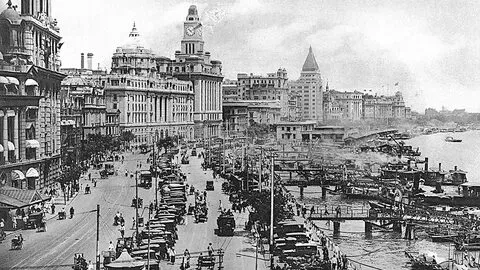
How Shanghai’s riverfront became a stage for finance, vice, and foreign power struggles.
Shanghai’s International Crossroads
In the 1920s, Shanghai’s Bund was more than just a riverside promenade it was a symbol of China’s uneasy encounter with global capitalism and foreign control. Stretching along the Huangpu River, the Bund’s skyline reflected the wealth of foreign banks, trading houses, and shipping companies. British, French, American, and Japanese firms dominated the financial architecture, transforming Shanghai into what many called the “Wall Street of Asia.”
Yet beneath the glittering façades of neoclassical and art deco buildings, Shanghai was a city divided. Chinese merchants and workers shared the streets with colonial elites, but the rules of business, justice, and even daily life were stacked in favor of foreign powers. Extraterritoriality meant that Chinese courts had no jurisdiction over foreign residents, embedding inequality in the city’s very governance.
The Economics of Empire
The Bund was at the heart of foreign concessions, where European and American companies handled everything from shipping cotton to financing railroads. The Hongkong and Shanghai Banking Corporation (HSBC) and Jardine Matheson stood as symbols of Britain’s commercial reach, while American trading houses built fortunes on textiles and tobacco.
For Chinese entrepreneurs, the Bund offered both opportunity and humiliation. Figures such as industrialist Zhang Jian and banker Li Ming ventured into modern finance, but often faced structural barriers to competing with established foreign monopolies. As one observer noted, Shanghai was “China’s richest port, yet not fully China’s own.”
Crime and the Underworld
The 1920s Bund was also a hub of vice. Behind the grandeur of the riverfront hotels and clubs lurked opium dens, gambling parlors, and brothels. Shanghai’s underworld was organized and influential, with secret societies such as the Green Gang controlling vast networks of smuggling, protection rackets, and labor unions.
The Green Gang’s influence reached into the city’s politics and business community. Leaders like Du Yuesheng became infamous not only as crime bosses but also as power brokers who navigated between foreign interests, Chinese politicians, and nationalist forces. For many locals, the Bund symbolized both the prosperity of modern Shanghai and the moral compromises that came with it.
Colonialism Meets Nationalism
As the Nationalist Party (Kuomintang) gained strength in the 1920s, Shanghai became a flashpoint for anti-imperialist resistance. Labor strikes erupted along the docks, where Chinese workers protested low wages and dangerous conditions imposed by foreign employers. Student activists used the Bund’s iconic skyline as a backdrop for demonstrations demanding the end of unequal treaties.
The tension exploded in events such as the May 30th Movement of 1925, when police opened fire on Chinese protesters, killing several. The massacre shocked the nation and intensified calls for sovereignty. For many, the Bund came to embody the humiliation of semi-colonialism a place where China’s wealth flowed outward while its people bore the burdens.
A City of Contradictions
By the end of the decade, Shanghai’s Bund stood as a paradox: a glittering showcase of international modernity, and a stark reminder of national subjugation. The city’s jazz clubs, electric lights, and bustling newspapers projected an image of cosmopolitan sophistication. Yet for Chinese nationalists, the Bund remained a contested space, where symbols of foreign domination loomed over their struggle for self-determination.
Conclusion: The Bund’s Legacy
Today, the Bund is one of Shanghai’s proudest landmarks, celebrated for its architecture and historical significance. But its 1920s story is not just about glamour, it is about how colonialism, capitalism, and crime intertwined to shape modern China.
The Bund of the 1920s reminds us that globalization has always been a double-edged sword: opening doors to progress while deepening divisions. For historians, it remains a vivid case study of how cities can embody the triumphs and traumas of a nation’s encounter with the world.

