
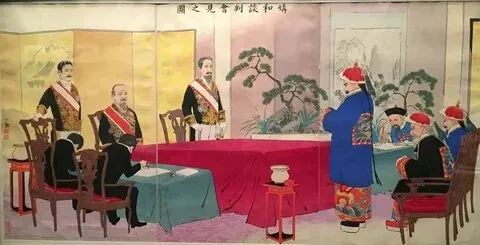
Japan’s victory over Qing China marked the start of a century of regional upheaval.
The Fall of a Regional Giant
In April 1895, the Treaty of Shimonoseki ended the First Sino-Japanese War, a conflict that shocked China and transformed Asia’s balance of power. For centuries, the Qing dynasty had been seen as the central authority in East Asia, maintaining tributary relations with Korea, Vietnam, and other neighbors. Japan, once a junior partner in this order, emerged from the war as a formidable rival, reshaping the geopolitics of the region.
The defeat underscored the Qing dynasty’s decline. Military modernization efforts had been inconsistent, corruption plagued the court, and industrial progress lagged behind. Against Japan’s disciplined, Western-trained army and navy, Qing forces were ill-prepared. The humiliation was not just military it was civilizational.
Terms of the Treaty
Signed in the southern Japanese city of Shimonoseki, the treaty imposed harsh conditions on China. Among its main provisions:
- Recognition of Korean independence, ending centuries of tributary ties.
- Cession of Taiwan and the Pescadores Islands to Japan.
- Transfer of the Liaodong Peninsula (later reversed under pressure from Russia, Germany, and France).
- A massive indemnity of 200 million silver taels, straining China’s already fragile finances.
- Opening of new treaty ports to Japanese trade and industry.
For Japan, the treaty was a triumph that secured colonies and capital. For China, it was yet another “unequal treaty” that eroded sovereignty and deepened domestic crises.
The Rise of Japan
The Treaty of Shimonoseki marked Japan’s arrival as a modern imperial power. Taiwan became Japan’s first overseas colony, serving as a base for future expansion. The indemnities financed Japan’s industrial growth, strengthening its navy and economy.
The victory also boosted Japan’s international standing. Western powers, impressed by its military efficiency, began to treat Japan as an equal, paving the way for its later role in global politics.
China’s Soul-Searching
For China, the treaty sparked intense soul-searching. Reform-minded intellectuals, such as Kang Youwei and Liang Qichao, concluded that only sweeping modernization could save the country from further humiliation. Their calls for constitutional reform, industrialization, and educational change culminated in the Hundred Days’ Reform of 1898.
Yet conservative resistance within the Qing court blunted these efforts. The dynasty limped forward, weakened further by foreign encroachments and internal unrest. The seeds of revolution, however, had been sown.
Korea’s Turning Point
Perhaps the most immediate casualty was Korea. Declared “independent” from China, the peninsula quickly fell under Japan’s sphere of influence. Within two decades, Korea was formally annexed, setting the stage for decades of colonial rule. The treaty thus redefined Korea’s destiny as much as China’s.
A Prelude to a Century of Upheaval
Historians view the Treaty of Shimonoseki as a turning point. It was the moment when Japan stepped into the role once held by China, and when East Asia became a contested arena of imperial ambitions. The war and treaty foreshadowed the 20th century’s conflicts, from Russo-Japanese rivalry to the Pacific War.
For China, the humiliation of 1895 joined the growing list of national traumas that would inspire both reform and revolution. Sun Yat-sen and later leaders pointed to Shimonoseki as proof that the old order had failed.
Conclusion: Lessons of 1895
The Treaty of Shimonoseki was more than a diplomatic document. It was a symbol of shifting power in East Asia: the decline of a dynasty, the rise of a new empire, and the vulnerability of smaller states caught in between.
For today’s readers, it reminds us that currency, trade, and diplomacy are inseparable from military power and national resilience. The echoes of 1895 still linger in regional rivalries, showing how a treaty signed in Shimonoseki helped redraw the map of modern Asia.

