
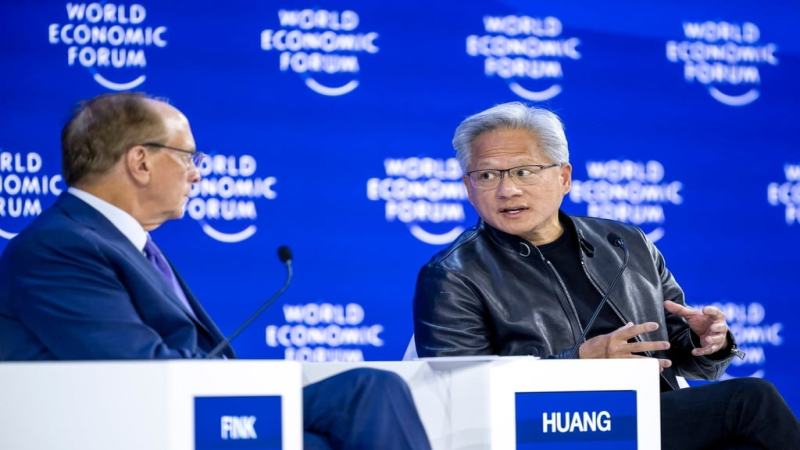
Jensen Huang said the world is entering the largest infrastructure buildout in history as artificial intelligence rapidly reshapes economies, industries, and national strategies. Speaking at the World Economic Forum in Davos, Huang said hundreds of billions of dollars have already been invested in building the foundations of the AI ecosystem, while trillions more will be required in the years ahead. He described the current phase as the early stages of a structural transformation comparable to past industrial revolutions, driven by surging demand for computing power, data centres, and energy. According to Huang, AI is no longer a narrow technology sector but a new industrial platform that will underpin future growth across manufacturing, services, and public infrastructure, forcing governments and companies alike to rethink long term investment priorities.
Huang outlined AI development as a layered system, beginning with energy and power generation, followed by advanced chips, cloud infrastructure, foundational models, and finally applications used by businesses and consumers. He stressed that reliable and affordable energy is becoming a strategic bottleneck as AI workloads consume vast amounts of electricity. Governments are increasingly recognising that power generation and grid capacity are as critical to AI competitiveness as semiconductor supply chains. Huang also argued that nations should develop their own AI systems that reflect local languages, cultures, and values rather than relying solely on foreign models. He said this approach would allow countries to retain digital sovereignty while ensuring AI technologies are better aligned with domestic social and economic needs.
Addressing concerns over job losses, Huang sought to ease fears that AI would trigger widespread unemployment, arguing instead that the technology would transform work rather than eliminate it outright. He said AI would boost productivity and create new categories of jobs, even as it automates certain tasks. The Nvidia chief emphasised that the scale of infrastructure investment underway reflects confidence in AI’s long term economic impact. As competition intensifies between major economies, including the United States and China, Huang’s remarks underscored how AI has become a central pillar of national strategy. The race to build energy systems, computing infrastructure, and domestic AI capabilities is increasingly shaping global economic and geopolitical dynamics.

