
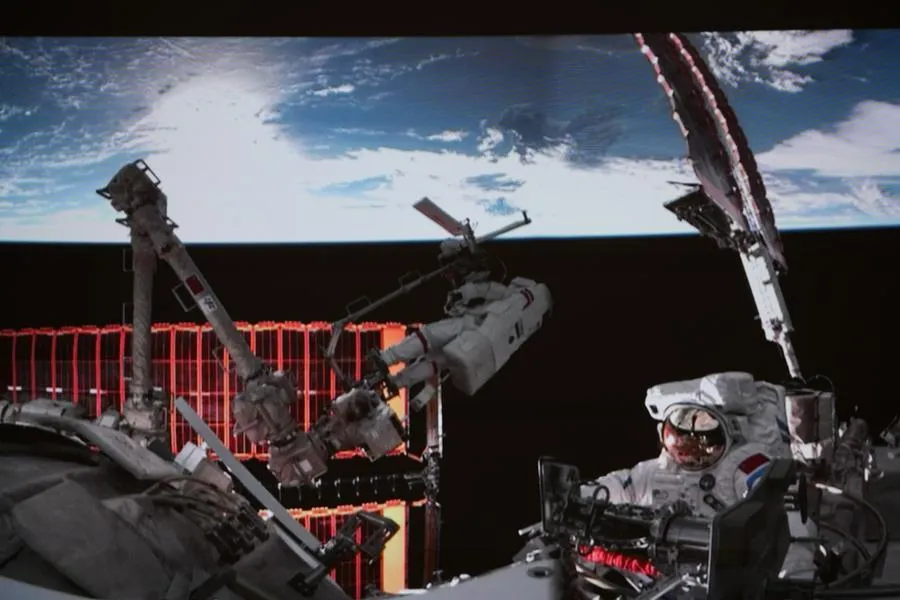
China’s Shenzhou 21 astronauts successfully carried out their first spacewalk on Tuesday, marking another step forward in the country’s efforts to strengthen the safety and long term operation of its orbiting space station. The China Manned Space Agency announced that the extravehicular mission concluded smoothly at 6:45 p.m. Beijing Time after nearly eight hours of continuous work outside the station.
Astronauts Zhang Lu and Wu Fei exited the station to perform a series of planned tasks, while their teammate Zhang Hongzhang coordinated operations from inside the core module. The mission required close collaboration between the astronauts, support from the space station’s robotic arm and assistance from scientific teams monitoring the activities from the ground. According to the agency, the operation demonstrated strong technical capability and high levels of precision in crew coordination.
One of the primary objectives of the spacewalk was the installation of new debris protection devices on the station. These shields are designed to reduce the risks associated with micro debris in orbit, which can cause damage to modules and equipment. As global satellite activity increases, debris monitoring and protection have become essential for the long term reliability of space missions.
The astronauts also inspected the return capsule porthole on the Shenzhou 20 spacecraft, which remains docked to the station. The inspection was considered a high priority after previous assessments showed signs that further evaluation was needed. Depending on future results, engineers may decide whether additional protective adjustments are required during upcoming missions.
Another important task completed during the spacewalk was the replacement of an insulation cover on a thermal control adapter. This component helps regulate the space station’s temperature, ensuring that onboard systems remain stable during changes in sunlight exposure and thermal conditions. The adjustment was part of routine maintenance designed to extend the operational lifespan of the equipment.
The mission carried symbolic significance as well. Astronaut Wu Fei became the youngest Chinese astronaut to undertake a spacewalk, marking a personal and national milestone. For Zhang Lu, the spacewalk was his second, coming more than two years after his first experience working outside the station. The agency noted that the return of an experienced astronaut to extravehicular duty highlights the maturing skill set of China’s space crews.
Looking ahead, the Shenzhou 21 crew will continue with a schedule that includes additional spacewalks, ongoing scientific experiments and further technological tests. If necessary, they will also prepare follow up measures to address any issues identified during the inspection of the Shenzhou 20 porthole. The mission remains part of China’s broader plan to advance space science and maintain stable operations aboard its growing station.

