
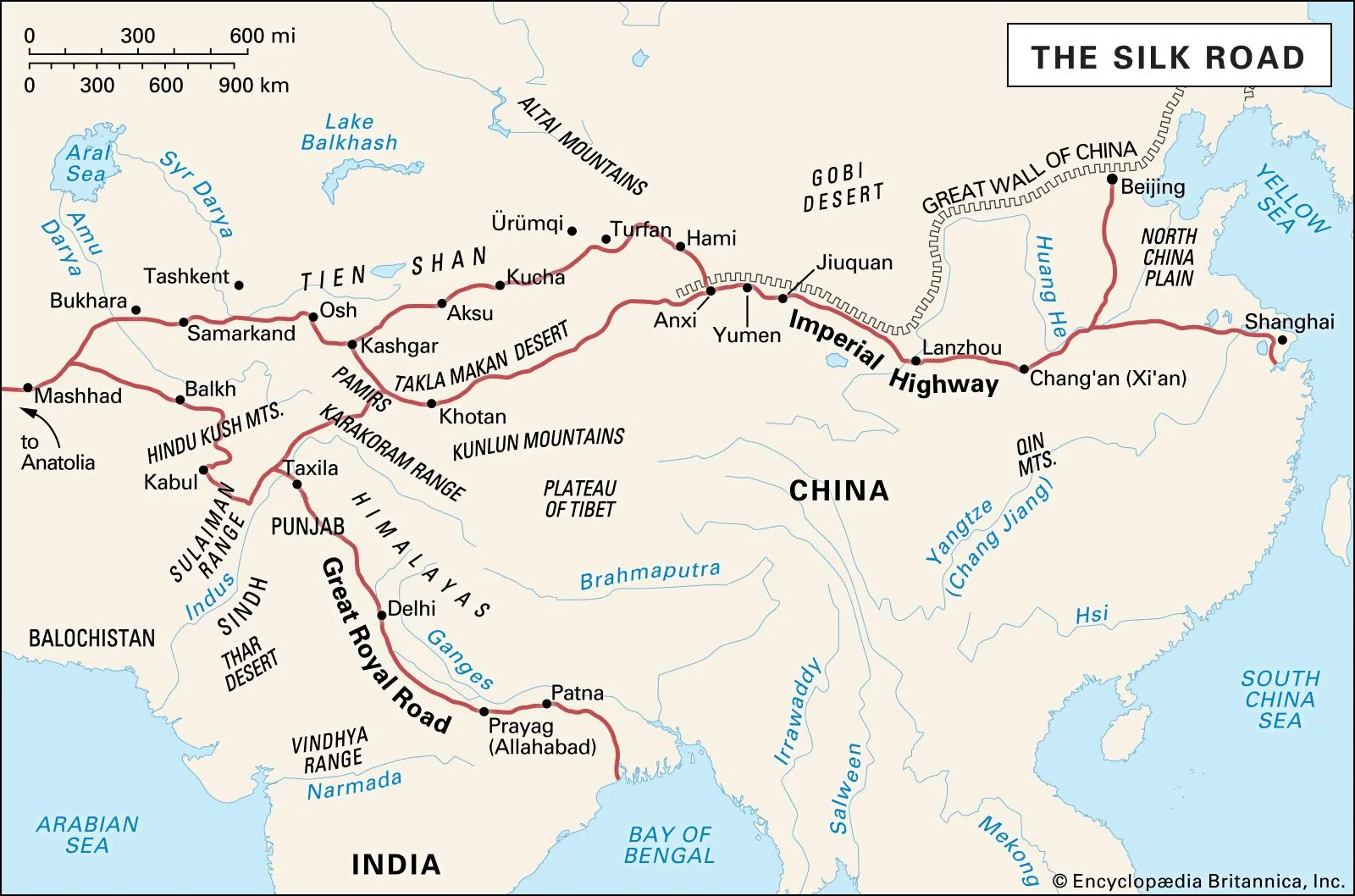
Long before modern borders and global markets, China’s rise was deeply connected to the ancient networks known as the Silk Roads. These routes were not single pathways but vast webs of land and sea corridors linking East Asia with Central Asia, the Middle East, Africa and Europe. Along these routes merchants carried silk, porcelain, metalwork and spices, but they also moved ideas, beliefs and cultural practices that reshaped societies across continents. The Silk Roads played a defining role in establishing China as a major cultural and economic force, laying the groundwork for centuries of influence.
Cities that flourished through exchange
At the heart of these networks were vibrant trade cities such as Xi’an, Dunhuang and Kashgar. Each served as a gateway where cultures intersected. Caravans loaded with goods stopped to rest, refuel and negotiate deals, while scholars and travelers shared stories of distant lands.
Dunhuang, located near the edge of the desert, became especially significant for its artistic and religious exchanges. The famous Mogao Caves reflect this history. Paintings and sculptures there reveal influences from India, Persia and Central Asia, demonstrating how deeply interconnected the Silk Road civilizations were. These cities became living museums of global interaction long before globalization became a modern concept.
Ideas that traveled farther than goods
The Silk Roads were more than economic engines. They carried knowledge that reshaped China and the world. Buddhism traveled from India into China through translators and monks who journeyed across treacherous landscapes. Their teachings would go on to influence Chinese philosophy, art and literature for centuries.
Technologies also moved along these routes. Papermaking and printing spread westward from China, while new crops such as grapes, pomegranates and alfalfa came eastward. Medical knowledge, astronomical insights and artistic techniques flowed between cultures, creating shared intellectual foundations.
Maritime routes expand China’s influence
In addition to overland travel, maritime routes played a crucial role in China’s early global presence. Ports like Guangzhou and Quanzhou connected China to Southeast Asia, the Indian Ocean and beyond. Ships carried ceramics, tea and luxury goods while foreign merchants brought silver, spices and exotic items into China.
These maritime routes allowed Chinese influence to reach new regions and helped coastal cities grow into economic hubs. This blend of land and sea commerce strengthened China’s position as a major power in regional and global trade networks.
A legacy still felt today
The Silk Roads left a lasting mark on China’s cultural identity and global outlook. They showed that interaction with the outside world could enrich society, strengthen economies and inspire innovation. The modern Belt and Road Initiative, though vastly different in scale and context, reflects an awareness of this historical legacy.
Understanding the Silk Roads helps explain how China became a global power not only through political strength but through cultural exchange and economic connectivity. The routes shaped relationships between civilizations and built bridges that influenced countless generations.
Why the Silk Roads still matter in the modern era
The movement of people, goods and ideas along the Silk Roads demonstrates the importance of openness and exchange. At a time when global cooperation faces new challenges, the Silk Roads remind us of how interconnected human history has always been. They highlight China’s long tradition of engagement with the world and show how collaboration can lead to growth, creativity and understanding.
By looking back at these ancient routes, we gain insight into how China’s influence spread and how global networks helped shape one of the world’s oldest civilizations. The Silk Roads continue to stand as a testament to the power of connection and shared progress.

