
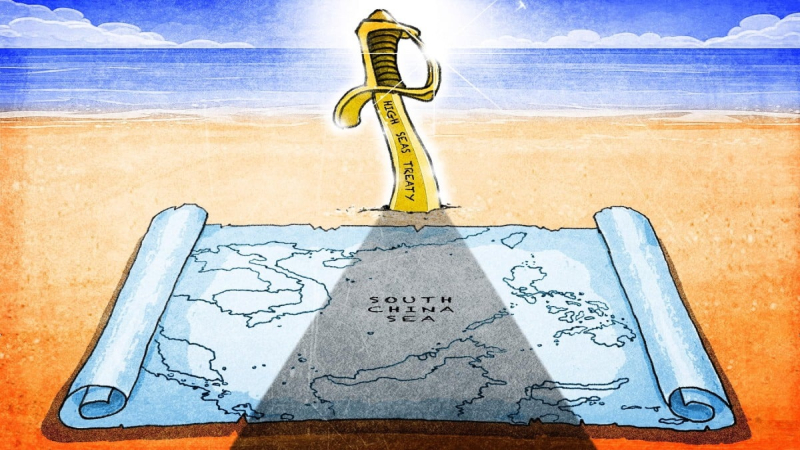
The South China Sea remains one of the world’s most sensitive geopolitical flashpoints and the entry into force of the High Seas Treaty has introduced a new layer of legal and diplomatic complexity to an already contested region. While the agreement was designed as a global conservation framework its implementation is increasingly being viewed through the lens of strategic competition and overlapping territorial claims.
The High Seas Treaty formally known as the Biodiversity Beyond National Jurisdiction agreement became effective in mid January after years of negotiations and a critical number of ratifications by United Nations member states. Its primary objective is to protect marine biodiversity in areas beyond national jurisdiction through mechanisms such as marine protected areas environmental impact assessments and the fair sharing of marine genetic resources. However in regions like the South China Sea the distinction between national waters and the high seas is heavily disputed.
Several countries bordering the South China Sea maintain competing claims over islands reefs and maritime zones. These disputes have long involved issues of sovereignty resource access and freedom of navigation. The introduction of a new international legal framework governing conservation activities has raised concerns that environmental provisions could be used to reinforce political or territorial positions under the banner of biodiversity protection.
Supporters of the treaty argue that it provides an important tool for safeguarding fragile marine ecosystems that have suffered from overfishing pollution and unregulated development. They emphasize that conservation efforts should be separate from sovereignty disputes and that international cooperation is essential to prevent irreversible ecological damage. From this perspective the treaty offers an opportunity for confidence building and shared responsibility in contested waters.
Critics and security analysts are more cautious. They warn that the process of designating protected areas or conducting environmental assessments could become politicized. States may seek to shape conservation boundaries or enforcement mechanisms in ways that align with their strategic interests. In a region where legal interpretations are already deeply contested any new framework risks becoming another arena for rivalry rather than cooperation.
China has consistently maintained that disputes in the South China Sea should be managed through dialogue between directly involved parties and that external mechanisms should not be used to interfere in regional affairs. Chinese officials have also emphasized their commitment to marine environmental protection while rejecting what they see as attempts to internationalize or legally reframe sovereignty issues.
Other claimant states view international law as a way to balance power asymmetries and strengthen their negotiating positions. For them the High Seas Treaty could complement existing legal instruments and provide additional leverage in promoting rules based governance. This divergence in perspectives highlights why the treaty’s implementation in sensitive regions will require careful diplomatic handling.
The broader context is one of shifting global governance where environmental protection security and geopolitics are increasingly intertwined. As climate change and biodiversity loss intensify international agreements are expanding in scope and ambition. In contested maritime regions these well intentioned frameworks can have unintended strategic implications.
Whether the High Seas Treaty becomes a platform for cooperation or a new front line in South China Sea disputes will depend largely on how states choose to apply it. Transparent processes restraint in enforcement and genuine multilateral engagement will be crucial. Without these safeguards conservation measures risk deepening mistrust rather than protecting the shared marine environment.

