
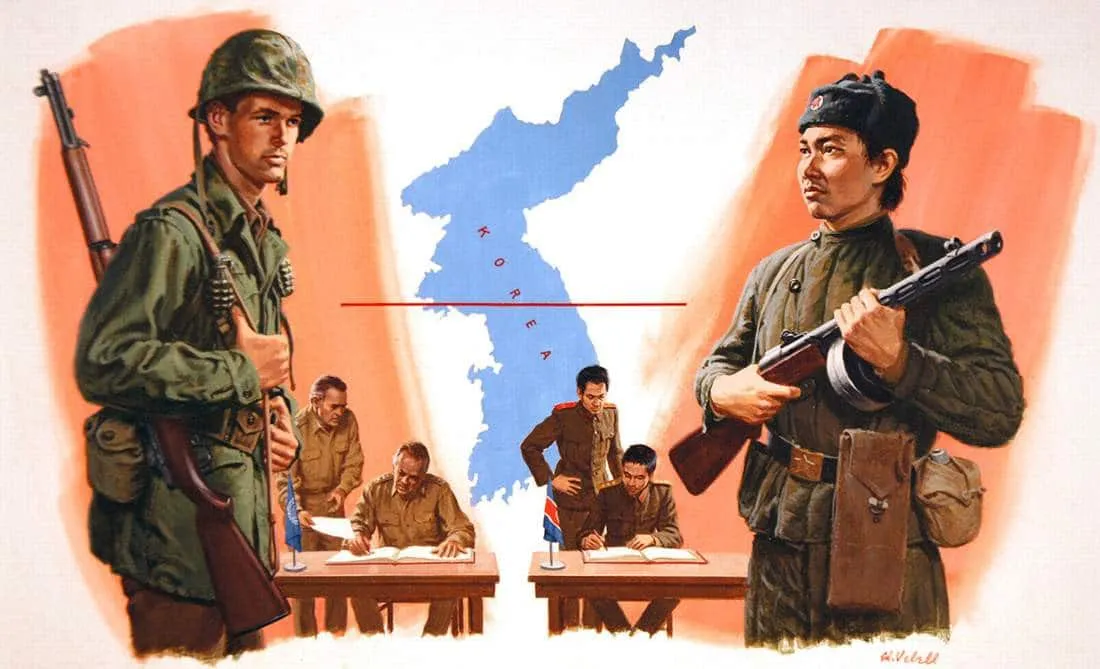
How China’s intervention in 1950 defined its role in Cold War geopolitics.
The War Begins
In June 1950, North Korean troops crossed the 38th parallel, launching a surprise invasion of South Korea. The United States and United Nations quickly intervened to support the South, while North Korea received backing from the Soviet Union.
As UN forces pushed toward the Yalu River, which borders China, Beijing faced a critical decision. For the newly established People’s Republic of China, founded only a year earlier, the war threatened national security and tested its global standing.
China Enters the Conflict
In October 1950, China entered the war under the banner of the People’s Volunteer Army. Waves of Chinese troops crossed into Korea, catching UN forces off guard and pushing them back from the Chinese border. Fierce winter battles, including the Battle of Chosin Reservoir, cemented China’s role as a formidable military power.
For Mao Zedong, intervention was both ideological and strategic. Supporting a fellow socialist regime aligned China with the Soviet bloc while preventing a hostile US-backed presence on its doorstep.
Turning the Tide
China’s entry transformed the war. UN forces, which had nearly unified the Korean Peninsula under southern control, were forced into retreat. The conflict stabilized along the 38th parallel, leading to years of brutal stalemate.
The armistice signed in 1953 restored roughly the same boundaries as before, but the war had already altered China’s place in global politics.
Costs of Intervention
The war came at immense human and economic cost. Hundreds of thousands of Chinese soldiers were killed or wounded, and resources were stretched in a country still recovering from civil war. Families across China carried the burden of sacrifice, with propaganda emphasizing national pride and solidarity.
Despite losses, the war boosted domestic legitimacy for the Communist Party. It presented the government as defender of sovereignty and socialist allies against foreign aggression.
China on the World Stage
The Korean War marked China’s emergence as a player in Cold War geopolitics. For the first time, the PRC confronted the United States directly. Though costly, China’s intervention demonstrated that it could shape regional security and resist Western pressure.
The war also tightened Sino-Soviet ties, though this alliance would later fray. Internationally, recognition of the PRC as a serious power grew, even among adversaries.
Legacy of Division
The Korean Peninsula remains divided to this day, with the armistice never replaced by a formal peace treaty. For China, the war forged a relationship with North Korea that continues to shape regional dynamics.
The memory of the war is preserved in Chinese textbooks, films, and memorials as a symbol of resistance against imperialism. It reinforces a narrative of China as a nation willing to sacrifice to protect sovereignty and allies.
Conclusion: The War That Announced China
The Korean War was not only about Korea. It was the moment when China stepped onto the global stage as a military and political power. By intervening, China reshaped Cold War dynamics and signaled that it could not be ignored in regional or global affairs.
For CHEE NEWS readers, the Korean War highlights how quickly global roles can shift. In less than a year after its founding, the PRC went from revolutionary state to a decisive actor in world politics, a role it continues to play today.

