
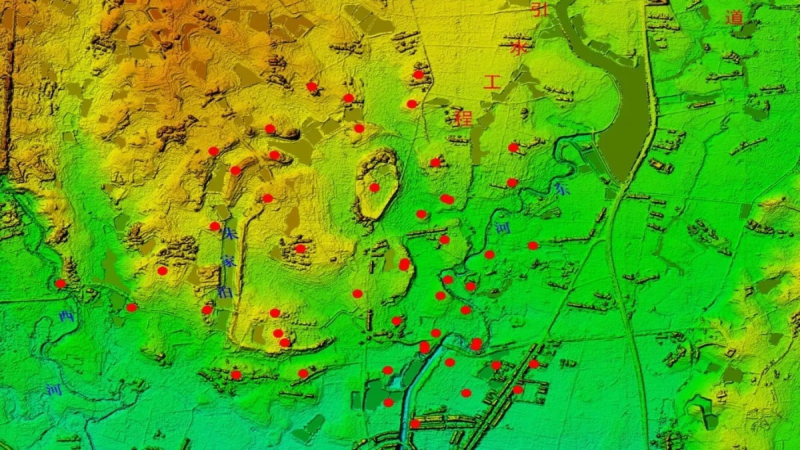
New archaeological research is reshaping long held assumptions about the origins of water management and political organization in ancient China, challenging Western theories that linked large scale hydraulic projects to authoritarian rule. Using advanced digital technologies, researchers have uncovered evidence that cooperative water systems were being built in China as early as five thousand years ago, far earlier than previously documented. The findings suggest that early communities across the Yangtze Plain developed water infrastructure through shared effort rather than centralized coercion. These discoveries push back the timeline of organized water conservancy by nearly three millennia and present a more complex picture of early social organization. Scholars involved in the research argue that the evidence undermines the notion that large infrastructure projects in the East necessarily required despotic power structures to function or endure.
The study draws on remote sensing, spatial mapping, and archaeological fieldwork to identify ancient dams, ponds, and irrigation systems spread across multiple regions. Researchers found that these early projects were often small to medium in scale and closely tied to local settlement patterns. Rather than being imposed by a dominant authority, water systems appear to have been managed at the family or clan level, serving practical needs such as irrigation, flood control, and water storage. This decentralized approach allowed communities to adapt water management strategies to local environments and seasonal conditions. The research indicates that cooperation and shared responsibility were central to sustaining these systems, highlighting a tradition of collective problem solving that contrasts sharply with earlier interpretations focused on rigid hierarchy and state dominance.
For decades, a prevailing Western narrative argued that the need to control water resources in ancient societies inevitably led to centralized power and authoritarian governance. This view gained prominence through twentieth century scholarship that portrayed Eastern civilizations as fundamentally different from the West due to their reliance on large scale hydraulic engineering. The new evidence from China challenges this framework by demonstrating that early water projects did not automatically translate into political centralization. Instead, archaeological patterns suggest gradual development driven by community consensus and shared labor. Researchers argue that applying a single theoretical model to diverse historical contexts oversimplifies the complex relationship between technology, environment, and social organization in early civilizations.
The findings have broader implications for understanding early Chinese history and global debates about governance and technological development. By showing that ancient Chinese communities managed water through cooperation rather than coercion, the research invites a reassessment of how early societies balanced collective needs with social structure. It also highlights the value of modern digital tools in uncovering hidden aspects of the past that traditional excavation alone could not reveal. Scholars say the study contributes to a more nuanced global historical narrative, one that recognizes multiple paths to social organization and challenges assumptions rooted in outdated theoretical frameworks. As further research continues, these discoveries are expected to deepen understanding of early human collaboration and environmental adaptation.

