
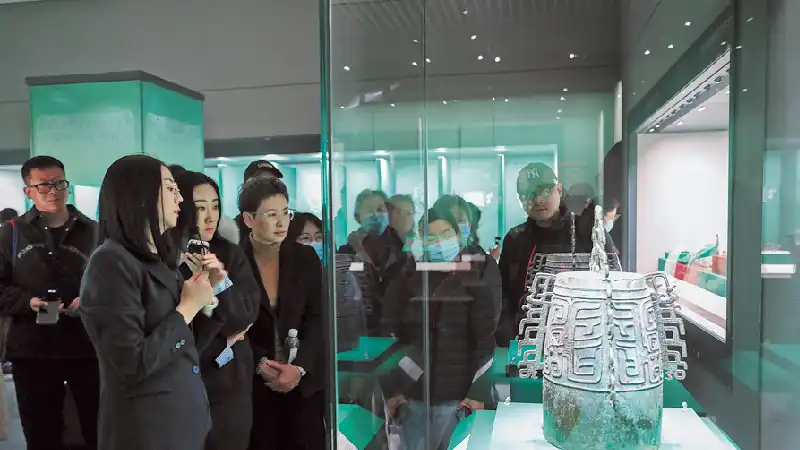
Ancient Chinese decorative patterns are offering fresh insight into how early civilizations expressed belief systems, social hierarchy, and their relationship with nature through art. A major exhibition in Suzhou is bringing together hundreds of historical artifacts to decode these visual symbols, presenting them not as simple decoration but as a structured language that reflects thousands of years of cultural evolution. Scholars say these motifs reveal how artisans embedded philosophy and cosmology into everyday objects, turning art into a medium that communicates deeper meanings about harmony, spirituality, and societal order.
The exhibition gathers more than 370 artifacts from across China, spanning an 8,000 year timeline from the Neolithic era to later imperial periods. Organizers have designed the display using a dual framework that combines philosophical concepts with chronological development. Central to the presentation is the concept of the five elements, which serves as a guiding lens to interpret how patterns evolved alongside shifts in belief and artistic expression. The exhibition is structured into thematic phases that reflect stages of cultural and aesthetic transformation, offering visitors a comprehensive view of how symbolic design developed over time.
Experts explain that these patterns functioned as a visual code deeply connected to Chinese philosophical thought. Motifs found on bronze vessels, silk textiles, and porcelain objects were not only decorative but carried layers of meaning tied to the natural world and spiritual beliefs. Early designs often reflected cosmological ideas, with shapes and symbols representing balance, transformation, and the interconnectedness of life. Over time, these elements became more refined, illustrating the progression of artistic techniques and the increasing complexity of cultural narratives embedded in material culture.
Among the highlights of the exhibition are artifacts that reveal early forms of symbolic storytelling. A painted pottery basin from the Yangshao culture features a human and fish motif, believed to reflect spiritual or ritual significance. Another key piece, a jade object from the Liangzhu culture, displays intricate designs that may represent mythological figures or early forms of religious authority. Scholars suggest that such patterns indicate the emergence of structured belief systems and social hierarchy, where visual symbols played a role in defining status and identity.
Curators emphasize that understanding these motifs requires looking beyond their aesthetic appeal to uncover their philosophical and cultural context. By organizing the exhibition around both thematic and chronological perspectives, they aim to help visitors connect artistic forms with broader ideas about existence and order. The use of familiar philosophical frameworks is intended to guide audiences in interpreting the deeper meanings behind the designs, making complex historical concepts more accessible to modern viewers.
The study of ancient patterns also reflects how Chinese civilization adapted its artistic language over time in response to changing environments and social structures. As new materials and techniques emerged, artisans incorporated them into their work while maintaining continuity with traditional symbolism. This balance between innovation and preservation highlights the enduring importance of visual language in shaping cultural identity and collective memory.
The exhibition continues to attract attention for its detailed approach to presenting historical artifacts and their meanings. By combining academic research with public display, it offers a unique opportunity to explore how art and philosophy intersect in Chinese history. Observers note that such initiatives play an important role in preserving cultural heritage while encouraging deeper understanding of the values and ideas that have shaped one of the world’s oldest civilizations.

