
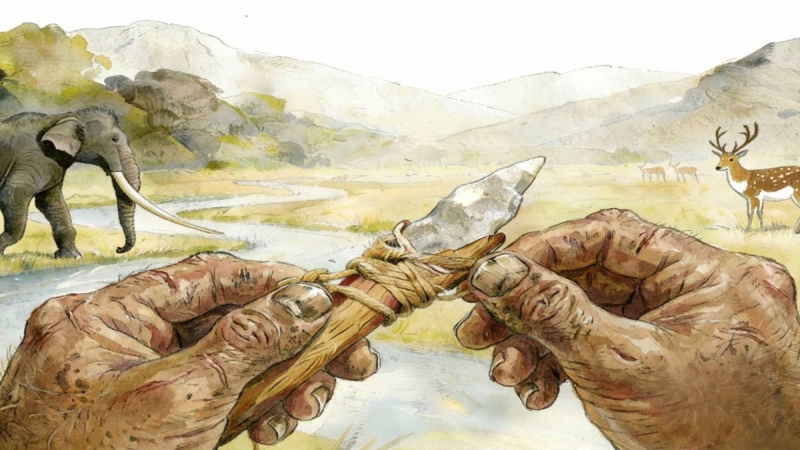
New archaeological findings suggest that China may have played a central role in an early technological breakthrough during the Stone Age, reshaping long held views about human innovation in East Asia. Researchers have identified sophisticated composite stone tools in China dating back as far as 160,000 years, indicating advanced problem solving skills among early hominins. These tools, designed for cutting, piercing, and sawing, demonstrate an understanding of how combining different materials could significantly enhance performance. Scientists say the discovery challenges earlier assumptions that technological development in eastern Asia lagged behind other regions during the Middle Pleistocene. Instead, the evidence points to a complex and inventive technological tradition, suggesting that early populations in the region were capable of adapting tools to suit diverse tasks and environments long before previously believed.
The tools are described as hafted, meaning stone components were attached to handles made from organic materials such as wood or bone. This technique represents a major step in technological evolution, as it requires planning, material selection, and precise assembly. Researchers note that composite tools allow for greater efficiency and versatility, giving early humans an advantage in hunting, processing food, and daily survival activities. The presence of such tools in China is the earliest known evidence of composite technology in eastern Asia, indicating that innovation was occurring independently rather than being introduced from other regions. Experts say this finding alters the broader narrative of early human development by highlighting regional diversity in technological experimentation and challenging the idea of a single dominant center of innovation during this period.
The discovery has wider implications for understanding human adaptability and migration across Asia. By demonstrating advanced tool making capabilities, the findings suggest that early populations in China were not only technologically skilled but also capable of responding creatively to environmental pressures. This adaptability may have supported population resilience during periods of climatic change and resource scarcity. Scholars believe the study will prompt renewed examination of archaeological sites across the region, as similar technologies may have been overlooked or misclassified in the past. As research continues, the emerging picture places China firmly within the global story of early human ingenuity, offering fresh insight into how technological knowledge developed and spread among ancient societies over hundreds of thousands of years.

