
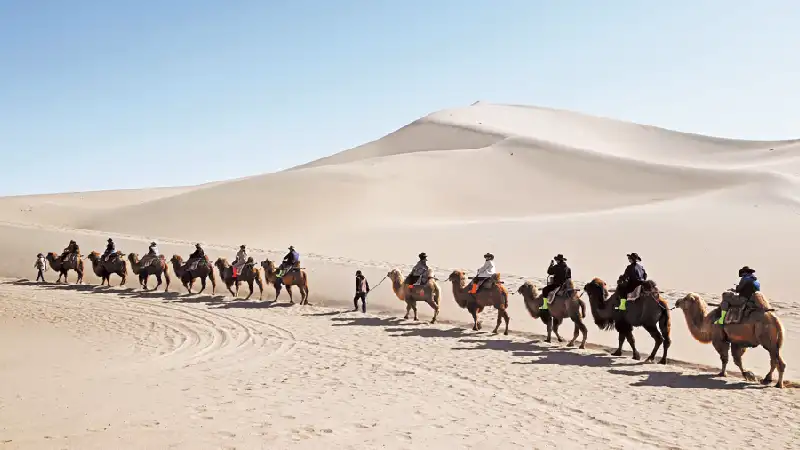
Dunhuang, located in China’s Gansu province, continues to draw attention as a destination where natural landscapes and ancient history converge, offering visitors a rare glimpse into life along the historic Silk Road. Known for its vast desert terrain and cultural landmarks, the city presents a blend of towering sand dunes, preserved heritage sites, and archaeological significance. Tourism activity in the region highlights the enduring appeal of locations that once served as critical hubs for trade, cultural exchange, and military defense across centuries of transcontinental interaction.
Among the most notable attractions is Mingsha Mountain, where expansive dunes stretch across dozens of square kilometers and rise to impressive heights. Visitors often explore the area through guided camel rides, experiencing terrain that mirrors the conditions faced by ancient traders and travelers. At the foot of the dunes lies Crescent Lake, a natural oasis that has historically served as a vital water source in an otherwise harsh environment. The lake’s presence, even during colder months, continues to symbolize survival and continuity in one of China’s most challenging landscapes.
Dunhuang’s significance extends beyond its natural scenery into its historical and cultural foundations. The region sits near the edge of the Gobi Desert and features sections of the Great Wall dating back more than two thousand years to the Han Dynasty. Constructed from locally sourced materials such as sand, gravel, and plant fibers, these fortifications played a crucial role in protecting trade routes and maintaining territorial control. The remains of watchtowers and defensive structures provide insight into the strategic importance of the area during periods of imperial expansion and border management.
Archaeological discoveries in the region have added to its historical value, with artifacts such as bamboo slips revealing details about military communication and daily life along the frontier. Beacon towers once used for signaling threats remain standing as reminders of the coordinated defense systems that protected the Silk Road. Nearby ruins, including storage sites and military outposts, further illustrate how Dunhuang functioned as both a logistical center and a safeguard for merchants traveling between East and West.
The city is also closely linked to the legacy of the Silk Road, one of the most important trade networks in history. Routes passing through Dunhuang connected China with Central Asia, the Middle East, and Europe, facilitating not only the exchange of goods but also ideas, culture, and technology. Strategic gateways such as Yumen Pass played a key role in regulating movement and securing trade flows. These sites have become symbolic of the region’s historical importance and continue to attract scholars and tourists interested in early globalization.
Cultural landmarks in Dunhuang, including ancient caves filled with murals and Buddhist statues, further enhance its global significance. These artistic and religious sites reflect centuries of cultural interaction and spiritual development, showcasing influences from multiple civilizations that passed through the region. The preservation of these caves has contributed to Dunhuang’s recognition as a center of cultural heritage, offering valuable insights into the artistic and religious practices of earlier eras.
Tourism development in Dunhuang has increasingly focused on balancing preservation with accessibility, ensuring that visitors can experience the region’s unique environment without compromising its historical integrity. Infrastructure improvements and guided experiences have made it easier to explore remote areas while maintaining protections for fragile sites. The combination of desert landscapes, historical monuments, and cultural artifacts positions Dunhuang as a distinctive destination within China’s broader tourism landscape.
As interest in heritage tourism continues to grow, Dunhuang stands out as a location where history is closely tied to geography. The city’s enduring connection to the Silk Road, combined with its striking natural features, offers a narrative that spans thousands of years. Visitors and researchers alike continue to explore its sites, contributing to a deeper understanding of how this desert region once served as a crossroads of civilizations and remains a significant part of China’s cultural identity.

