
The Qin Dynasty stands as one of the most transformative periods in Chinese history, remembered for unifying the warring states and laying the foundations for an imperial system that endured for over two thousand years. Before the Qin emerged as the dominant force, China was fragmented into rival kingdoms competing for territory, resources and influence. Among them, Qin started as a relatively remote western state, yet through strategic reforms and strong leadership, it gradually grew into a formidable power capable of overpowering its rivals. Much of this early strength came from the Legalist reforms introduced by Shang Yang, whose policies reorganized the military, strengthened agriculture, centralized authority and rewarded merit over aristocratic privilege.
The unification of the warring states
By the third century BCE, Qin was poised to challenge the remaining states. Under the leadership of King Zheng, later known as Qin Shi Huang, the Qin army embarked on a decisive series of military campaigns. One by one, the six major states were conquered through strategic warfare, innovative weaponry and a disciplined, well organized army. In 221 BCE, King Zheng declared the end of the Warring States period and proclaimed himself the First Emperor of China. This marked the first time in history that the diverse regions of what we now know as China were brought under a single centralized authority. The unification was not only a political achievement but also a cultural and administrative one, as Qin Shi Huang sought to integrate the territories into a cohesive empire.
Transformative reforms that shaped an empire
Once unified, the Qin government quickly implemented sweeping reforms to ensure stability and standardization across the vast empire. One of the most notable achievements was the establishment of a uniform writing system. Previously, different states had used their own scripts, making communication and governance difficult. By standardizing characters, the Qin ensured clearer communication throughout the empire and laid the foundation for the written Chinese language used today. The dynasty also standardized currency, weights and measures, creating consistency that supported trade and economic development. A national road system was constructed to improve transportation and administrative control, allowing officials to travel efficiently across regions. Even the width of the axles on carts was standardized to ensure smoother travel on uniform roads.
The legacy of monumental construction
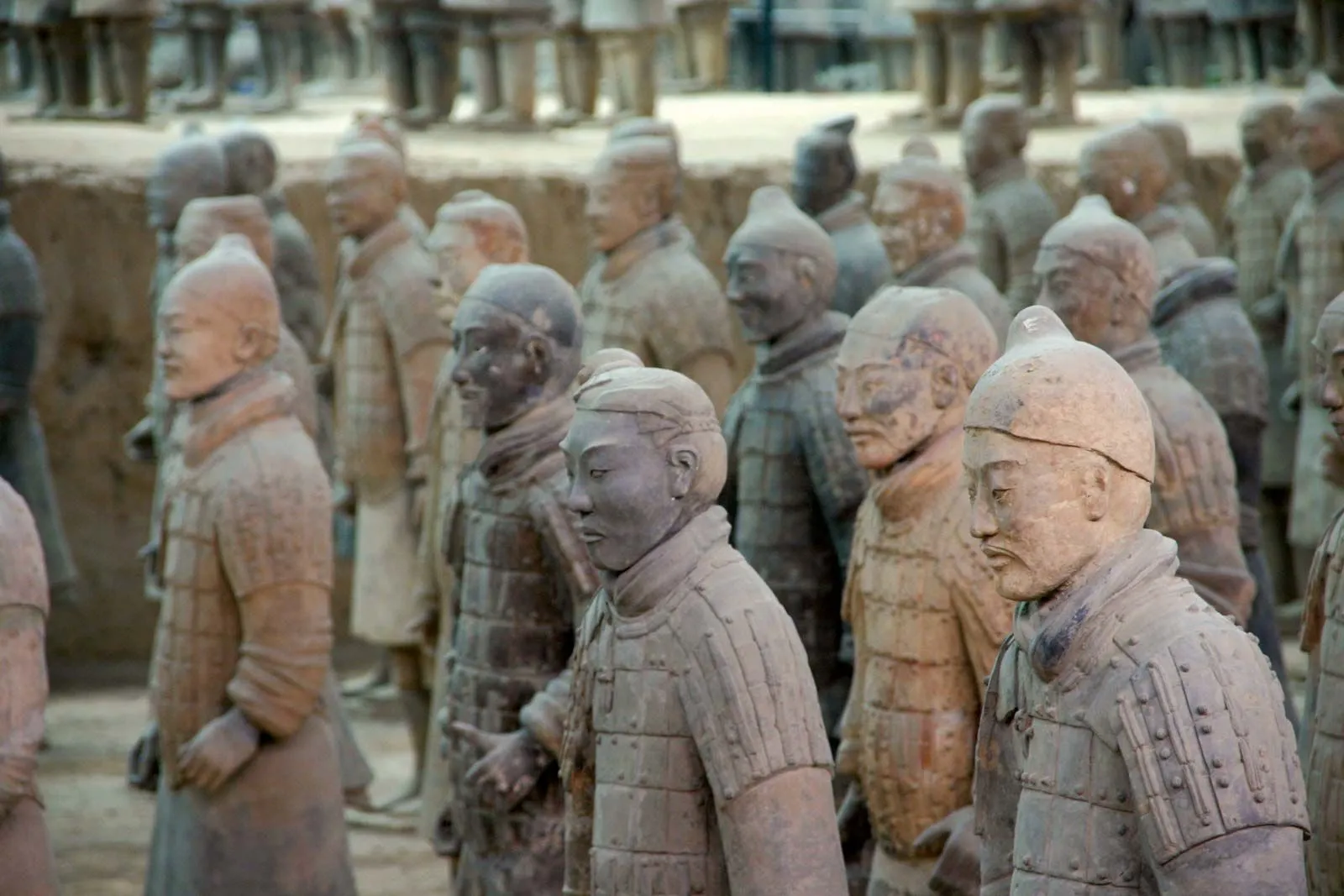
The Qin Dynasty is also known for ambitious construction projects that demonstrated both the empire’s power and its determination to protect and consolidate its territory. Several defensive walls from earlier states were connected and reinforced, forming the early version of what would later become the Great Wall. This massive undertaking aimed to defend the northern frontier from nomadic incursions. Another monumental project was the imperial mausoleum of Qin Shi Huang, famously guarded by the Terracotta Army. Thousands of life sized clay soldiers, each with distinct facial features, were crafted to accompany the emperor in the afterlife. These projects remain among the most iconic archaeological treasures of China.
A short reign with a long lasting impact
Although the Qin Dynasty lasted only fifteen years, its influence on Chinese history is immeasurable. The dynasty fell quickly due to harsh rule, heavy labor demands and widespread unrest, yet the structures it created endured. The administrative framework, centralized bureaucracy and cultural standardization became the blueprint for later dynasties, beginning with the Han. The unification achieved by Qin Shi Huang reshaped China’s identity and set the stage for centuries of imperial development. In many ways, modern China still reflects the systems and political philosophy first introduced during this transformative era.

