
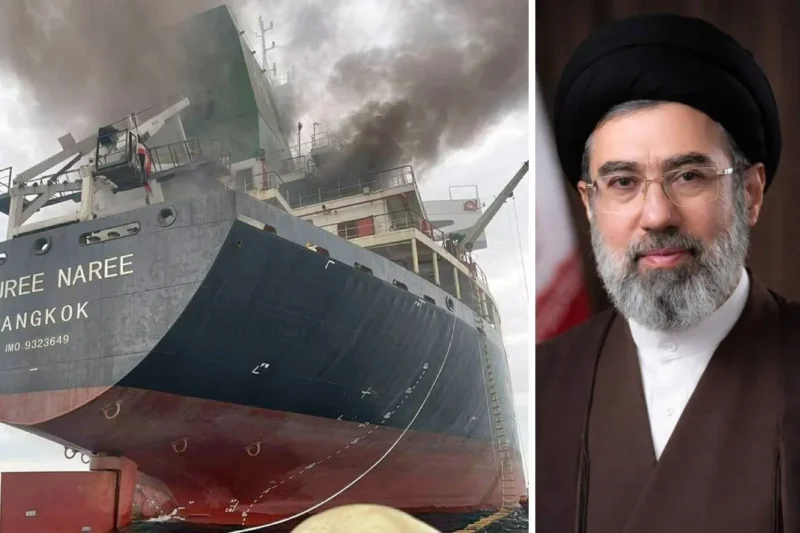
Iran’s newly appointed supreme leader Mojtaba Khamenei has declared that the Strait of Hormuz should remain closed, delivering a defiant message that signals rising tensions across the Gulf region. In his first major public statement since assuming leadership, Khamenei warned that Iran would continue using control of the strategic waterway as leverage in its confrontation with the United States and its allies. The narrow maritime corridor is one of the world’s most critical energy routes, carrying nearly one fifth of global oil shipments. Any disruption to traffic through the strait has immediate consequences for international energy markets and global trade flows.
Khamenei’s remarks came amid a sharp escalation in regional hostilities and follow recent attacks on vessels moving through the Strait of Hormuz. A cargo ship sailing under the Thai flag reportedly caught fire after being struck by Iranian missiles, highlighting the growing risks facing commercial shipping in the area. The incident has intensified concerns among energy importers and maritime operators about the security of one of the most heavily used oil transportation corridors in the world. Analysts say the strategic importance of the strait means that even temporary disruptions could cause immediate volatility in global oil prices and shipping insurance costs.
In his statement the Iranian leader also called on Gulf nations to reconsider their military cooperation with Washington. He urged neighboring states to close American military bases operating within their territories, arguing that the United States had failed to deliver stability in the region. The comments reflect Iran’s long standing opposition to the presence of US forces across the Middle East and signal a more confrontational stance following the leadership transition. Regional governments have so far responded cautiously, emphasizing the importance of maintaining maritime security and avoiding actions that could further escalate the conflict.
The Strait of Hormuz sits between Iran and Oman and connects the Persian Gulf to the open ocean, making it one of the most strategically significant chokepoints in the global energy system. Oil exporters from the Gulf region rely heavily on the passage to transport crude to markets in Asia, Europe and North America. Because of this dependence, any threat to the route quickly becomes a global economic issue. Energy analysts note that prolonged instability in the strait could tighten oil supply and increase transportation costs, potentially pushing fuel prices higher across international markets.
Security experts say Iran has long viewed the strait as a powerful strategic tool because of its geographic position along the waterway. The country has repeatedly suggested that it could disrupt shipping if its national interests are threatened. Over the years Iran has developed a range of naval and missile capabilities designed to influence activity in the area, including coastal missile systems, fast attack boats and surveillance networks along the Gulf coastline. These capabilities allow Tehran to project influence over the maritime corridor even without maintaining a conventional large naval fleet.
International observers are closely monitoring the evolving situation as governments and energy companies assess the potential risks to global supply chains. Several countries with naval forces in the region have emphasized the importance of keeping the strait open to ensure uninterrupted trade and energy flows. Diplomatic discussions are also expected to intensify as global powers seek to prevent the crisis from expanding into a broader regional confrontation that could threaten stability across the Middle East and beyond.

