
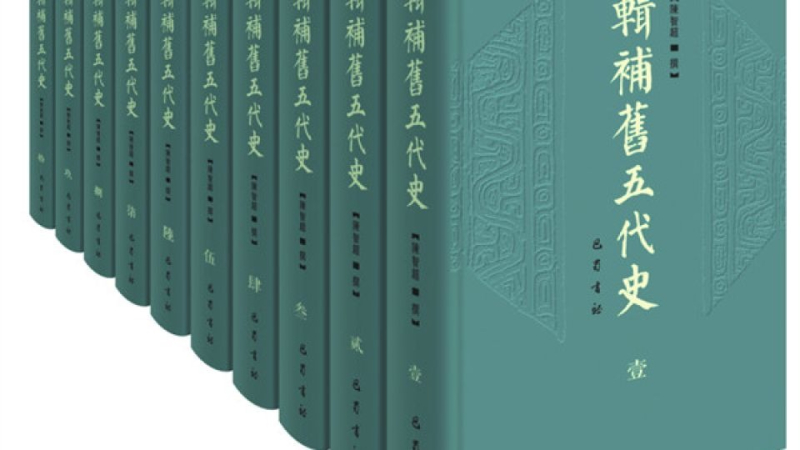
Chinese historians have reconstructed and expanded the official historical record of the Five Dynasties and Ten Kingdoms period, one of the most complex and fragmented chapters in China’s past. The research project, completed by scholars at the Institute of Ancient History under the Chinese Academy of Social Sciences, has produced a revised edition of the Old History of the Five Dynasties, a key historical text that had been partially lost and reconstructed multiple times over centuries. The newly compiled work recently received first prize in the Chinese Academy of Social Sciences’ Outstanding Research Achievements Awards, highlighting renewed academic interest in a turbulent era that shaped the political transition between the Tang and Song dynasties.
The Five Dynasties and Ten Kingdoms period lasted from 907 to 960 and is widely considered one of the most politically fragmented eras in Chinese history. Following the collapse of the Tang dynasty, China entered a period in which five successive dynasties ruled parts of northern China while numerous regional kingdoms governed other territories across the country. Frequent changes in leadership and shifting political alliances made the period difficult for historians to document. As a result the era has often remained less understood compared with the relatively stable and culturally celebrated Tang and Song dynasties that came before and after it.
Interest in the historical period has recently grown due to academic research and cultural works exploring the era. A historical drama set during the period has helped spark wider public curiosity about the political and social transformations that occurred during those decades. Scholars say the drama and similar cultural portrayals have encouraged renewed efforts to examine historical sources and reconstruct records that can provide deeper insights into governance, regional politics and social life during that time. This growing interest has supported research projects aimed at clarifying historical narratives and correcting inaccuracies in earlier compilations.
One major challenge faced by historians was that the original Old History of the Five Dynasties disappeared over time. In ancient China it was customary for each newly established dynasty to commission an official history of the previous dynasty it replaced. These official records eventually became part of a famous collection known as the Twenty Four Histories, which document the development of Chinese civilization across centuries. However the original version of the Old History of the Five Dynasties compiled during the early Song dynasty was lost, leaving later historians to reconstruct it using scattered historical materials.
The version that survived into modern times was reconstructed during the Qing dynasty using texts from earlier literature and historical references. Over time scholars discovered that the Qing version contained inconsistencies and passages that were not part of the original work. Early twentieth century historian Chen Yuan identified many of these issues and began research to correct the text, though he was unable to complete the project during his lifetime. Decades later his grandson Chen Zhichao, also a historian, continued the effort with a team of researchers dedicated to producing a more accurate historical reconstruction.
Researchers used a wide range of historical sources to rebuild the missing sections of the text. One key reference was the famous historical chronicle Zizhi Tongjian, a comprehensive work covering centuries of Chinese history that includes detailed accounts of the Five Dynasties and Ten Kingdoms era. By comparing these historical documents with the Qing dynasty reconstruction, scholars were able to identify missing passages and restore portions of the original narrative. Through extensive textual analysis and comparison the research team assembled a more reliable and detailed account of the period’s political events and institutions.
The final reconstructed work contains about 4.5 million Chinese characters and is nearly three times longer than the earlier Qing dynasty edition. Published in 2021, the revised history reorganizes materials according to the traditional style used in official Chinese historical records while correcting errors and adding newly verified information. Scholars involved in the project say the updated text provides a much stronger foundation for future research on the Five Dynasties period, allowing historians to better understand developments in governance, economic activity and social change during a time of political fragmentation.
Researchers say the reconstruction also carries broader cultural significance because it restores an important part of China’s historical heritage. The expanded historical record helps preserve the memory of a transitional period that influenced the formation of the Song dynasty and shaped the political institutions that followed. By bringing together decades of academic research and historical documentation, the project provides scholars with new material to explore how regional kingdoms, shifting alliances and evolving administrative systems contributed to the long term development of Chinese civilization.

