
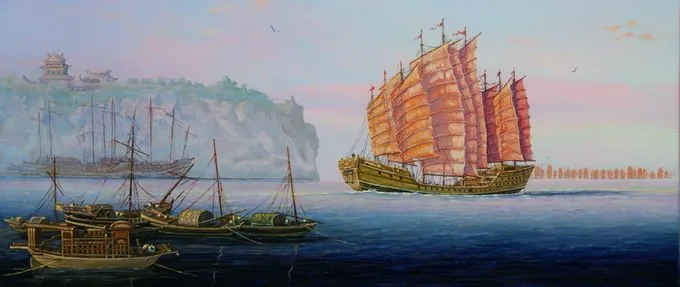
China’s long history includes powerful moments when the sea became a pathway for exploration, diplomacy, and cultural exchange. Early archives show that coastal communities developed advanced navigation skills long before formal maritime policies emerged. These skills allowed fishermen, traders, and explorers to travel through the South China Sea and beyond. By the time powerful dynasties took shape, China had already built a foundation for marine activity. Understanding these early developments helps explain how China transitioned from local seafaring traditions to a large-scale maritime influence that shaped both regional and global history.
The era of Zheng He and the grand Ming voyages
The most iconic chapter in China’s maritime history came during the early Ming Dynasty when Admiral Zheng He led a fleet of enormous treasure ships across Asia and Africa. These voyages carried diplomats, soldiers, merchants, and valuable gifts that showcased China’s wealth and craftsmanship. The ships visited ports in Southeast Asia, India, the Arabian Peninsula, and East Africa, creating extensive cultural and economic connections. Although the voyages eventually ended, their impact remained significant. They demonstrated China’s shipbuilding strength, diplomatic confidence, and ability to manage long-distance expeditions supported by detailed navigation systems and logistical planning.
Maritime trade networks that shaped coastal societies
Beyond government-led voyages, everyday maritime trade played a major role in shaping coastal communities. Ports such as Quanzhou, Guangzhou, and Ningbo became vibrant centers of exchange where merchants from Arabia, Persia, India, and Southeast Asia brought spices, ceramics, textiles, and rare materials. These interactions led to cultural blending that influenced architecture, cuisine, religion, and local customs. Many coastal families built their livelihoods around fishing, shipbuilding, and long-distance trade. Historical records reveal how these ports grew into multicultural trading hubs with diverse populations and thriving economies.
Technological advancements and naval strategy
China’s maritime evolution was supported by technological innovations that enhanced navigation and ship design. The invention of the magnetic compass, improvements in hull construction, and the development of advanced sails allowed ships to travel farther with greater safety. These advancements contributed to the expansion of trade routes and the strengthening of naval capabilities. Military archives show how naval strategy evolved to protect coastal regions from piracy and foreign threats. During certain dynasties, large fleets were stationed along the coast to ensure stability and secure shipping lanes. These strategies show how maritime power was linked to national security and economic strength.
Periods of decline and the impact of isolation
Despite early achievements, China experienced periods when maritime activity declined sharply. Political priorities shifted toward agriculture and land based defense, reducing investment in naval development. Restrictive policies during some dynasties limited overseas travel and weakened international trade connections. As global exploration expanded, China’s reduced presence at sea allowed other nations to dominate maritime routes. These periods of isolation reshaped coastal economies and changed the balance of power across regions. Studying these shifts helps explain the fluctuating influence of China’s maritime history.
Modern revival of maritime strategy
In recent decades, China has revived its maritime ambitions with renewed investment in naval development, port construction and global trade routes. Modern shipping networks connecting China to Africa, Europe and Southeast Asia echo the spirit of earlier maritime exchanges. Advances in technology have transformed how goods move across oceans, yet the historical roots of China’s maritime identity remain important. Today’s strategies are shaped by lessons from the past, including the need for strong navigation skills, stable trade relationships and secure sea lanes. This modern revival highlights how historical patterns continue to influence China’s approach to global connectivity.
Why maritime history still matters
Understanding the evolution of Chinese maritime power helps explain how the nation engaged with the world through exploration, trade and diplomacy. These interactions shaped cultural identity, economic growth and technological progress. By studying ancient voyages, thriving port cities and naval strategies, historians gain insight into how China balanced land and sea based priorities across centuries. This knowledge also provides context for current maritime policies and China’s role in global trade. The legacy of China’s maritime past serves as a reminder that oceans have always been gateways to opportunity, cooperation and cultural exchange.

