
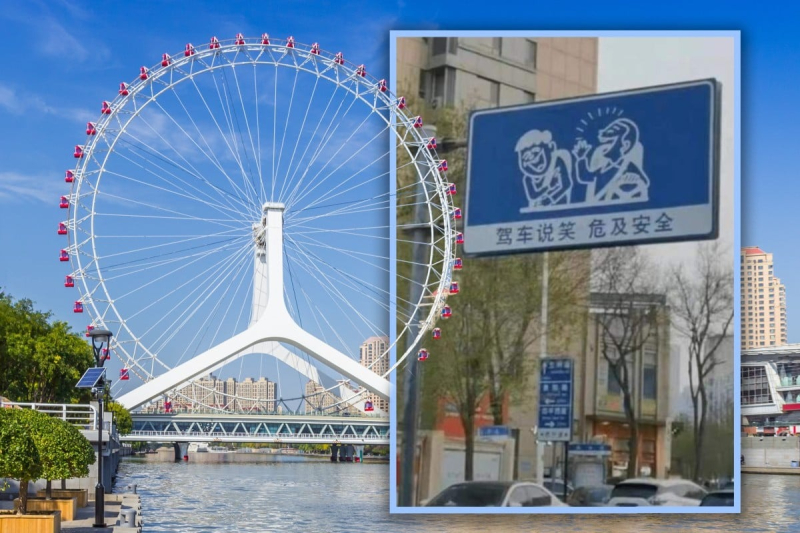
A humorous road safety sign in the northern Chinese city of Tianjin has captured widespread attention online after tourists discovered it is the only place in China where drivers are warned not to make jokes while driving. The unusual sign shows a cartoon illustration of a driver and passenger laughing together in a car accompanied by a message stating that joking while driving can be a safety hazard. The sign recently went viral on social media after travelers shared photos of it, surprising many people across the country and sparking conversations about the city’s distinctive humor driven culture.
Visitors who encountered the sign said they initially believed it was a joke or a tourist attraction rather than an official road safety warning. However local residents explained that the message reflects a common stereotype associated with Tianjin, where humor and storytelling are deeply embedded in everyday life. Some locals said conversations inside vehicles can become so lively that drivers occasionally lose focus on the road. A resident noted that lighthearted discussions or jokes between passengers can easily distract drivers and lead them to miss turns or traffic signals, which is why the city decided to include the warning among its road safety messages.
The sign is part of a broader series of illustrated road warnings introduced in Tianjin in 2008 to make traffic safety reminders more engaging and memorable. More than thirty cartoon based road signs were designed to communicate safety messages in a creative and visually appealing way. The project was developed by Xu Maolin, a retired teacher and self taught cartoonist from Tianjin who used simple illustrations to highlight everyday driving risks. Officials believed that combining humor with safety advice could encourage drivers to pay closer attention to their behavior behind the wheel.
Tianjin’s reputation as China’s so called city of humor also plays an important role in the story behind the sign. The coastal municipality located near Beijing has long been known for its tradition of comedic storytelling and folk performance. One of its most famous cultural expressions is xiangsheng, a traditional comedic art form often performed as a dialogue between two performers who exchange witty remarks and humorous observations. Although the art form originated in Beijing during the late Qing dynasty, many performers later moved to Tianjin where it flourished and became deeply associated with the city’s cultural identity.
The popularity of xiangsheng helped shape Tianjin’s reputation for humor across China. For decades the performances were broadcast widely through radio and television programs, spreading classic jokes and comedic routines nationwide. In recent years modern performance groups such as Deyun Society have introduced the traditional art to younger audiences, keeping the culture alive while attracting new fans. Many Tianjin residents grow up listening to comedic performances on local media, reinforcing the city’s image as a place where humor is part of everyday life.
Tianjin has also gained attention in recent years for other quirky local traditions that reflect its lively atmosphere. Along the banks of the Haihe River, groups of amateur divers regularly gather to jump into the water as part of a long standing local pastime. Videos of middle aged and elderly participants diving from bridges into the river have circulated widely online and attracted visitors curious to witness the spectacle. The diving events have become a popular attraction and are often accompanied by humorous remarks and cheerful encouragement from spectators.
The road sign warning drivers against joking has now become another symbol of Tianjin’s unique personality. Tourists frequently stop to photograph the sign and share it online, while locals view it as a playful reminder that humor can sometimes be distracting in everyday situations. Although there have been no confirmed reports linking joking drivers to traffic accidents, the unusual warning continues to attract attention as a lighthearted example of how safety messages can reflect local culture.

