
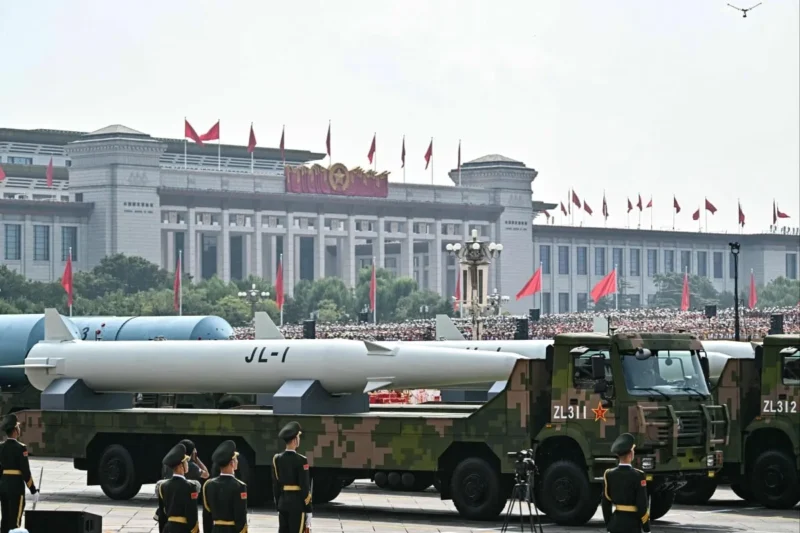
A new report by a United States defense research institute has raised concerns about the structure of China’s nuclear weapons storage system, suggesting that a significant portion of the country’s warheads may be concentrated at a single location. According to the study, the majority of China’s nuclear warheads are believed to be stored at a centralized facility in the country’s northwest. Analysts say such concentration could represent a strategic vulnerability in the event of a conflict, even though the facility is believed to be heavily protected and located in a remote mountainous region designed to enhance security.
The assessment was released by the China Aerospace Studies Institute, a research organization associated with the United States Air University. Using open source intelligence and publicly available satellite data, researchers examined the logistical and management systems linked to China’s nuclear arsenal. The report suggests that many of the warheads are stored at a facility known as Base 67, also referred to as Hongchuan. The complex is believed to be located within the Qinling mountain range, an area that offers natural geographic protection and is considered suitable for highly sensitive military installations.
According to the analysis, China’s nuclear weapons management system is closely tied to the operations of the People’s Liberation Army Rocket Force, which oversees the country’s land based missile capabilities. The report outlines how warheads may be stored separately from delivery systems such as ballistic missiles, a structure designed to strengthen command control and reduce the risk of accidental launches. This arrangement is consistent with China’s long standing nuclear strategy, which emphasizes strict centralized control over its nuclear arsenal while maintaining a policy of limited but credible deterrence.
Researchers noted that concentrating warheads in a single complex could create operational risks during a crisis scenario. In theory, a highly centralized storage system might make the stockpile more vulnerable if the location were successfully targeted or disrupted. However analysts also acknowledge that facilities like Base 67 are likely to include extensive underground infrastructure, reinforced protection and layered security systems. Such measures are intended to protect strategic weapons from surveillance, sabotage or military attack.
China has significantly expanded its nuclear capabilities in recent years, according to various international assessments. Satellite imagery and defense analyses have pointed to the construction of new missile silos and the modernization of delivery systems capable of carrying nuclear warheads. These developments have fueled debate among security experts about the pace and purpose of China’s nuclear expansion as the country modernizes its armed forces and adjusts its strategic posture within an evolving global security environment.
Beijing has consistently maintained that its nuclear weapons policy remains defensive in nature and that it adheres to a doctrine of minimum deterrence. Chinese officials have also repeatedly reaffirmed the country’s commitment to a no first use policy, which states that nuclear weapons would only be used in response to a nuclear attack. Despite these assurances, international observers continue to monitor China’s nuclear modernization programs closely as global strategic competition intensifies.
Security analysts say discussions about nuclear weapons storage and command structures are likely to remain an important part of international strategic debates. As major powers modernize their nuclear forces and develop new technologies such as hypersonic delivery systems and advanced missile defenses, the structure of nuclear arsenals will continue to draw attention from military planners and researchers around the world.

