
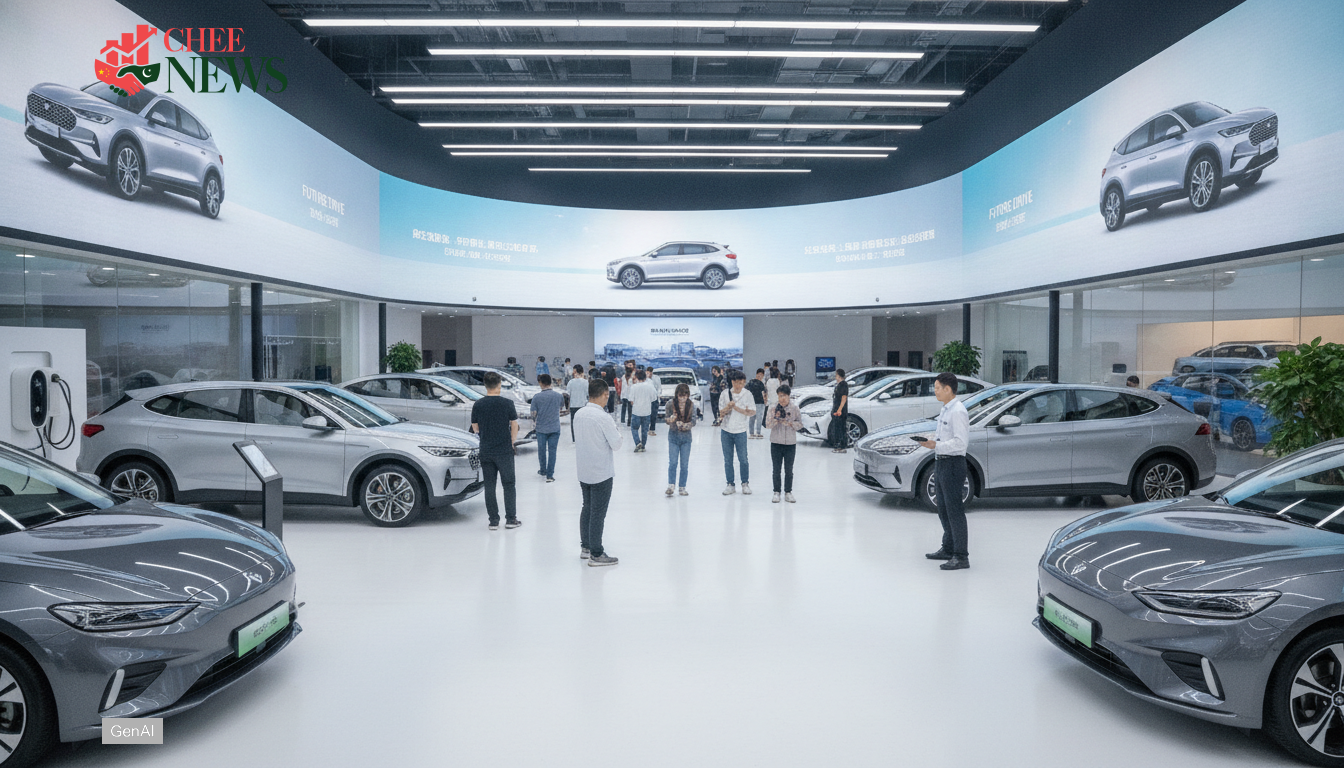
China EV Market: Sales Surge and Pricing Pressure
China’s latest auto sales figures underline how quickly electrification is rewriting competition across the China car industry. In 2024, the China EV market appeared to keep expanding as battery electric and plug-in hybrid models moved beyond early adopters in major cities, as indicated by widely cited monthly sales tallies and industry commentary. Recent industry reporting has highlighted faster model turnover, as automakers refresh lineups to defend share and keep pricing sharp. Domestic brands are often described as leveraging scale and integrated supply chains to hold transaction prices down while adding more software and driver-assistance features. This combination is generally seen as pushing shorter product cycles and tighter competition for components and battery capacity.
What is Driving Demand: Policy, Charging, and Costs
Policy design and industrial capacity are frequently mentioned as supporting momentum, with charging build-out and grid planning described as improving across many provinces in official planning documents and public statements. In the China EV market, a wider range of price points is helping electrified models compete with conventional sedans and SUVs, according to market observers. Battery cost declines are commonly discussed in industry analysis, though the pace can vary by chemistry, supply contracts, and raw-material prices. In the middle of this broader manufacturing ramp, AgiBot’s scaling is sometimes used as an adjacent example of how automation and component ecosystems are expanding, and AgiBot Leads Humanoid Robot Shipments as IPO Nears shows how those supplier bases are expanding, which can support factory throughput and supplier depth. Together, these forces may help explain why product cadence has accelerated and why discounting can spread quickly during new model launches.
Impact on Legacy Brands and Joint Ventures
Legacy joint ventures and long-established global brands are reportedly being pushed toward deeper discounting and faster localization, as noted in ongoing auto-industry coverage. Incumbents face a two-front challenge: rebuilding cost structures for batteries while matching infotainment and driver-assistance expectations that many buyers increasingly treat as standard, as suggested by analysts. The market’s speed can punish slow product planning, particularly when rivals are perceived to refresh platforms more frequently. Some manufacturers are responding by partnering with domestic suppliers for software and power electronics, while others rely on China-specific sub-brands, based on company announcements and media reporting. Supply security is also commonly described as a pressure point, as battery materials and cell contracts can shape profitability.
Global Trade Implications: Exports, Pricing, and Supply Chains
China’s scale is apparently influencing export flows, supplier pricing, and competitive benchmarks in markets from Southeast Asia to Europe, based on trade data reporting and sector analysts. Home-market volumes can help firms amortize research and tooling, potentially enabling aggressive export pricing while still funding upgrades, as commentators often argue. Upstream investment decisions may lock in cost advantages for years, tightening the link between battery supply and trade politics. For a broader macro lens on how shifts in Chinese demand can transmit through commodities and trade channels, China economic challenges: spillovers to world markets is a useful reference. In materials, Chinese Lithium Investment Zimbabwe: Deals, Risks 2026 details how overseas mining and refining strategies can shape availability. These cross-border dynamics can feed back into the China EV market through input costs and export price ceilings.
2026 Outlook: Volumes, Margins, and Investment Signals
Looking ahead to 2026, product cadence and battery economics are likely to be key variables in whether recent gains hold as competition intensifies. Forecast discussions typically hinge on assumptions about cost trajectories, fast-charging coverage, and the pace of new model launches across mass-market segments, as reflected in analyst notes and investor commentary. In the China EV market, investment signals also matter: multi-year capacity plans for cells, cathodes, and charging networks are usually made well before demand peaks, though timelines can shift with policy and financing conditions. For clearer context on trade policy frictions that can affect components and technology access, US-China export licenses: Faster Reviews, Clearer Rules provides relevant background. The next phase may be defined less by early adopters and more by mainstream replacement cycles and service quality.

