
China has introduced a new generation marine observation buoy that researchers say represents a major shift away from the traditional Western engineering models that have dominated ocean monitoring systems since the Second World War. The development highlights Beijing’s growing push to build independent technological standards in maritime science, particularly in areas linked to environmental monitoring, climate research and ocean resource management.
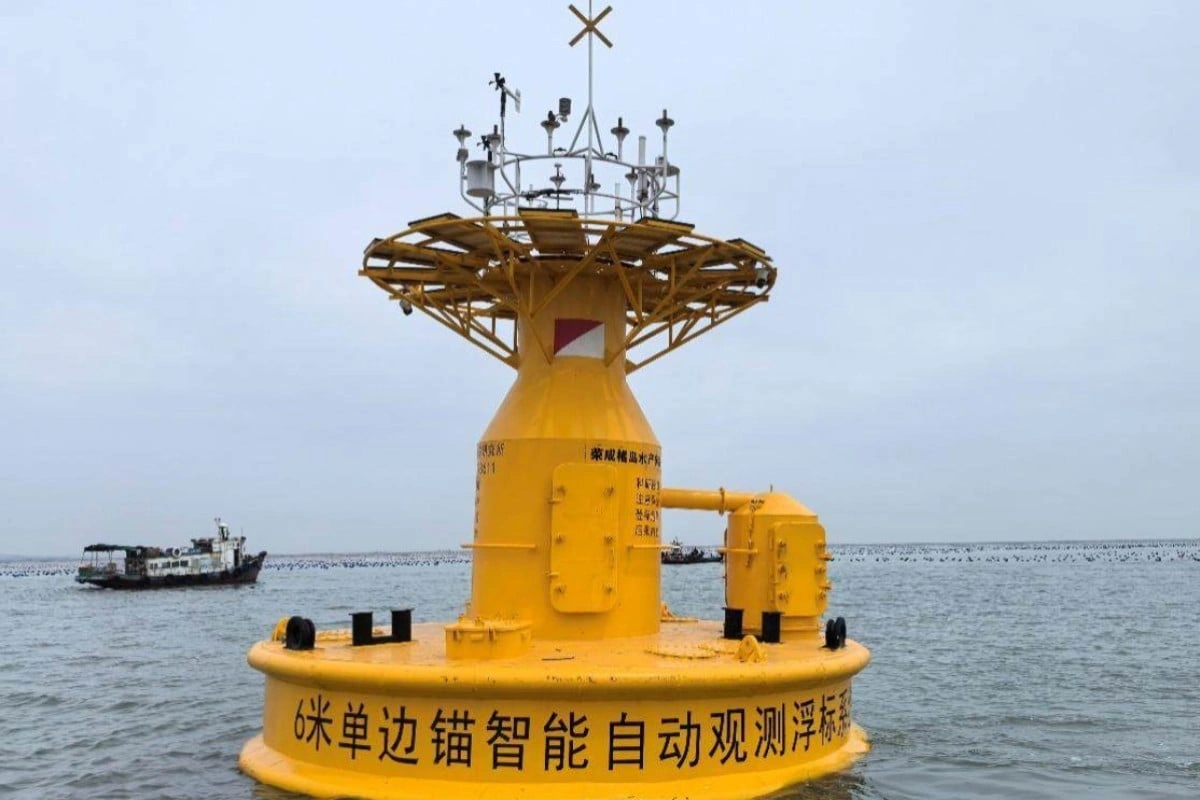
The new system has been deployed off the coast of Shandong province in eastern China, where a large orange disc shaped platform has been anchored into the sea as part of a newly expanded observation network in the Yellow Sea. Developed by the Institute of Oceanology, Chinese Academy of Sciences, the buoy is described by researchers as an intelligent ocean observation platform capable of delivering continuous real time data across multiple layers of the marine environment. It has now officially entered operational service following successful sea trials.
Unlike conventional buoy systems that rely on long established mooring structures used widely in Western marine engineering, the Chinese designed platform introduces a fundamentally different structural approach. Researchers say the new architecture departs from designs that have remained largely unchanged since the post war era, signalling what they describe as a generational upgrade in how ocean data collection systems are built and deployed. The innovation reflects a broader effort within China’s scientific community to reduce reliance on imported marine technology standards.
The buoy itself spans approximately six metres in diameter and is equipped with integrated sensing systems designed to monitor a wide range of oceanographic conditions. These include temperature variations, salinity levels, water currents and ecological indicators across different depths of the water column. By transmitting continuous data streams, the platform is expected to improve forecasting accuracy and support long term environmental modelling, particularly in regions affected by changing climate patterns and increasing maritime activity.
Officials involved in the project say the deployment marks an important step in strengthening China’s national ocean observation capabilities. The Yellow Sea network, which now includes the new buoy, forms part of a wider strategy to build a more advanced marine monitoring infrastructure along China’s coastline. This system is intended to support both scientific research and practical applications such as weather prediction, fisheries management and maritime safety operations. Researchers argue that the ability to gather uninterrupted, high resolution ocean data will be increasingly important as coastal economies expand and environmental pressures intensify.
The introduction of the buoy also reflects a growing emphasis on technological self reliance in strategic scientific fields. By developing systems that diverge from long standing Western engineering frameworks, Chinese marine scientists are seeking to establish alternative standards in ocean observation technology. This shift is seen as part of a broader trend in which China is investing heavily in indigenous innovation across aerospace, artificial intelligence and environmental sciences. The successful deployment in the Yellow Sea is expected to serve as a model for future ocean monitoring systems in other strategic maritime zones.

