
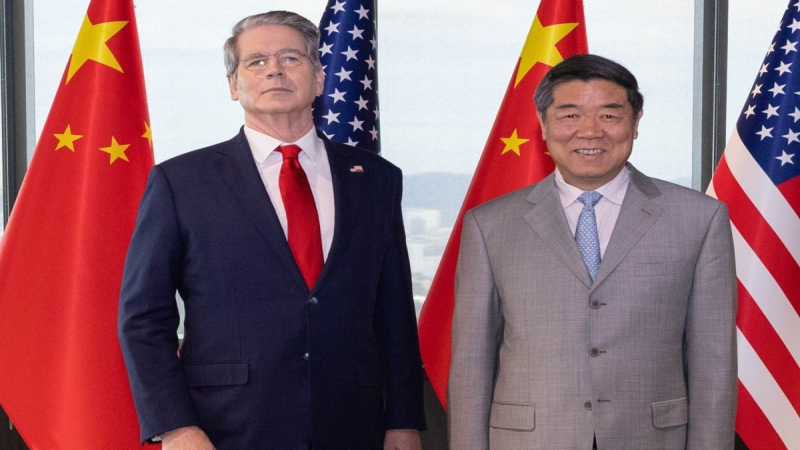
Senior trade negotiators from the United States and China met again on the sidelines of the World Economic Forum in Davos, signaling continued efforts to stabilize economic ties after a prolonged period of tariff escalation and policy uncertainty. US Treasury Secretary Scott Bessent confirmed discussions with Chinese Vice Premier He Lifeng, describing progress in specific trade areas including agricultural commodities and critical minerals. The meeting followed months of quiet but sustained engagement between the two sides, positioning Davos as a venue not only for symbolic diplomacy but for practical dialogue. Both officials have emerged as central figures in managing trade frictions between the world’s two largest economies, particularly after tariff levels on both sides climbed to historically high levels. Their renewed engagement suggests a shared interest in preventing further escalation while exploring targeted areas of cooperation.
The Davos talks build on a series of negotiations that began in Geneva last year and continued through multiple global capitals, reflecting a deliberate effort to maintain communication channels despite broader strategic rivalry. According to officials, progress has been noted in sectors where both sides face economic pressure, including soybeans and rare earth supply chains. These areas are critical for domestic industries and global markets, making them practical starting points for confidence building. The discussions also reflect recognition that prolonged trade disruption carries costs beyond bilateral relations, affecting supply chains, inflation, and industrial planning worldwide. While no formal agreements were announced, the emphasis on incremental progress highlights a shift away from headline-driven confrontations toward more managed competition through sustained negotiation.
The engagement comes as global investors and policymakers closely watch signals from Washington and Beijing for clues on the future direction of trade policy. Both governments face domestic economic considerations that make stability increasingly attractive, even as strategic mistrust persists. The Davos meeting underscores how economic dialogue has become compartmentalized, allowing cooperation in select areas while disagreements remain unresolved elsewhere. For China, ensuring access to key export markets and stabilizing commodity flows remains a priority, while the United States continues to balance economic interests with national security concerns. The continuation of high-level talks suggests that despite deep structural tensions, both sides see value in keeping trade discussions active to manage risks and preserve a degree of predictability in global economic relations.

