
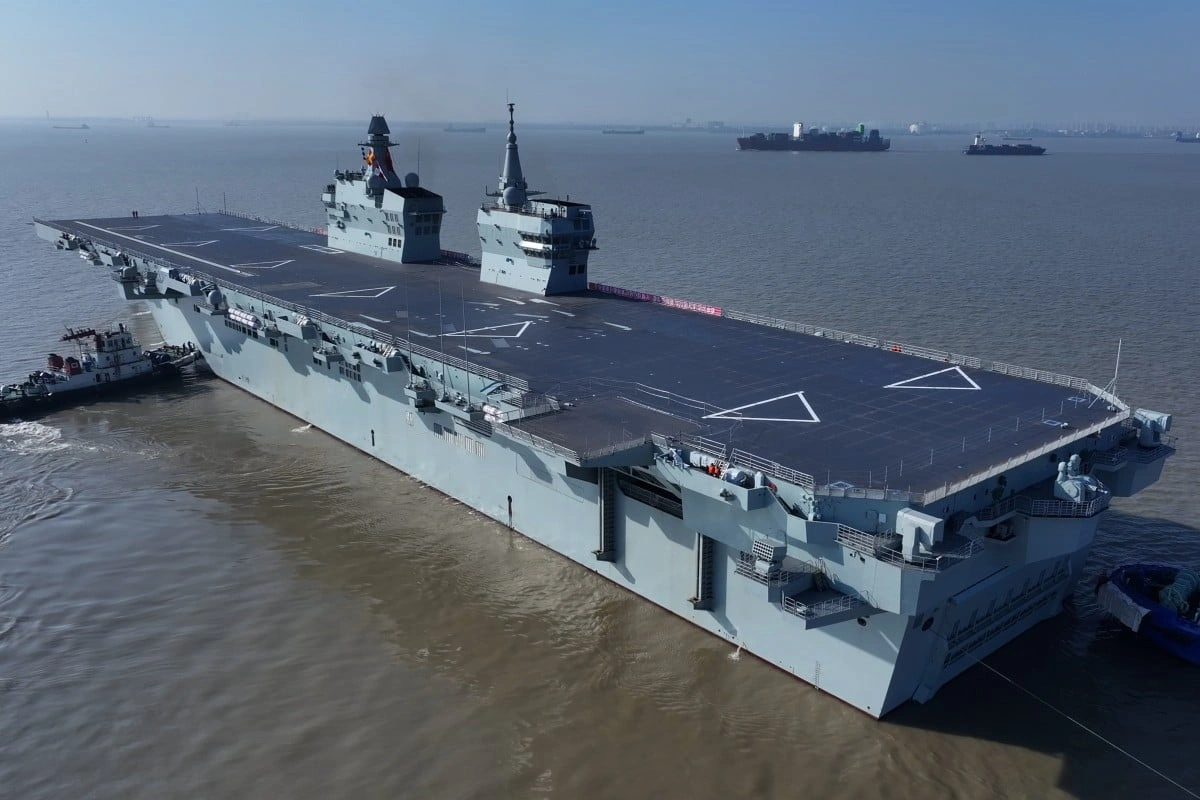
China has deployed its next generation amphibious assault ship, the Type 076 vessel named Sichuan, to the South China Sea for a series of sea trials and training exercises, marking a significant step in the development of its naval aviation and drone warfare capabilities. The move comes at a time of heightened military activity in the region, with multiple foreign navies conducting joint exercises nearby, underscoring growing strategic competition in one of the world’s most sensitive maritime zones.
The deployment involves the Type 076 amphibious assault ship Sichuan, which is designed to operate as a drone carrying assault platform capable of launching unmanned aerial systems, landing craft, and supporting amphibious operations. The ship recently completed its maiden sea trial and is now undergoing additional testing of onboard systems, reflecting its role as a key component in China’s future naval modernization strategy. Military analysts view the vessel as a significant advancement in integrating drone technology with traditional naval force projection.
According to official statements, the Sichuan departed from Shanghai and is conducting what Chinese authorities describe as routine cross regional testing in the South China Sea. The People’s Liberation Army Navy emphasized that the exercises are part of scheduled development work and are not directed at any specific country or ongoing operation. However, the timing of the deployment has drawn attention due to simultaneous multinational military drills being conducted by the United States, Japan, and the Philippines in the same broader maritime region.
The South China Sea remains a heavily contested strategic corridor, with overlapping territorial claims and frequent naval activity from multiple regional powers. The presence of advanced platforms such as the Sichuan adds a new dimension to existing tensions, particularly as drone capable ships are expected to play an increasing role in future maritime operations. The vessel’s design allows it to support rapid deployment of unmanned systems, which are becoming central to modern naval doctrine focused on surveillance, strike capability, and electronic warfare support.
Regional security dynamics have been further complicated by the movement of other major Chinese naval assets, including aircraft carrier operations reported in nearby waters. While Chinese authorities maintain that these activities are part of normal training cycles, neighboring countries continue to monitor developments closely due to the strategic importance of the region. The introduction of advanced drone carriers is likely to influence long term naval planning across Asia as countries adjust to emerging technologies that reshape maritime power balance.

