
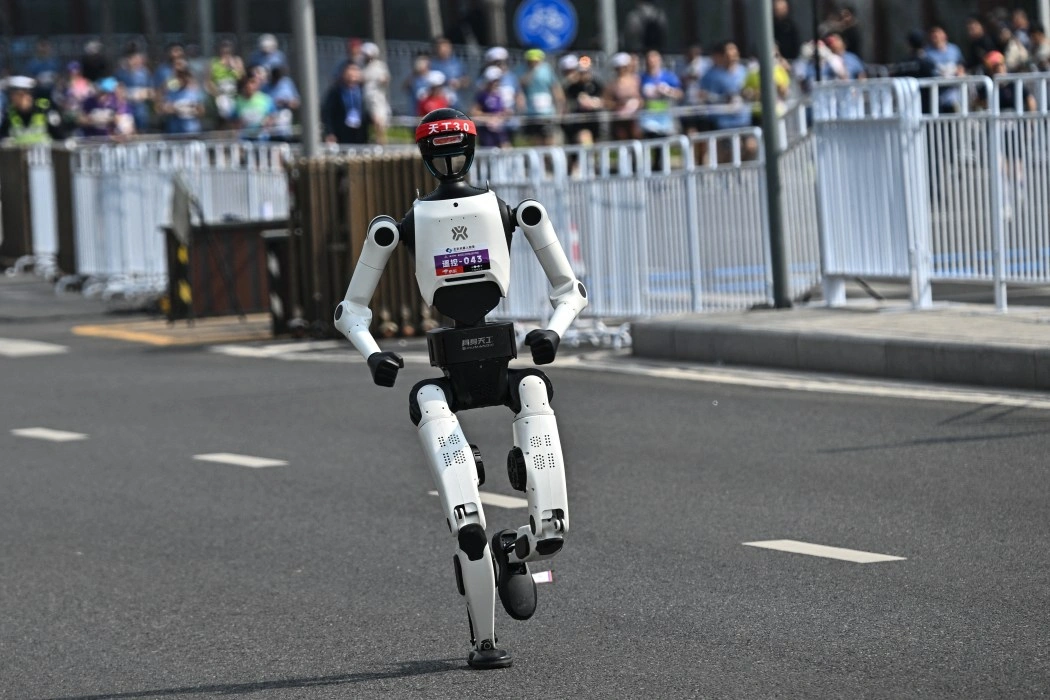
A humanoid robot developed by a Chinese technology team has completed a half marathon in Beijing at a speed that surpasses the human world record, marking a major milestone in robotics performance and engineering development. The robot, created by a division linked to Honor, finished the 21 kilometre race in 50 minutes and 26 seconds, outperforming elite human athletes and highlighting rapid advancements in robotic mobility and endurance systems. The achievement has sparked global attention in both the technology and sports science communities.
The event took place during a mixed format race in Beijing where humanoid robots competed alongside human participants on the same course. According to organisers, the winning robot demonstrated significantly improved speed and stability compared to previous trials. Last year’s winning robot completed a similar race in more than two hours, showing how quickly the technology has evolved. Engineers involved in the project said the latest model was designed with enhanced biomechanics inspired by professional human runners, including optimized leg length and improved motion coordination systems.
Developers reported that the robot’s design included advanced engineering features such as a high efficiency liquid cooling system and reinforced structural components to maintain performance over long distances. These systems were developed to ensure the machine could sustain consistent movement without overheating or mechanical failure. Engineers noted that the goal of the project is not only to improve racing capability but also to apply the underlying technologies to broader industrial and commercial robotics applications in the future.
Despite the record breaking performance, the race also highlighted the current limitations of humanoid robotics. Several robots experienced technical difficulties during the event, including balance failures and collisions with track barriers. These incidents underline the ongoing challenges in achieving full stability and adaptability in real world environments. Experts say that while progress has been rapid, humanoid robots still require significant refinement before they can reliably operate in unpredictable conditions outside controlled settings.
The development is being seen as part of China’s broader push to lead in advanced robotics and artificial intelligence driven engineering. The success of the robot half marathon demonstrates how quickly the field is advancing, with improvements in speed, endurance, and mechanical efficiency becoming increasingly visible. Researchers believe that technologies developed for such competitions could eventually be transferred into sectors such as logistics, manufacturing, and healthcare, where high performance robotic systems are expected to play a growing role in the coming years.

