
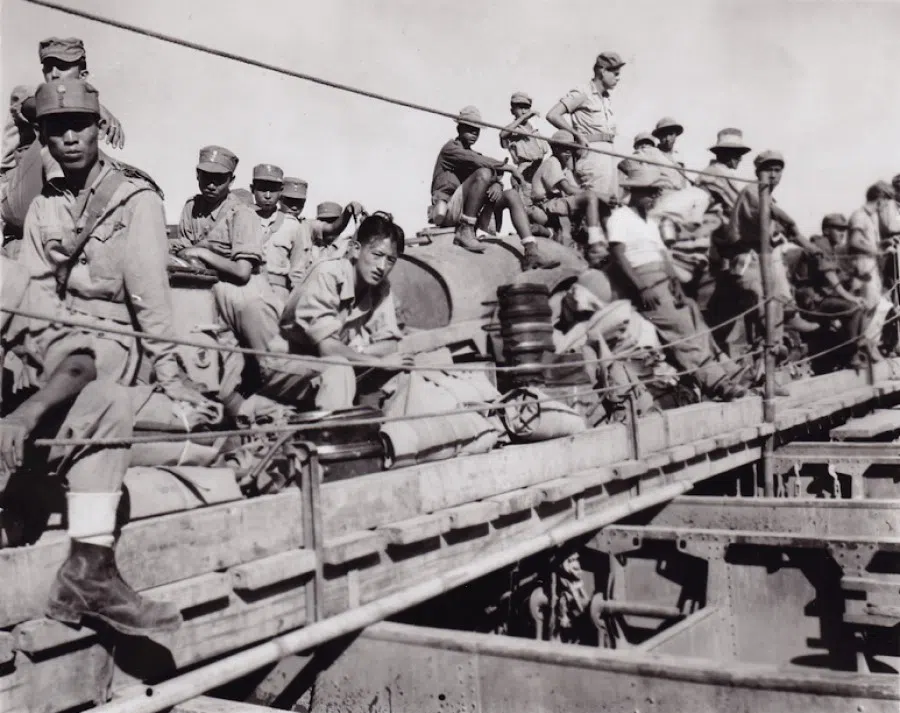
At the center of a long forgotten photograph is a man named Li Xiaosheng, a veteran of the Chinese Expeditionary Force that fought alongside Allied troops in Burma and India during World War II. The image captures a moment of quiet resolve, yet Li himself never knew it existed. The photograph surfaced more than seventy years later, discovered in the US National Archives by researcher Yan Huan, three years after Li had already passed away.
Li was part of the Chinese Expeditionary Force, an overseas unit of China’s National Revolutionary Army sent to the China Burma India theater to resist Japanese forces. Like many soldiers of his generation, he survived war only to return to a life of anonymity. His personal experiences, sacrifices, and memories remained largely unrecorded, known only to himself and a few close companions.
The photograph was one of more than twenty three thousand images taken during the China Burma India campaign and preserved overseas. When Yan Huan came across Li’s face among the archival material, it offered a rare visual trace of a man whose wartime story had never been fully told. Yet the discovery also carried a sense of regret. Li never had the chance to see the image, to point himself out, or to explain what that moment meant to him.
The search for Ma Tinghui, a name connected to similar wartime fragments, reflects a broader effort to restore individual identities to soldiers long reduced to numbers and units. Many veterans left behind only partial records, faded photographs, or second hand stories. As years pass, memories fade and families lose direct links to their ancestors’ experiences.
Researchers say this is a common pattern when studying war veterans. Many soldiers lived modest lives after returning from the front, rarely speaking about what they endured. Some felt their suffering was ordinary and unworthy of attention. Others were shaped by a culture that valued endurance over expression. As a result, entire chapters of personal history disappeared with them.
The China Burma India theater was one of the most grueling fronts of World War II. Soldiers faced disease, harsh terrain, and constant danger, often with limited supplies. Their contribution was crucial to sustaining Allied resistance in Asia, yet their stories have remained underrepresented in popular history.
For descendants, the absence of firsthand testimony leaves unanswered questions. Who were these men before the war. What did they fear. What did they hope would come after survival. Each newly discovered document or photograph becomes a bridge across time, offering a glimpse into lives once lived quietly.
The image of Li Xiaosheng stands as a reminder that history is made not only by generals and grand strategies, but by ordinary individuals whose lives were shaped by extraordinary circumstances. The search for Ma Tinghui and others like him is not just about filling historical gaps. It is about restoring dignity to forgotten lives and ensuring that their silent contributions are finally seen and remembered.

