
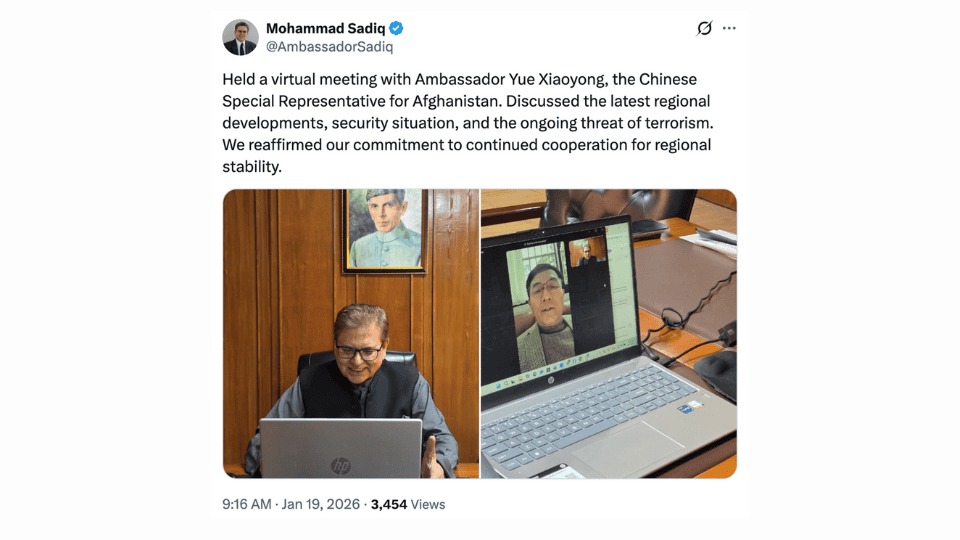
Pakistan and China have stepped up diplomatic coordination on Afghanistan as security concerns near the country’s northern borders intensify and regional risks grow more pronounced. Senior officials from both sides held an online consultation focused on the deteriorating security situation, with particular attention on terrorism threats and their spillover impact on neighboring states. The talks were led by Mohammad Sadiq and Yue Xiaoyong, reflecting a shared priority to address instability through closer policy alignment. According to officials familiar with the discussions, the engagement forms part of a broader effort by Beijing and Islamabad to maintain regional stability at a time when militant activity and political uncertainty continue to challenge Afghanistan’s security landscape. Both sides emphasized the importance of sustained dialogue and coordination to prevent escalation.
The discussions were reportedly triggered by recent attacks targeting Chinese personnel near Afghanistan’s border with Tajikistan, incidents that have heightened Beijing’s concerns over the safety of its nationals and projects in the wider region. These events occurred against the backdrop of growing militant activity and appear to have preceded a subsequent attack in Kabul, underscoring the volatility of the security environment. Chinese officials have consistently urged stronger measures to curb attacks on Chinese interests, particularly those linked to infrastructure, connectivity and regional development initiatives. Pakistan, meanwhile, has reiterated concerns that militant groups operating from Afghan territory pose risks not only to its own security but also to regional partners, adding urgency to trilateral and regional engagement on counterterrorism.
The latest exchange highlights how Afghanistan remains a central variable in China Pakistan strategic coordination, with security increasingly intersecting economic and geopolitical interests. Stability in Afghanistan is viewed by both sides as critical for regional connectivity and long term development ambitions, while continued insecurity threatens cross border trade and investment flows. Officials indicated that consultations on Afghanistan are likely to continue as part of an ongoing framework to manage risks, share assessments and align responses. The engagement also reflects China’s growing diplomatic involvement in regional security matters and Pakistan’s role as a key interlocutor on Afghan affairs, positioning both countries as stakeholders seeking to contain instability through coordinated political and security channels.

