
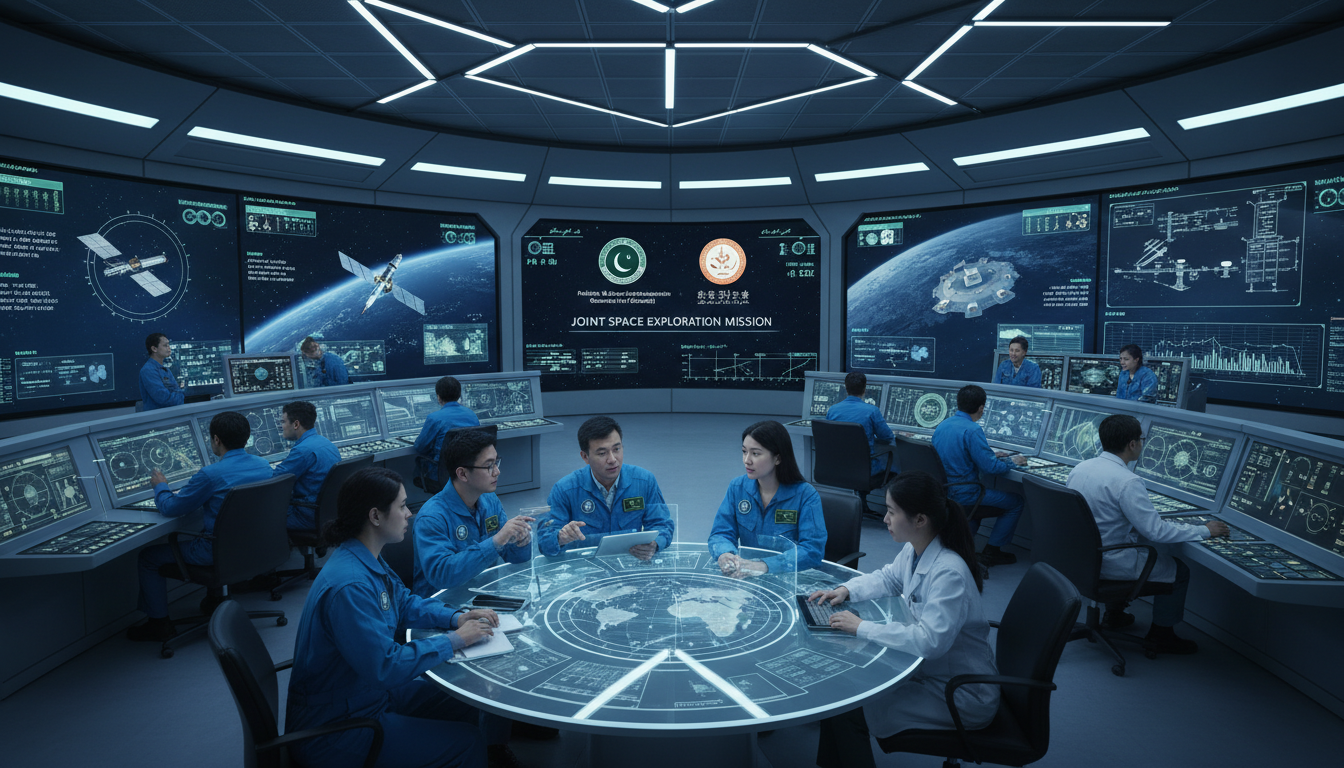
Pakistani Prime Minister’s Focus on Space
Prime Minister Shehbaz Sharif met Pakistani candidates selected for a Chinese spaceflight track and framed the meeting as a governance priority rather than a photo opportunity. In remarks carried by Dawn, he said the effort should help Pakistan enter a new era of space research, with universities and labs expected to follow the momentum. Today, officials briefed him on training phases, medical screening and security clearances connected to the Pakistan space mission. He also asked ministries to keep a Live line of coordination so scholarships, visas and technical attachments do not stall between departments. An Update on timelines was shared with the Prime Minister during the closed door session. The delegation left with instructions to maintain institutional continuity beyond the current news cycle.
China’s Expanding Space Program: An Overview
The Chinese side positioned the selection as part of an established pipeline inside the China space program, with specific modules tied to human spaceflight operations. For readers tracking the regional tech climate Live, policy choices in Beijing often shape scientific investment signals, as seen in Xi calls for disruptive tech push amid US rivalry. A Dawn account of the meeting noted the Prime Minister’s emphasis on research outcomes, while Pakistan’s planners pointed to technology transfer and training exposure as the immediate dividend. Today, a government communication referenced ongoing engagement with Chinese counterparts as schedules are finalized and medical reviews proceed. Separately, South China Morning Post detailed regulatory moves in the United States in US telecoms agency votes to expand tech crackdown on China. That external pressure frames why space capability is treated as strategic infrastructure, not only science.
The Role of Pakistani Scientists in China’s Mission
Officials described the selected Pakistanis as future operators and research contributors, not simply symbolic passengers, with experimental planning expected to be part of their preparation. In the middle of these briefings, China-Pakistan space cooperation was presented as the organizing principle for aligning universities, SUPARCO linked projects and Chinese host institutions. Briefings cited by Dawn indicated the Prime Minister wants outputs that can be replicated in Pakistan’s labs, including joint experiments and training pathways for younger researchers. Today, managers stressed that documentation, language preparation and safety certification will be treated as a single track, with Live monitoring of milestones to avoid missed windows. An Update on institutional responsibilities will be circulated to participating ministries so procurement and travel approvals do not delay technical placements. The message from the meeting was execution, measured by deliverables and validated research.
Implications for Pakistan-China Relations
The space initiative is being handled as a diplomatic signal that complements security, trade and financing discussions already active between the two governments. Pakistani officials have argued that high technology collaboration can widen the relationship beyond infrastructure and emergency balance of payments conversations. Today, policy staff referenced parallel engagement in other sectors, including recent coverage such as Zardari in China for trade talks and CPEC focus, to show how high level schedules are being synchronized. China-Pakistan space cooperation was repeatedly framed as a trust marker because it involves sensitive training and long lead planning. A Live diplomatic calendar matters because mission planning relies on stable intergovernmental access and predictable funding lines. The next Update is expected to clarify which Pakistani institutions will host follow on research activities and how data handling protocols will be managed across agencies.
Future Prospects for Space Research Collaborations
The Prime Minister’s instruction, as quoted by Dawn, was to turn selection into a sustained programme with local research capacity, not an isolated headline. Government planners outlined near term tasks, including building university partnerships, strengthening instrumentation pipelines and preparing domestic teams to receive any mission data products. Today, officials emphasized that success will be judged by published research, trained cohorts and the ability to design experiments that meet Chinese safety and integration standards. A Live environment of oversight is expected, with ministries asked to submit regular status notes and financial burn rates to prevent silent delays. An Update cycle will also be needed for public communication so expectations remain anchored to verified milestones rather than speculation. Pakistan’s challenge now is institutional follow through: converting a rare human spaceflight opportunity into repeatable training, credible labs and internationally reviewable science outcomes.

