
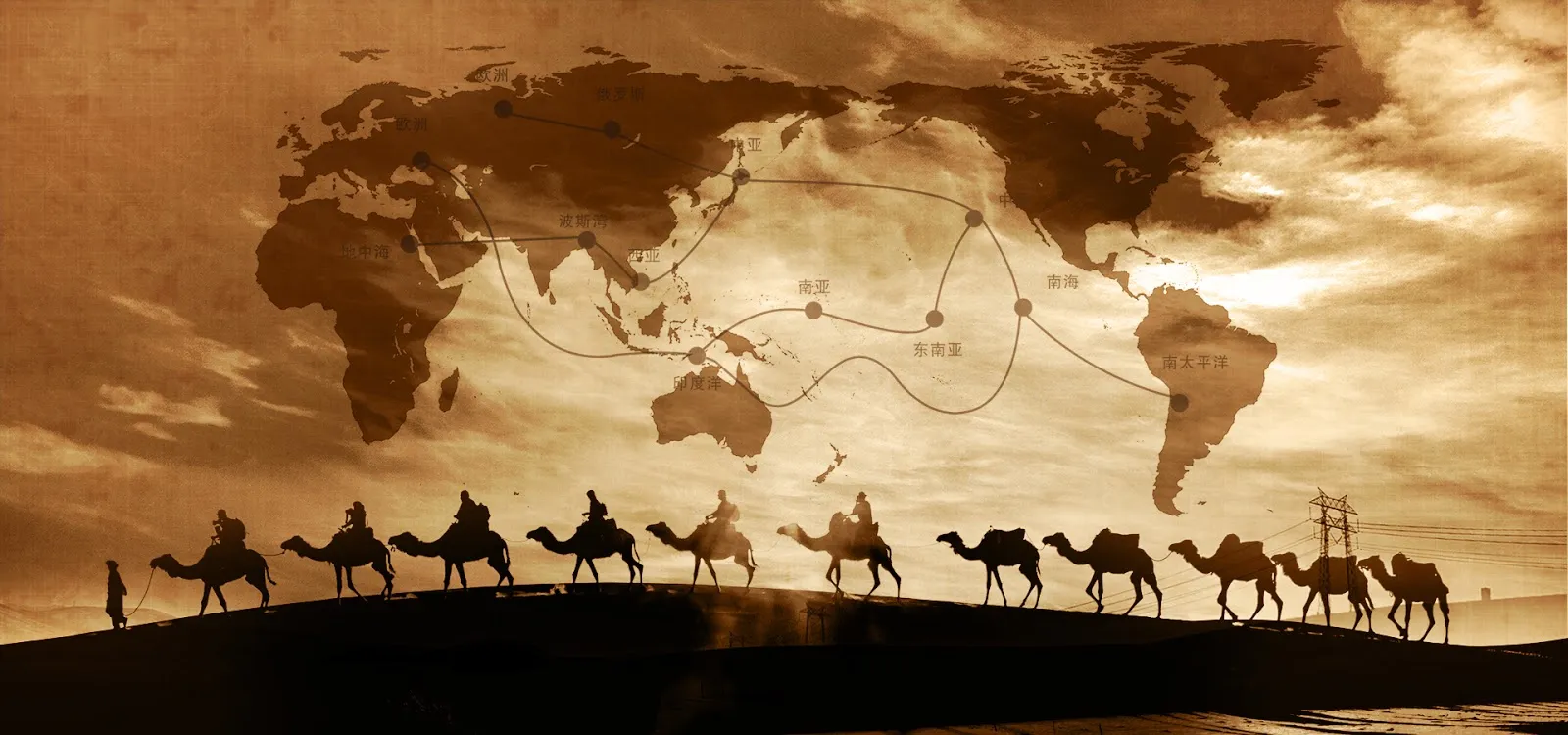
How ancient caravans connected China to the wider world.
The Highways of Empire
During the Tang dynasty, between the 7th and 9th centuries, China presided over one of the most cosmopolitan ages in its history. Caravans moved westward carrying silk, porcelain, and tea, while merchants brought back horses, glassware, and spices. The Silk Road was not a single road but a network of land and sea routes that converged on Chang’an, the Tang capital, where foreign embassies and traders thrived.
This traffic was not only economic. Diplomats and monks joined the flow, spreading ideas, languages, and religions. The Tang court embraced this exchange, viewing diversity as proof of China’s central role in a wider world.
Trade as Diplomacy
Tribute missions doubled as trade envoys. A Persian merchant could arrive in Chang’an as both diplomat and trader, presenting gifts while negotiating for silk contracts. These dual functions blurred political and commercial lines. For the Tang, trade was not a distraction from diplomacy but its method. The empire projected soft power through the silk that dressed foreign elites and the porcelain that decorated palaces from Baghdad to Constantinople.
Cultural Encounters
Religions traveled along the Silk Road. Buddhism from India took root in China, while Nestorian Christianity and Islam also found followers. Artistic styles fused: Chinese painters borrowed motifs from Persian miniatures, while Central Asian musicians performed at Tang banquets. Cosmopolitan Chang’an hosted markets where more than 100 languages were spoken, making it one of the world’s most diverse cities of its age.
Challenges of Distance
Yet the routes were perilous. Bandits, deserts, and shifting alliances could disrupt caravans. When central authority weakened, Silk Road traffic slowed. The prosperity of Tang China was tied to the empire’s ability to maintain stability across its frontiers.
Conclusion: The Tang as a Global Connector
The Silk Road in Tang times illustrates how China once served as a hub of a global system. The caravans carried more than goods. They carried the idea that prosperity and diplomacy could be built on openness and exchange.

