
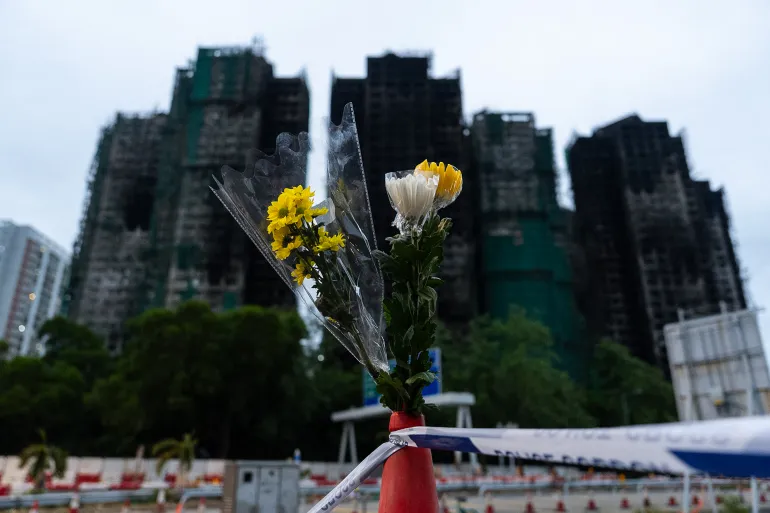
In the wake of the most devastating fire in Hong Kong in nearly 80 years, Chinese authorities have taken rapid and firm action against those calling for government accountability. The fire, which tore through seven towers at the Wang Fuk Court housing complex in the Tai Po district, claimed at least 151 lives and left dozens injured. As the city mourns, a parallel crisis has unfolded over how public demands for answers are being treated.
Over the weekend, Hong Kong’s national security police arrested three individuals in connection with calls for an independent investigation into the tragedy. Among those detained is former district councillor Kenneth Cheung Kam-hung, reportedly accused of “attempting to incite discord.” Also arrested were a volunteer managing supplies for survivors and 24-year-old university student Miles Kwan, who launched a now-removed online petition seeking greater transparency.
Kwan’s petition, which quickly gained traction with over 10,000 signatories, called for the establishment of an independent commission to examine the circumstances surrounding the blaze. The petition included four specific demands, one of which raised concerns about potential conflicts of interest in the redevelopment and management of the affected buildings.
The online initiative was abruptly taken down on Saturday, following sharp condemnation from both local authorities and state-backed media. China’s Office for Safeguarding National Security in Hong Kong described such calls for inquiry as attempts to “incite confrontation and tear society apart,” while accusing organizers of having “sinister intentions.”
State media has echoed these sentiments. A commentary published in Wen Wei Po, a Beijing-aligned newspaper, warned the public to be vigilant against what it termed “anti-government elements.” The article accused these groups of exploiting public grief and fear in order to destabilize society and revive the unrest seen during the 2019 protests.
The swift crackdown raises complex questions about civic space and freedom of expression in Hong Kong. Since the imposition of the National Security Law in 2020, authorities have acted aggressively against activities deemed to threaten public order or state authority. Critics argue that legitimate civil society actions, such as petitions and public advocacy, are increasingly being interpreted through a lens of national security risk.
Still, some Hong Kong residents continue to express frustration over the government’s initial handling of the blaze. Social media platforms have seen outpourings of grief, solidarity, and subtle criticism, with many urging the administration to prioritize safety reforms in older housing estates and to be more transparent with the public.
Chief Executive John Lee has announced the formation of an independent investigative committee led by a judge to determine the cause of the fire and recommend safety improvements. However, the parallel suppression of public voices seeking accountability may complicate efforts to build public trust during this time of tragedy.
As Hong Kong balances grief, recovery, and a tense political atmosphere, the coming weeks may test the boundaries of civic engagement in a city still redefining its identity under new governance dynamics.

