
How exploration beyond Earth became a pillar of national strategy.
Lifting Off
When China launched its first satellite, Dongfanghong-1, in 1970, it was a modest step compared to the U.S. Apollo program. Half a century later, China fields a full space program with lunar probes, a Mars rover, and its own space station. What was once catch up has become leadership in key areas, placing China among the top three space powers.
Lunar Exploration
The Chang’e program, named after the moon goddess, symbolizes this rise. In 2013, Chang’e-3 landed on the moon, the first soft landing since the 1970s. Chang’e-4 followed with a historic landing on the far side of the moon in 2019, deploying rover Yutu-2. In 2020, Chang’e-5 returned lunar samples to Earth, the first such mission since the Soviet Union’s effort in 1976. These successes demonstrated capabilities in landing, roving, and sample return, paving the way for future crewed missions.
Mars and Beyond
In 2021, the Tianwen-1 mission entered Mars orbit, landing the Zhurong rover on the surface. China became the first country to conduct orbit, landing, and rover operations in a maiden attempt. The rover explored Martian geology and climate, showcasing China’s growing expertise in interplanetary missions. Plans now include asteroid sampling and possible Jupiter system exploration.
The Space Station Tiangong
With the International Space Station aging, China built its own orbiting laboratory, Tiangong. Launched in modules starting in 2021, it now hosts crews of taikonauts conducting experiments in biology, physics, and medicine. The station represents not just scientific ambition but also political independence, as China was excluded from the ISS due to U.S. restrictions.
Military and Strategic Dimensions
Space exploration is not only about science. Satellites provide navigation, communication, and surveillance. The Beidou navigation system, completed in 2020, offers global coverage as an alternative to GPS. Military strategists view space as critical to modern warfare, making achievements in launch capacity and satellite networks essential to national security.
International Partnerships
China collaborates with countries from Europe to Africa on satellite launches, training, and lunar projects. It has invited partners to conduct experiments on Tiangong and proposed a joint lunar research station with Russia. These partnerships enhance China’s image as a space power willing to share resources, while also building influence in regions where Western space agencies have limited presence.
Domestic Inspiration
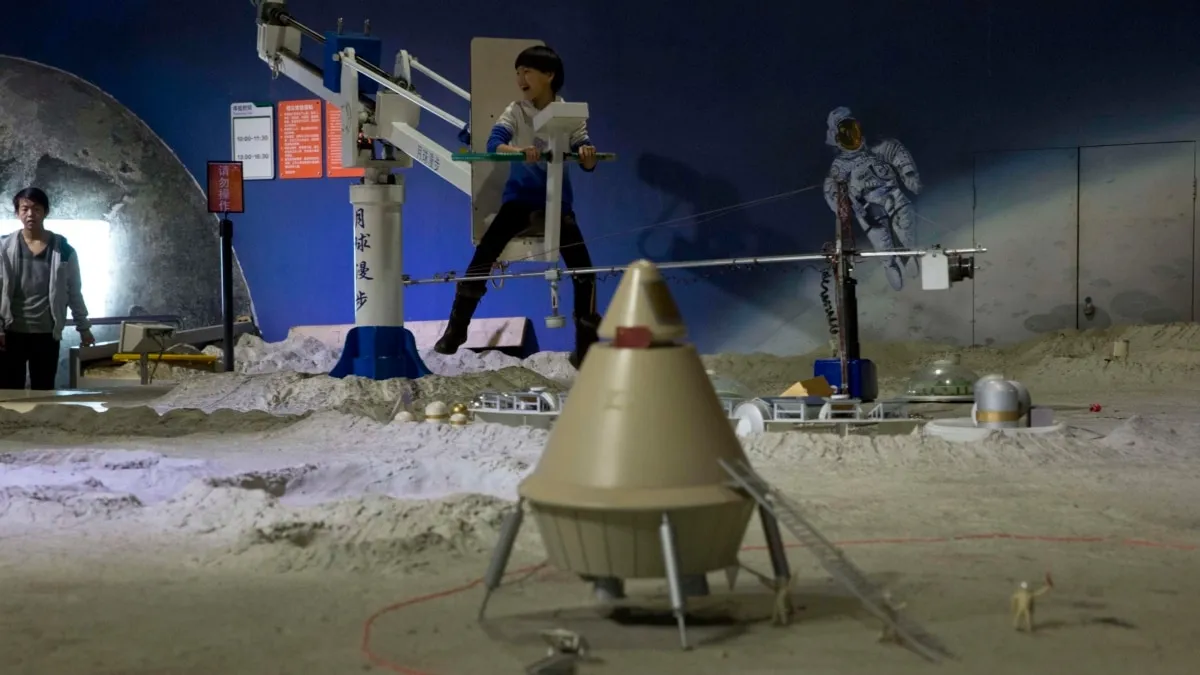
At home, space achievements inspire pride. Launches are broadcast live, schools highlight taikonauts as role models, and museums display spacecraft replicas. The narrative frames space as symbol of national rejuvenation, proof that China has risen from poverty to global leadership. Public enthusiasm reinforces political legitimacy, linking space with broader themes of progress.
Challenges Ahead
Ambition also brings hurdles. Space exploration is costly, and balancing investment with domestic needs poses dilemmas. Technical challenges remain in deep space missions, reusable rockets, and life support for long duration flights. Geopolitical rivalries add complications, as competition with the U.S. and private firms like SpaceX intensifies. Still, China’s steady progress suggests determination to remain a permanent player.
The Next Horizon
Looking ahead, China plans crewed moon landings by the 2030s, construction of lunar bases, and expansion of interplanetary missions. These goals place it at the center of a new space race, one where science, industry, and prestige converge. Success would secure not only technological leadership but also influence over rules governing outer space.
Conclusion: Space as Destiny
China’s space ambitions reveal how exploration becomes strategy. Rockets and rovers are more than scientific tools. They are instruments of soft power, national pride, and geopolitical competition. Whether on the moon, Mars, or beyond, China signals that its story is no longer confined to Earth. It is a story written in the stars.

