
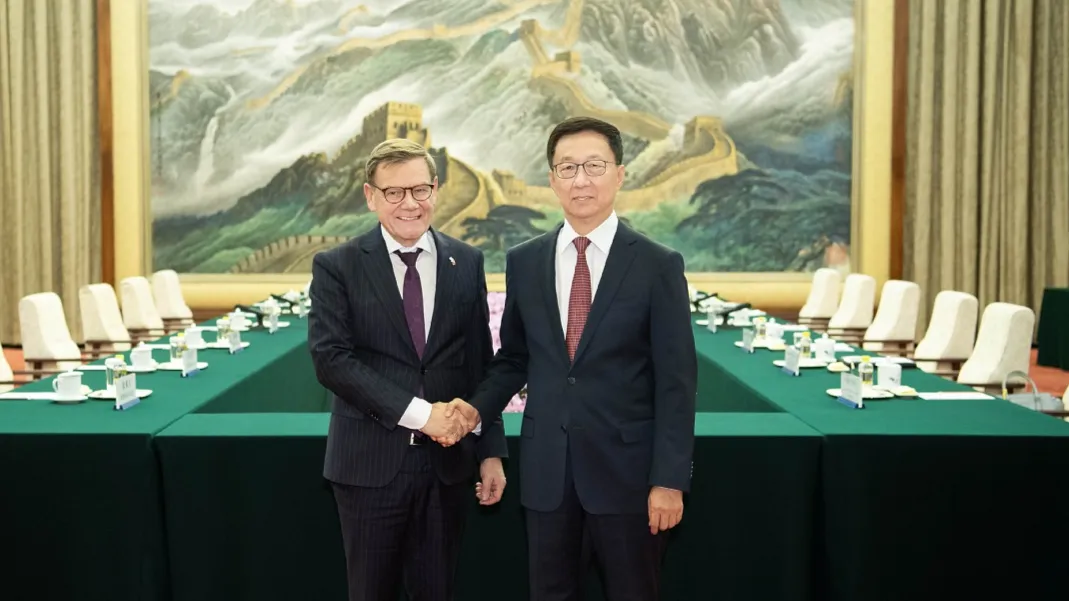
Chinese Foreign Minister Wang Yi said on Monday that any attempt to support what he described as “Taiwan secession” is a violation of China’s constitution and of internationally recognized legal principles. Speaking in Beijing during talks with German Foreign Minister Johann Wadephul, Wang outlined China’s longstanding historical and legal position that Taiwan is an integral part of its territory.
Wang stressed that Taiwan’s connection to China can be traced back through centuries of administrative, cultural and historical ties. He referred to key milestones in modern diplomatic history that, according to Beijing, cement the international understanding of Taiwan as part of China. The 1943 Cairo Declaration stated that territories taken from China by Japan, including Taiwan, should be returned. This position was reinforced in the 1945 Potsdam Proclamation, which required adherence to the Cairo terms.
After Japan’s surrender in August 1945, the Chinese government resumed administrative authority over Taiwan and held the formal surrender ceremony in Taipei that October. Wang said that this sequence of events establishes clear legitimacy over the island even before the founding of the People’s Republic of China in 1949. With the establishment of the PRC, he added, China’s central government became the sole legal authority representing the entire country, including Taiwan.
Wang also highlighted UN General Assembly Resolution 2758, passed in 1971, which recognized the PRC as the only legitimate representative of China at the United Nations and removed the representatives of the Taiwan authorities. He said this resolution reflects the position of the international community and affirms that Taiwan is considered a province of China within the UN system.
He went on to cite diplomatic agreements with Japan as further evidence. The 1972 Sino Japanese Joint Statement affirmed Japan’s recognition of the PRC as the sole legal government of China and acknowledged Beijing’s view that Taiwan is an inalienable part of its territory. The 1978 Treaty of Peace and Friendship between the two countries reiterated that these principles must be upheld.
Wang criticized recent comments by Japan’s current leader regarding hypothetical scenarios involving Taiwan, saying such remarks undermine China’s sovereignty and violate Japan’s previously stated commitments. He argued that these comments also challenge the outcomes of World War Two and destabilize the regional security environment at a time when maintaining peace is especially important.
As this year marks the eightieth anniversary of China’s victory over Japanese aggression, Wang said Japan should show greater historical responsibility. He accused some Japanese leaders of attempting to exploit the Taiwan issue for political purposes and warned that such actions risk encouraging a return to militaristic thinking.
Wang concluded that China, together with the international community, has a responsibility to uphold the principles of the UN Charter and safeguard regional stability. He urged all countries to avoid actions that could contribute to division or conflict in Asia.

