
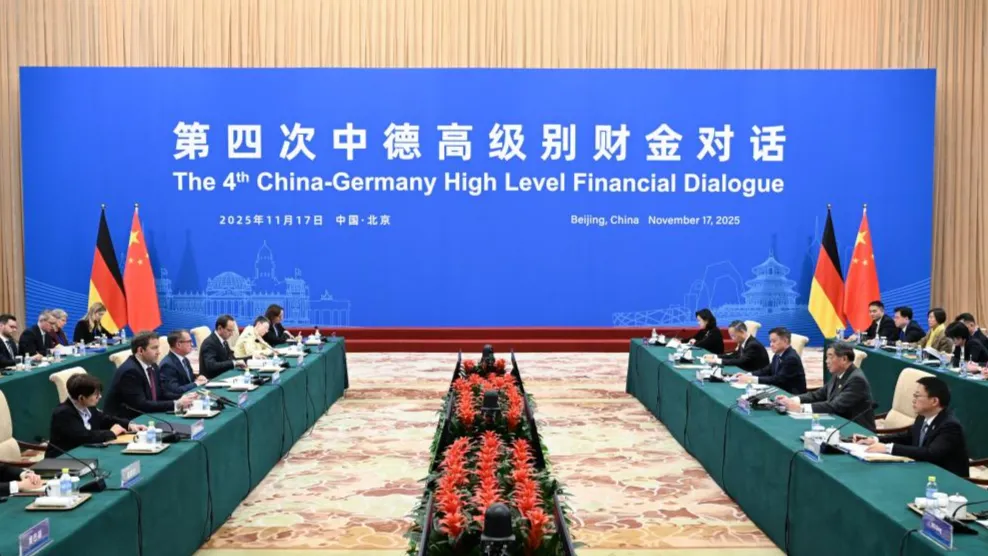
China hosted senior German officials in Beijing for a new round of high level trade discussions, coinciding with Foreign Minister Johann Wadephul’s two day visit. The meetings come at an important moment as China and the European Union mark fifty years of diplomatic ties, while China and Germany celebrate eleven years of their all round strategic partnership. Against this backdrop both sides expressed a shared commitment to stability, cooperation and long term economic engagement.
Leaders highlight the foundations of a strong partnership
During the talks Chinese Commerce Minister Wang Wentao emphasized that recent discussions between President Xi Jinping and German Chancellor Olaf Scholz have provided clear direction for expanding cooperation. Wang noted that China and Germany have built a pattern of deeply interconnected industries. Their markets rely on one another and their technologies complement each other in ways that continue to anchor bilateral relations.
He encouraged German companies to explore new opportunities in China, not only in established sectors but also in rapidly developing areas such as new energy, smart manufacturing and biopharmaceuticals. According to Wang these fields offer strong potential for turning shared opportunities into tangible progress.
Germany underscores value of close economic ties
Foreign Minister Wadephul expressed appreciation for the direct dialogue and arrived with a delegation of lawmakers and business leaders, signaling Berlin’s interest in strengthening ties with its largest trading partner. He stressed that economic relations between China and Germany remain central to Germany’s global strategy.
Wadephul highlighted China’s role as a major driver of innovation, which he said makes scientific and economic collaboration especially valuable. Germany hopes to maintain stable and expanding exchanges with China as both countries navigate shifting global economic conditions.
Shared commitment to open markets and climate goals
The German delegation reaffirmed support for free trade, World Trade Organization reform and joint efforts to advance climate transitions. These shared priorities form an important foundation for cooperation, even as both sides acknowledge ongoing differences in areas such as market access and competition rules.
Despite these challenges the meetings reflected a mutual belief that continued conversation is essential for managing tensions and building trust. The open exchange of concerns and expectations allows both governments to address issues in a constructive manner.
A relationship shaped by dialogue and shared interests
As the visit concluded officials from both countries voiced confidence in the future of China Germany relations. The combination of strong commercial ties, deep industrial links and shared technological ambitions continues to make the partnership a significant anchor in the broader China EU relationship.
With global economic uncertainty persisting, the willingness of Beijing and Berlin to maintain steady communication adds an important element of stability. The latest round of talks suggests that both sides remain committed to finding common ground and expanding cooperation in ways that benefit their industries, workers and long term strategic goals.

