
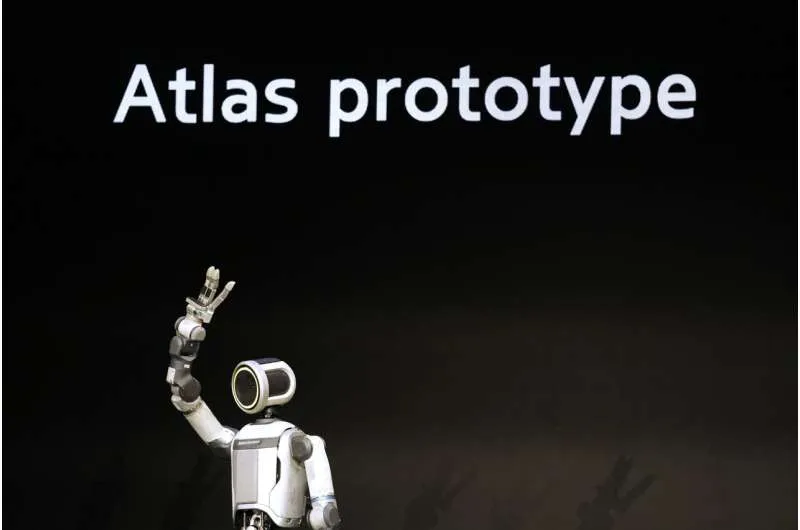
The unveiling of a next generation humanoid robot by Boston Dynamics at the Consumer Electronics Show in Las Vegas marks a defining moment in the evolution of artificial intelligence driven automation. Majority owned by Hyundai, the company presented its latest version of the Atlas humanoid as more than a technical demonstration. Instead, it positioned the robot as a practical platform designed for large scale industrial deployment, signaling a shift from experimental robotics toward real world application.
Why this Atlas debut matters
Unlike earlier showcases that focused primarily on movement and balance, the CES 2026 debut emphasized intelligence and scalability. According to Boston Dynamics executives, recent breakthroughs in AI finally provide the missing link needed to make humanoid robots commercially viable. The new Atlas is built around the concept of physical AI, where software intelligence and mechanical design operate as a unified system. This approach allows the robot to adapt to tasks and environments rather than rely on rigid programming.
AI as the turning point
Zachary Jackowski, vice president and general manager of Atlas, described the current moment as a turning point made possible by rapid progress in artificial intelligence. Advances in perception, decision making, and learning have enabled robots to understand their surroundings and respond dynamically. For Atlas, this means performing complex physical tasks with greater autonomy and fewer human instructions. AI is no longer an add on but the core engine that defines the robot’s usefulness.
From showcase to factory floor
What distinguishes this launch is the clear path toward deployment. Boston Dynamics announced plans to build a factory capable of producing 30,000 humanoid robots annually by 2028. This scale suggests confidence not only in the technology but also in market demand. While the company did not disclose pricing, it confirmed that Atlas will be rolled out across manufacturing sites as part of a broader automation strategy. This move aligns robotics with industrial planning rather than experimental innovation.
Hyundai’s role in industrial adoption
Hyundai’s majority ownership plays a central role in this strategy. As a global manufacturer with complex production lines, Hyundai provides a testing ground where humanoid robots can deliver immediate value. Deploying Atlas across factories allows the company to integrate AI driven robots into logistics, assembly support, and repetitive physical tasks. This internal adoption model reduces risk while accelerating learning and refinement of the technology.
What physical AI really means
The concept of physical AI reflects a broader trend in technology development. Instead of focusing solely on digital intelligence, companies are now embedding AI into machines that interact with the physical world. For humanoid robots, this means understanding space, weight, balance, and human workflows. Atlas is designed to operate in environments built for people, making it more flexible than traditional industrial robots that require controlled settings.
Implications for the workforce
The rise of AI powered humanoids raises important questions about labor and productivity. Supporters argue that robots like Atlas will handle dangerous, repetitive, or physically demanding tasks, allowing human workers to focus on supervision and skilled roles. Critics caution that large scale deployment could disrupt employment patterns. The reality will likely depend on how companies manage integration and retraining as automation expands.
A signal of what lies ahead
The CES 2026 debut of Atlas reflects a broader shift in the technology landscape. Robotics is moving from spectacle to infrastructure, driven by AI systems capable of real autonomy. By committing to mass production and factory deployment, Boston Dynamics and Hyundai are betting that humanoid robots will become a standard component of industrial operations. The coming years will test whether physical AI can deliver on this promise, but the direction is now unmistakably set.

