
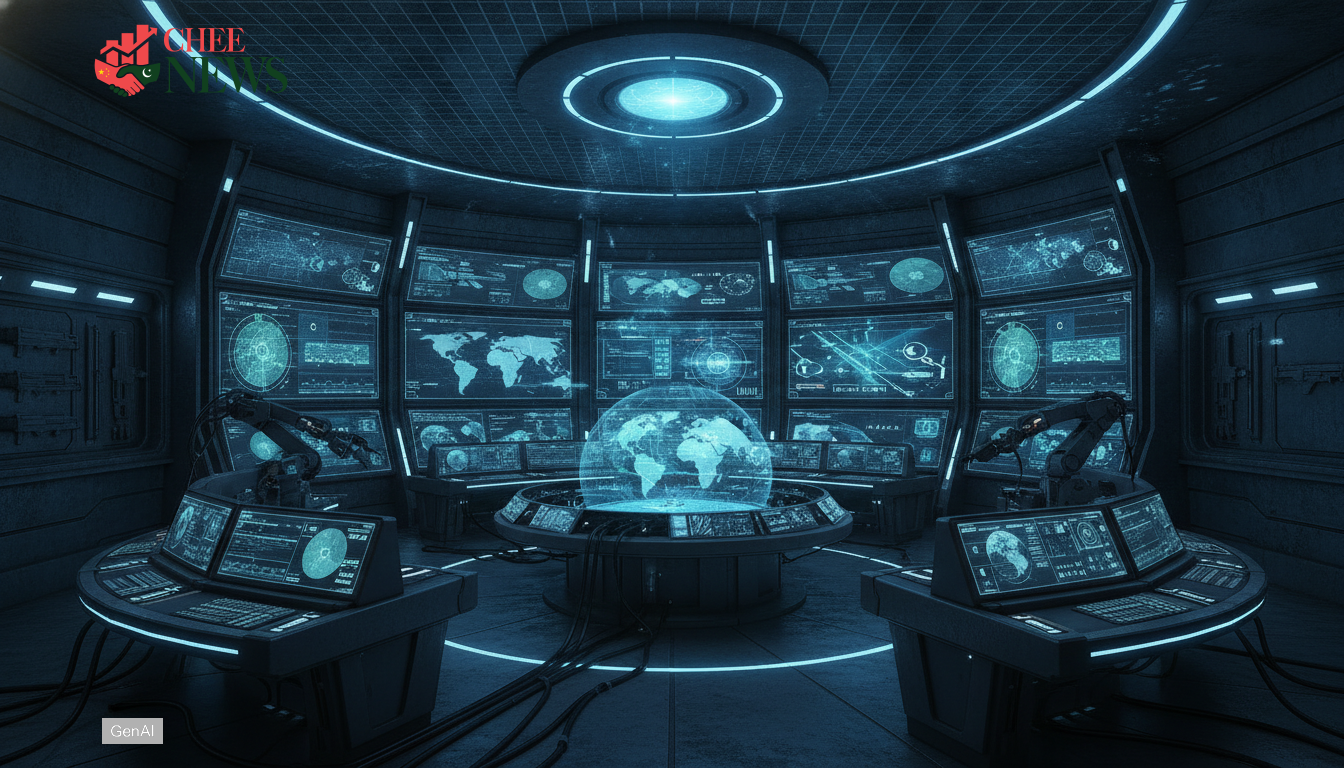
AI in Chinese military research and U.S. model access
AI in Chinese military research is increasingly discussed in open sources, with some Chinese teams reportedly testing civilian large language models for defense-adjacent tasks. Researchers in public-facing papers and demos have described using models to summarize technical literature, draft code, and support simulation workflows, which can shorten analysis cycles in laboratory settings. According to available reports, including those from the Honolulu Star-Advertiser, some 2024 reporting and analyst commentary has suggested that Chinese researchers were able to access U.S.-developed AI models for training or evaluation in certain contexts, illustrating how commercial tools may be repurposed even as policy restrictions tighten. The practical effect is often framed as less about a single weapon and more about potentially compressing timelines for experimentation, documentation, and testing inside labs. This also points to a governance gap, since access to general-purpose models in AI in Chinese military-adjacent contexts can sometimes persist through indirect channels and third-party services.
AI in Chinese military planning and China Pakistan security
For Islamabad, a key question is how faster Chinese iteration cycles could influence combined planning, interoperability, and intelligence processing, if such tooling is adopted in joint workflows. Debates framed as China Pakistan security often emphasize software maturity, data pipelines, and model governance rather than platform counts alone. That rivalry is tracked in US-China Tech Rivalry Heats Up Undersea Cable Race, which presents infrastructure and compute access as strategic levers, against a parallel backdrop of the broader U.S.-China technology contest, including expanding controls that shape which chips, tools, and services can be used at scale, as described by ongoing public reporting. Those dynamics can raise compliance and continuity questions for joint programs that rely on externally governed model ecosystems.
Transfer pathways, compute limits, and dual use spillovers
Defense-relevant AI systems typically require more than raw parameters. They depend on reliable compute, curated datasets, evaluation harnesses, and secure deployment practices designed to withstand adversarial pressure. Where China and Pakistan cooperate, transfer risk may concentrate in tooling and process, including how code is audited, how data is labeled, and how updates are validated before fielding. Trade and investment constraints can complicate this pipeline, and Trade curbs reshape CPEC projects and corridor plans has detailed how external curbs ripple through corridor planning. In that environment, AI in Chinese military-adjacent work could produce dual-use spillovers, while partners still have to resolve governance over training data, fine-tuning rights, and compartmenting sensitive outputs.
Regional stability risks from faster decision cycles
Across South Asia, analysts and defense commentators often flag the risk that automation could compress decision cycles in surveillance, targeting support, and electronic-warfare analysis. As militaries ingest more sensor feeds, they can also inherit new failure modes documented in broader AI safety research, including hallucinated summaries, brittle pattern recognition, and systematic bias from skewed training data. As a reminder of how governance disputes surface in adjacent tech settings, the South China Morning Post reported on a legal challenge over university fees in Mainland Chinese families lose legal challenge over public university fees, illustrating how institutions adjudicate accountability when systems affect public outcomes. This is why regional debates around AI models increasingly center on assurance and oversight, not vendor claims. Independent oversight can be difficult because many performance details are classified, but policymakers can still demand auditable test regimes, model cards, and regular red teaming.
Future directions for Sino Pakistani AI collaboration
The next phase of cooperation is likely to emphasize self-hosted stacks, clearer evaluation standards, and tighter security controls around data and inference, rather than dependence on any single foreign model endpoint, according to common themes in public policy discussion. In 2024, Islamabad policy discussions around Pakistan’s National AI Policy have highlighted local capacity-building and public-sector procurement guardrails as priorities. For Pakistan, value could come from jointly defined benchmarks that reflect local terrain, languages, and threat environments, plus agreed rules for when automated outputs can inform operational choices. China may push architectures that can run on constrained hardware, making deployments more feasible even under supply pressure, while also promoting domestic alternatives to reduce external chokepoints. AI in Chinese military-linked development may continue to influence doctrine and procurement, but durability would hinge on disciplined lifecycle management. That includes secure data acquisition, continuous testing against adversarial prompts, and resilience checks for spoofed sensor inputs.

