
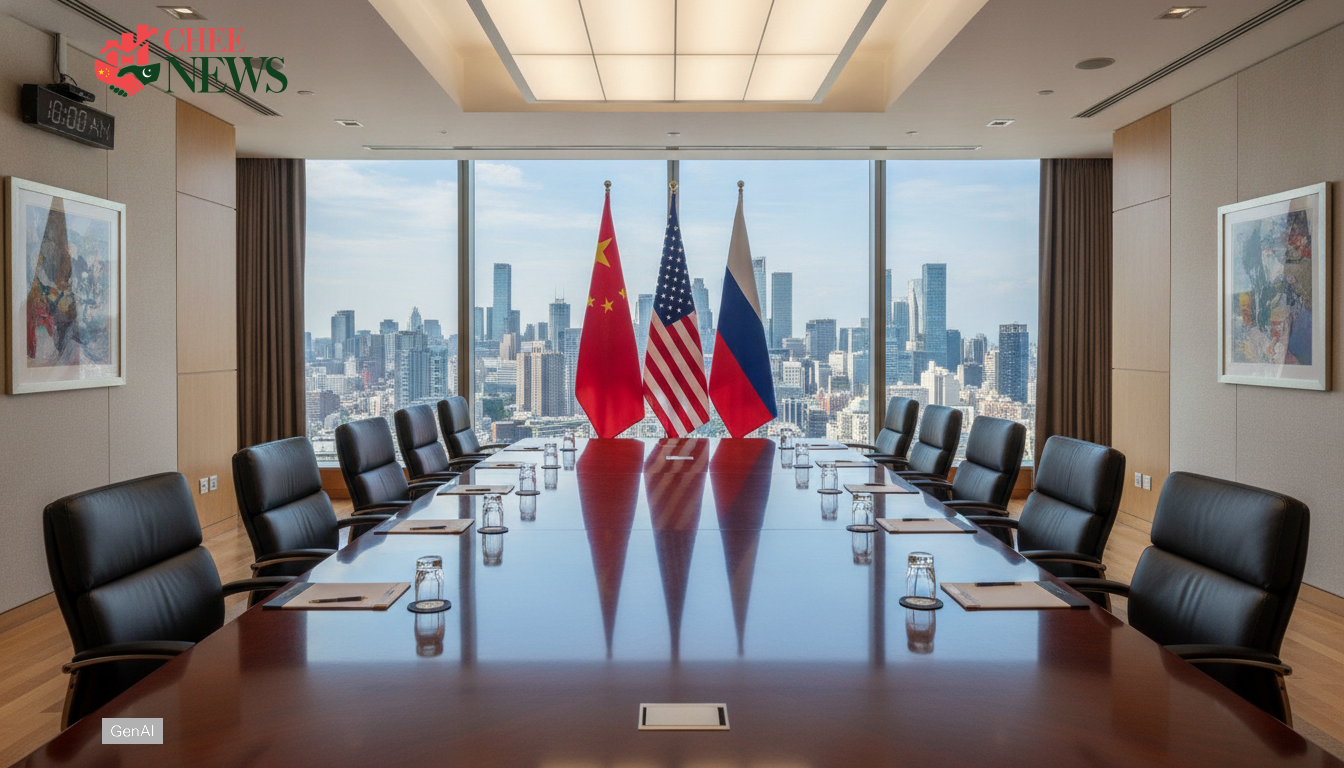
China trilateral talks: what Beijing confirmed
China trilateral talks moved closer to official acknowledgment after Beijing confirmed it is in contact with Washington and Moscow about a possible first three party format. Speaking at a regular Ministry of Foreign Affairs press briefing, as reported by Reuters, officials indicated that China “maintains communication” with Russia and the United States on the matter. The statement was presented as routine diplomatic engagement rather than a shift toward a formal alignment, and it offered no commitment on timing, venue, or agenda. This public acknowledgment still signals an effort to keep channels open as strategic tensions remain high, and bilateral communication between the other two capitals is strained.
What a three-way format could cover
If convened, a three-way format could provide a venue for addressing flashpoints where US, Russian, and Chinese actions intersect, including arms control, strategic risk reduction, and sanctions spillovers. As reported by Reuters, the confirmation of communications was attributed to China’s foreign ministry, but no side has released a joint readout or draft agenda. For more context on how security measures are debated in the region, see the South China Morning Post report on roll-out of HK$5m anti-terrorism bollards in Causeway Bay. Any early deliverable would likely be procedural, such as agreeing to working-level follow-ups, rather than a single sweeping statement. As a separate background reference, a related portal page currently shows Contact your hosting provider rather than functional content.
Past precedents and why talks stall
Past precedents suggest trilateral formats are challenging when participants insist on sequencing, with one side demanding concessions elsewhere before agreeing to meet. The Russia US China meeting concept has appeared intermittently in academic and policy discussions, but officials have often preferred bilateral channels where leverage is clearer. According to Reuters’ account, China’s current position emphasized communication rather than negotiations over a summit, reflecting how governments typically test feasibility before attaching leader-level prestige. In that context, China trilateral talks are seen as a feasibility check rather than a commitment to a timetable. In practice, the effort is less about a dramatic breakthrough and more about creating predictable contact points that reduce miscalculation during periods of limited direct engagement.
Key constraints and near-term openings
The main obstacle is that the three capitals approach “strategic stability” from incompatible starting points, with sanctions, military posture, and alliance structures treated as interconnected rather than compartmentalized. Related frictions shaping the broader backdrop are discussed in China Trade Secrets Rules Drafted After US Sanctions and China-US investment curbs: Beijing urges US to pause. Trilateral diplomacy also faces a credibility test: any meeting must be more than optics while staying narrow enough to be achievable. China’s foreign ministry has not offered a schedule, which reduces the risk of a public failure but complicates planning for substantive outcomes. A more realistic opening is technical work on incident prevention in military encounters and cyber communication.
Conclusion: Policy Implications and Future Outlook
Although a near-term summit is not confirmed, Beijing’s acknowledgment of communication suggests that all parties recognize the risks of unchecked competition. The reporting by Reuters serves as a significant public marker that Beijing is open to exploring a three-way mechanism while allowing each side the flexibility to define their objectives. If further channels develop, they could influence smaller, issue-focused arrangements by other powers, where establishing safeguards might prove more crucial than achieving grand agreements, particularly in light of anticipated technology and investment disputes toward 2024. The next practical test will be whether officials can agree on an agenda that limits the scope while still addressing tangible risks, especially as broader technology and investment disputes continue to affect strategic trust.

