
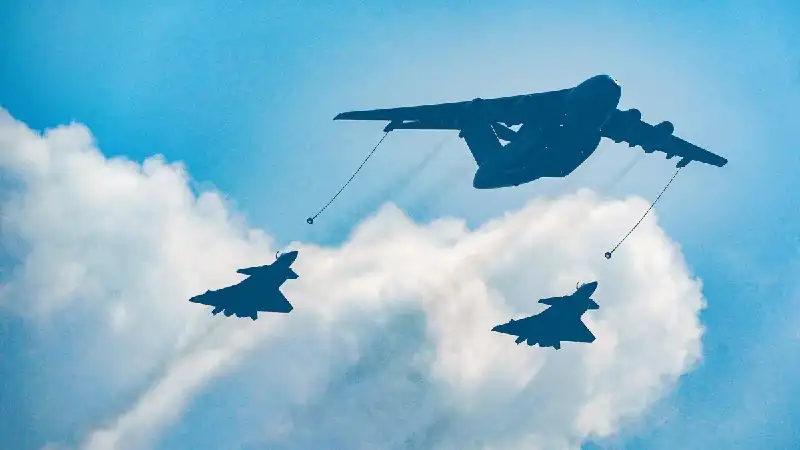
China’s military has introduced a new artificial intelligence driven system designed to enhance aerial refuelling operations, highlighting a growing focus on integrating advanced technologies into defense capabilities. The announcement comes shortly after a United States military refuelling aircraft crash in the Middle East drew attention to operational risks in complex air missions. Chinese officials indicated that the new system is intended to improve coordination, efficiency, and safety across refuelling tasks, particularly during high intensity or long range operations where precision timing and resource management are critical.
The system, developed for use by the People’s Liberation Army Air Force, is described as a smart task dispatch platform that uses AI to optimize mission planning and execution. By analyzing flight data, operational requirements, and real time conditions, the platform can assign refuelling tasks more effectively than traditional manual coordination methods. This allows tanker aircraft and receiving fighters to operate with improved synchronization, reducing delays and minimizing the risk of miscommunication during complex aerial maneuvers. The development reflects broader efforts to modernize military logistics through data driven systems.
Aerial refuelling plays a central role in extending the operational range of combat aircraft, enabling missions that would otherwise be limited by fuel constraints. In modern air forces, the ability to sustain aircraft in flight is critical for maintaining strategic reach and rapid response capabilities. The introduction of AI into this process represents a shift toward more automated and adaptive systems that can respond dynamically to changing mission conditions. Analysts note that such technologies can significantly enhance operational efficiency while also reducing the cognitive burden on pilots and ground controllers.
The timing of the announcement has drawn attention due to the recent crash of a US Air Force tanker aircraft during operations in the Middle East. While details surrounding the incident remain under review, it has underscored the inherent risks associated with aerial refuelling missions, which require precise coordination and stable flight conditions. Observers suggest that advancements in AI assisted systems could help address some of these challenges by improving situational awareness and reducing the margin for human error in complex operational environments.
China has been steadily advancing its military modernization programme, with a strong emphasis on incorporating artificial intelligence and other emerging technologies into its defense infrastructure. The development of AI assisted refuelling systems is part of a wider trend that includes autonomous systems, intelligent command platforms, and enhanced data integration across different branches of the armed forces. These initiatives are aimed at improving both efficiency and decision making in increasingly complex operational scenarios.
Beyond military applications, the use of artificial intelligence in aviation operations has also been expanding in civilian contexts, where airlines and logistics providers are exploring similar technologies to optimize flight scheduling and safety protocols. The overlap between civilian and military innovation highlights the broader impact of AI in transforming how complex systems are managed. In defense settings, however, the stakes are significantly higher, making reliability and precision critical factors in the adoption of such technologies.
Regional analysts are closely watching how these developments may influence the balance of capabilities among major military powers. The integration of AI into operational planning and execution is seen as a key component of next generation warfare, where speed, coordination, and adaptability are essential. As more countries invest in similar technologies, competition in this domain is expected to intensify, potentially reshaping strategic dynamics across multiple regions.
The introduction of the new system signals China’s continued efforts to enhance its operational readiness and technological edge in aviation logistics. Military planners are expected to further test and refine the platform as part of ongoing modernization efforts, with a focus on improving reliability and scalability across different mission types. The evolution of such systems will likely play an important role in shaping future air operations, particularly as the integration of artificial intelligence becomes more widespread.

