
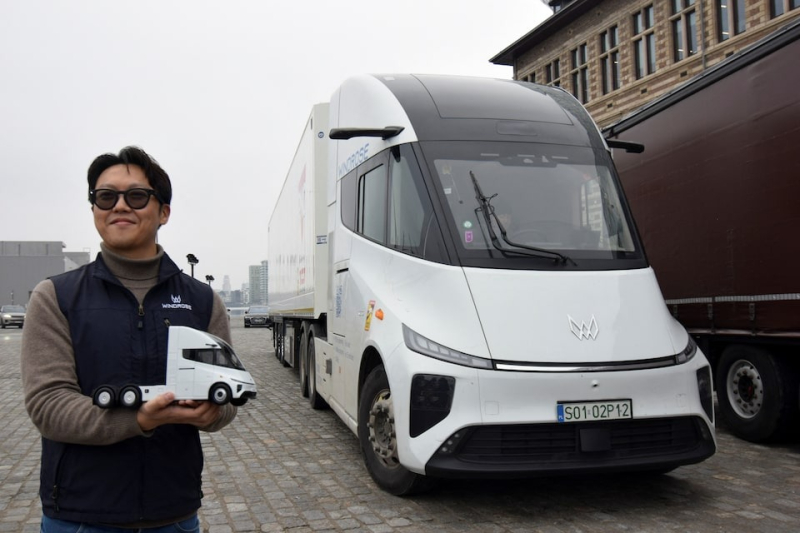
European truck manufacturers are preparing for intensifying competition as a wave of Chinese electric freight trucks prepares to enter the European market in 2026. Industry executives and analysts say several Chinese manufacturers are planning to launch heavy duty electric trucks across Europe, potentially reshaping the competitive landscape of the commercial transport sector. Companies including BYD, Geely’s Farizon, Sany, Sinotruk and emerging startups such as Windrose and SuperPanther are among those expected to introduce new models. Their entry follows the earlier expansion of Chinese electric car brands into European markets and reflects the growing global reach of China’s electric vehicle industry.
Chinese manufacturers are expected to attract fleet operators primarily through lower pricing and competitive technology. Industry sources indicate that Chinese electric trucks could be priced up to thirty percent lower than comparable European models, which currently average around 320000 euros. The cost advantage is largely driven by China’s massive domestic electric vehicle supply chain and large scale battery production. China’s heavy duty truck market has already seen rapid electrification, with zero emission trucks accounting for nearly thirty percent of sales in the country. This scale has allowed Chinese companies to refine manufacturing processes and reduce costs more quickly than many competitors.
Electric freight trucks remain a relatively small portion of the European market, though demand is gradually increasing. In 2025 electric trucks accounted for about 4.2 percent of total truck sales in the European Union, up from roughly 2.3 percent the previous year. Growth has been slower than in China due to higher prices and infrastructure limitations. Electric heavy trucks typically cost around three times as much as conventional diesel models, which average about 100000 euros. As a result many fleet operators have been cautious about adopting electric trucks despite growing pressure to reduce carbon emissions in the transport sector.
European manufacturers including Daimler Truck, Volvo Group, Iveco and Traton, which owns the MAN and Scania brands, continue to dominate the regional market and maintain strong relationships with fleet operators. However the arrival of lower priced competitors is raising concerns among industry leaders. Executives say fleet managers are generally loyal to established brands but remain highly sensitive to price differences when purchasing large numbers of vehicles. Industry groups warn that if Chinese companies quickly gain market share, European manufacturers could face a major challenge in maintaining their position in the emerging electric truck segment.
European industry associations have already begun lobbying policymakers to accelerate the transition toward zero emission trucks while supporting domestic manufacturers. Groups representing the automotive sector have called for stronger incentives to increase demand for electric freight vehicles. Proposed measures include reduced highway tolls for zero emission trucks, government subsidies and policies encouraging large logistics companies to adopt cleaner vehicle fleets. Some policymakers are also considering linking financial incentives to vehicles produced within Europe as a way to strengthen local manufacturing capacity.
Chinese manufacturers are simultaneously taking steps to build trust with European customers by establishing production facilities and service networks within the region. Some companies plan to assemble trucks locally or partner with established service providers to support maintenance and repairs. For example several Chinese manufacturers have signed agreements with European service networks that operate hundreds of maintenance centres across the continent. By ensuring reliable service infrastructure, these companies hope to reduce concerns among logistics firms about purchasing vehicles from relatively new brands.
Technological innovation has also become a major competitive factor. Industry analysts say Chinese manufacturers have surprised many European competitors with the speed at which they have developed advanced electric truck models. One startup developed its flagship heavy truck within just three years and obtained regulatory approval to sell the vehicle in multiple global markets. The truck features a central driving position that allows the same design to be used in both left hand drive and right hand drive regions, reducing production complexity. European manufacturers typically require longer development cycles and often produce separate models for different markets.
Some European companies are responding by expanding their research and development presence in China to learn from the country’s rapidly evolving electric vehicle ecosystem. A major European truck manufacturer recently invested billions of euros in a new factory near Shanghai that will produce both diesel and electric trucks while also expanding its engineering capabilities. Industry leaders say collaboration with Chinese technology ecosystems could help European companies accelerate innovation and compete more effectively as the global market for electric freight vehicles continues to expand.

