
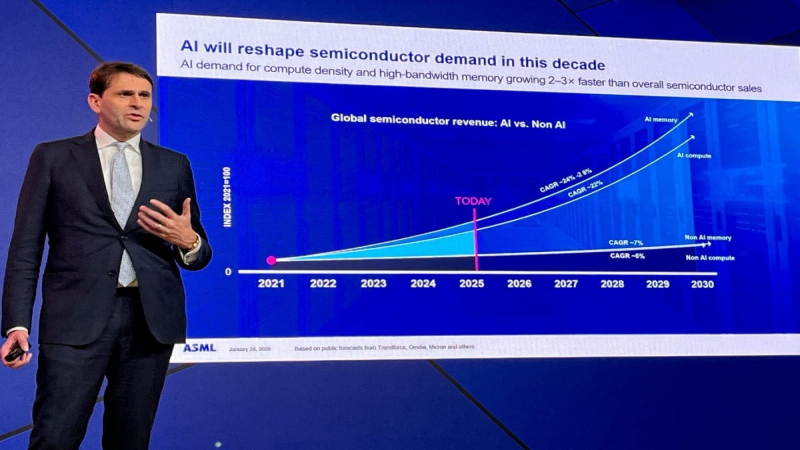
Global demand for semiconductor manufacturing equipment remained strong in 2025 as Dutch chipmaking equipment giant ASML recorded double digit growth in overall machine sales, driven largely by advanced chip production outside China. Company executives said global customers continued to invest heavily in cutting edge lithography tools, supported by strong demand linked to artificial intelligence and high performance computing. Despite this momentum, ASML signaled a continued slowdown in its China business as United States export restrictions limited shipments of its most advanced systems. China’s share of the company’s global sales declined sharply during the year, reflecting both regulatory constraints and a gradual easing of earlier pent up demand. The company said its overall growth trajectory remained intact, but regional sales patterns were increasingly shaped by geopolitical and trade policy developments.
ASML’s financial leadership said China’s contribution to total revenue fell to around one third of global sales in 2025, down significantly from the previous year, and is expected to decline further in 2026. The company attributed this trend to restrictions that prevent the export of its most advanced lithography machines to Chinese customers. Sales of deep ultraviolet systems, which can still be supplied to China, also declined during the year as earlier demand driven by post pandemic restocking began to normalize. Executives said Chinese customers had accelerated purchases following the lifting of Covid related restrictions, but that cycle had largely run its course. As a result, demand for less advanced tools softened, reinforcing expectations of lower China revenue in the near term.
While China sales cooled, ASML reported robust growth in its most advanced extreme ultraviolet lithography systems, which are essential for producing leading edge semiconductors. Total net machine sales rose by more than twelve percent in 2025, supported by strong demand in Europe, the United States, and other markets not subject to export restrictions. Sales of EUV machines surged sharply, reflecting heavy investment by global chipmakers racing to expand capacity for artificial intelligence workloads and next generation processors. Company executives said demand for these top tier systems was particularly strong in the final quarter of the year, with bookings reaching record levels. The AI driven investment cycle was described as a key structural driver that is expected to support continued demand into 2026.
Looking ahead, ASML said it expects a normalization of overall demand growth as the industry absorbs recent capacity expansion, while maintaining confidence in long term fundamentals. Management noted that global semiconductor investment remains closely tied to technological shifts such as artificial intelligence, data centers, and advanced manufacturing. At the same time, trade restrictions are expected to remain a defining factor in shaping regional sales, particularly in China. The company said it will continue to focus on innovation, supply chain execution, and serving markets where demand for advanced chipmaking tools remains strong. ASML’s outlook suggests that while geopolitical constraints may limit growth in specific regions, global demand for cutting edge semiconductor technology continues to provide a solid foundation for the business.

