
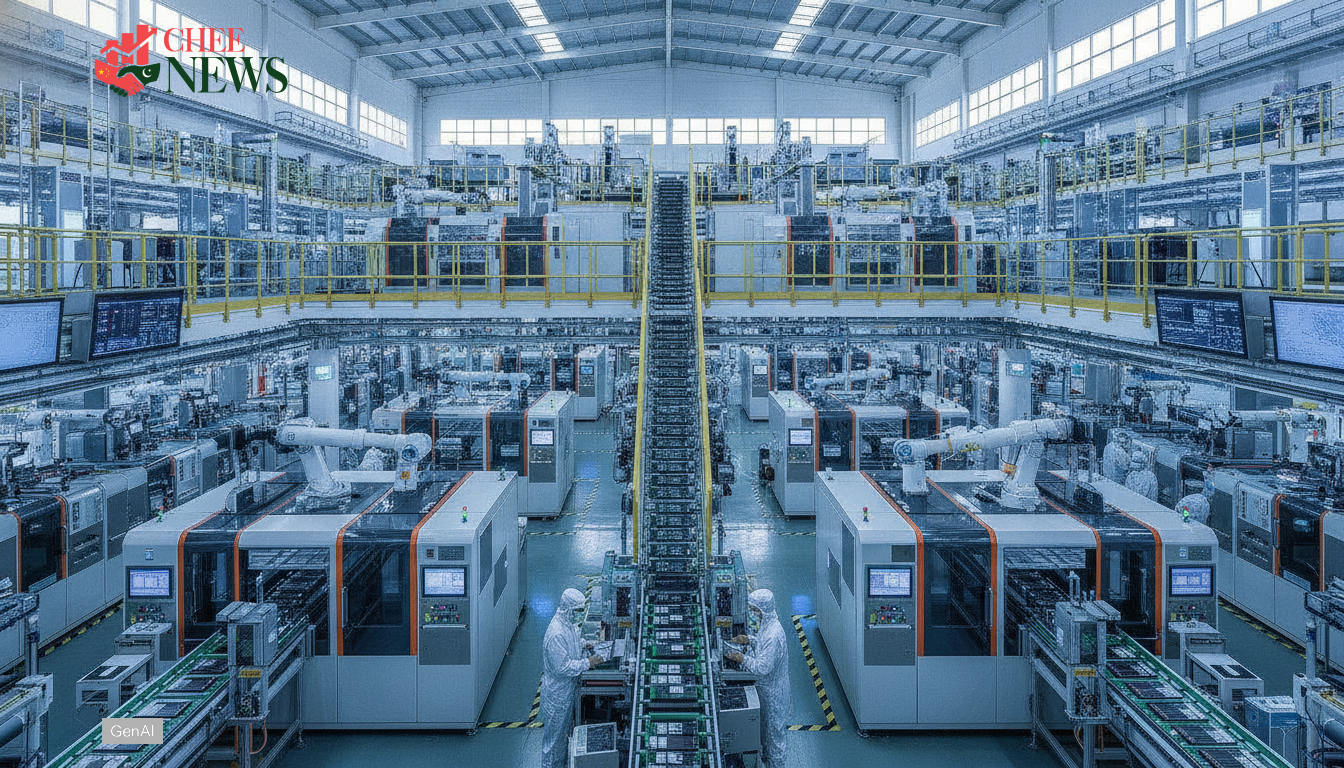
China chip manufacturing pushes domestic chip tools
China chip manufacturing is accelerating as Beijing directs financing, procurement, and subsidies toward homegrown lithography, etch, deposition, and metrology tools, as reported by Reuters. Since 2023, tighter export controls on advanced equipment and services have reportedly pushed some fabs to shorten qualification cycles and, in some cases, repeat installs across multiple sites. This chipmaking push depends less on one-off lab demonstrations and more on whether local toolchains can support stable uptime and yield learning in pilot and then high volume lines, according to industry reporting cited by Reuters. Reuters has described this shift as a tool-driven race that changes supply chain leverage where foreign suppliers face licensing risk. The near-term effect is described by industry participants as a faster feedback loop between tool builders and fabs, with more pressure on service, spare parts, and process control integration. This could have implications for the market as companies may need to adapt rapidly to changing supply chain dynamics.
Policy timeline and investment signals inside China
Beijing’s industrial push is visible in spending patterns and capital market activity, according to public announcements and market disclosures, even as project timelines remain uncertain. A parallel build-out in compute infrastructure is also influencing equipment demand, reflected in projects such as China data centers in ocean race to fuel AI growth, which can tilt orders toward mature-node capacity and the tools that support it. In parallel, funding and expansion narratives increasingly emphasize repeatability, local component sourcing, and qualification at multiple fabs, as reflected in domestic industry statements and related reporting. For a close view of staging and scale-up efforts around immersion capability, see Chipmaking tools: China starts immersion DUV production.
ASML exposure as export controls tighten
ASML remains pivotal because its lithography systems anchor advanced roadmaps, but demand is now filtered through overlapping US, Dutch, and other licensing regimes, according to Reuters and company disclosures. In 2023 and 2024, additional restrictions on shipments and servicing were reported by Reuters and other outlets, increasing uncertainty for customers planning multi-year capacity and tool roadmaps. Reuters has characterized ASML as caught between Washington and Beijing as restrictions and countermeasures collide, affecting orders, service access, and upgrade paths. For context, see China’s home-grown DUV progress not the biggest threat to ASML, analysts say. Analysts have argued that domestic deep ultraviolet progress is not the biggest near-term threat to ASML’s core franchise, though it could raise long-run substitution pressure if ecosystems mature.
How US-China tensions reshape semiconductor roadmaps
Export controls are increasingly defining what can be shipped, serviced, or upgraded, as described by policymakers and reported by Reuters, forcing companies to design around compliance constraints rather than pure performance. In practice, industry executives and compliance advisers say tensions are turning process roadmaps into legal roadmaps, since spare parts, software features, and remote diagnostics can trigger licensing questions. China chip manufacturing plans therefore often prioritize controllability, including local suppliers for precision components, materials, and tool subsystems where feasible, according to domestic industry reporting. South China Morning Post coverage also notes that subsystem improvements do not remove bottlenecks across materials and yield learning, keeping timelines uncertain. For additional reporting on how domestic programs are being expanded toward immersion lithography, see China ramps up DUV chipmaking tools for immersion lithography.
Global implications for supply chains and future outlook
Outside China, toolmakers and chip firms are diversifying manufacturing footprints, expanding compliance teams, and rebalancing customer exposure to reduce single-market risk, according to company statements and reporting from outlets including Reuters. China’s chipmaking push is influencing capital allocation globally because customers now price geopolitical risk into capacity decisions and supplier selection, according to analysts cited in Reuters reporting. Reuters highlighted how the squeeze on ASML underscores that Europe-based firms can become pressure points when the US and China escalate restrictions. Suppliers in Japan, South Korea, and Taiwan are reassessing where to locate sensitive process steps to keep access to multiple end markets, according to industry commentary, while smaller vendors can face strain from disrupted service revenue and parts logistics, as described by sector analysts. The next phase will likely be judged less by isolated demos and more by whether consistent high-volume performance is achieved across multiple fabs in 2024 and 2025.

