
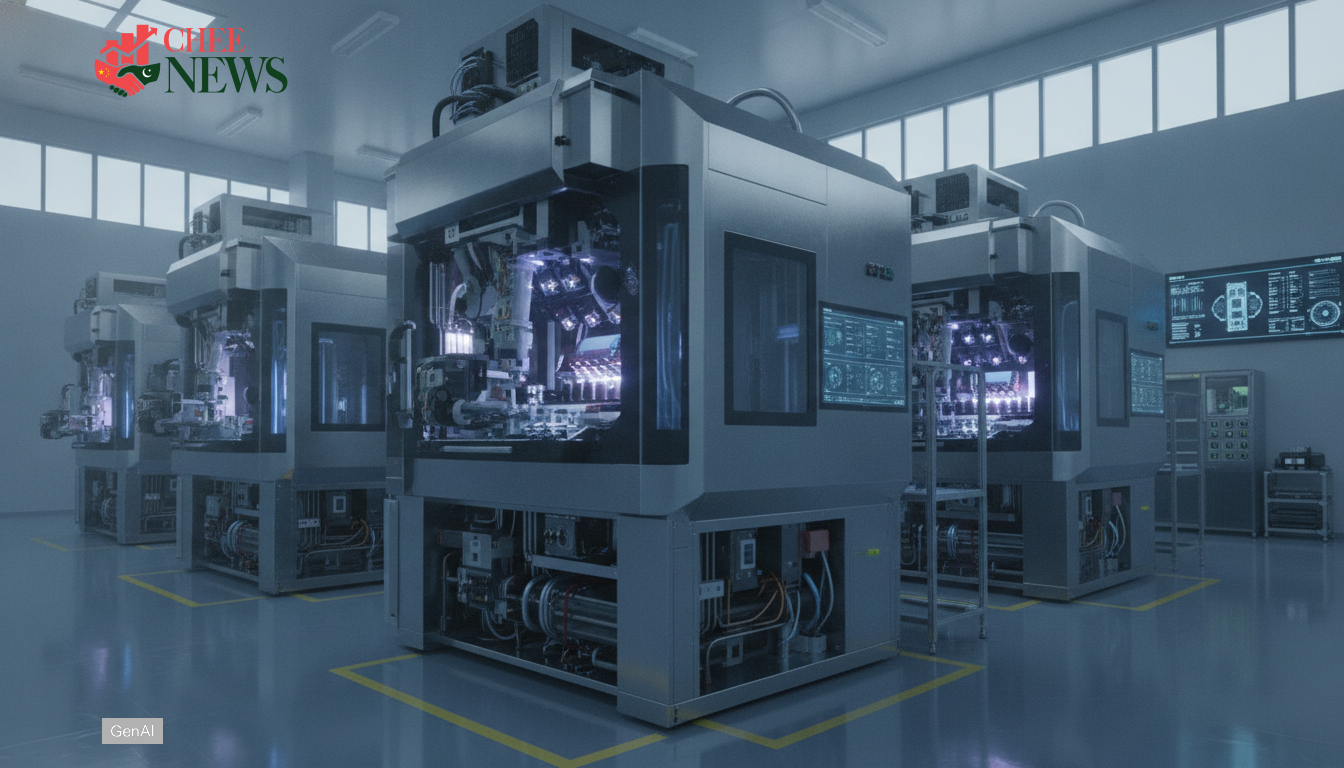
Chipmaking tools: China begins immersion DUV production
China’s semiconductor equipment push is entering a new phase as the country transitions from lab work into initial domestic manufacturing of immersion deep ultraviolet lithography systems for advanced chip production. According to Reuters, locally built immersion DUV systems are now being produced inside China, aiming to reduce exposure to export controls on critical equipment. Engineers and suppliers are focusing on subsystems that previously relied on overseas vendors, including optics alignment, wafer stages, and control software, as reported by Reuters. While output is limited, the immediate challenge is demonstrating consistent performance across wafers and reliable uptime in fabs. Qualification data from production lines will be crucial in determining how swiftly these systems can scale.
Supply chain impact and market response
If immersion lithography manufacturing in China ramps up credibly, it could potentially affect negotiating leverage across the chip equipment supply chain, even if production volumes remain small through 2025, as suggested by Reuters. A related procurement context is discussed in China data centers in ocean race to fuel AI growth, where domestic compute demand influences equipment decisions across the stack. Reuters described the start of production as a milestone that might reduce reliance on overseas suppliers for nodes that still depend on DUV chips rather than extreme ultraviolet. Analysts cited by the South China Morning Post indicated that the near-term commercial impact on ASML is limited, but the direction is crucial for customers planning multi-year capacity and service coverage.
Performance requirements for advanced manufacturing gear
The key technical question is whether locally built immersion systems can meet the overlay control, throughput, and defect performance required for high-volume manufacturing. In parallel, the South China Morning Post examined analyst views in China’s home-grown DUV progress not the biggest threat to ASML, analysts say, emphasizing that reliability and ecosystem depth matter as much as initial capability. Reuters described the units as home-grown immersion DUV, implying progress in integrating precision components that must operate as a single platform under tight stability constraints. A practical benchmark will be whether fabs can qualify process recipes and sustain yield targets without frequent tool intervention over continuous runs.
Economic implications and localization
Domestic production could shift the economics of capital spending by directing more value into local manufacturing, service, and spare parts. For additional reporting, see Domestic DUV production begins with limited immersion tools and China ramps domestic DUV chipmaking tools production. Reuters noted the beginning of local output, which could lead to shorter lead times for maintenance and more predictable procurement for fabs operating at scale. Equipment programs also bring in high-precision machining, motion control, sensors, and specialized chemicals that can spill over into aerospace and advanced manufacturing, according to industry observers. Even with limited shipments, a local service network might lower the lifetime cost of ownership for operators and enhance parts availability.
Next hurdles for scaling deliveries
Scaling from first production runs to stable deliveries will require rigorous qualification, a robust spare-parts inventory, and a pipeline of trained field engineers. Reuters emphasized that the initiative is at an early stage, so improvement will depend on feedback from fab deployments and iterative redesigns. Beyond tool performance, supply continuity for critical components such as light sources, photoresist compatibility, and ultra-clean subsystems will be essential to support sustained capacity expansion. Export controls remain a constraint on certain advanced parts, Reuters reported, with workarounds potentially adding complexity that must be reduced over time. Even if immersion DUV capability develops, competitive pressures will still come from the broader ecosystem, including EDA, materials, and inspection, influencing the long-term trajectory of chipmaking tools in China and the global market for chipmaking tools.

