
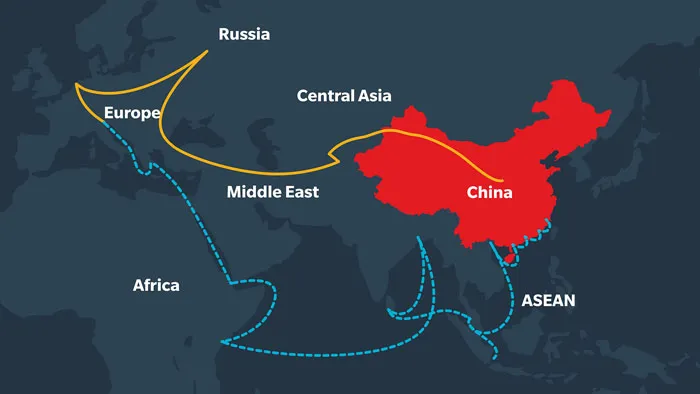
The Belt and Road Initiative (BRI) is entering a new stage. After a decade of focusing on bilateral projects, China is shifting its strategy toward regional connectivity and digital trade integration, particularly among ASEAN countries and Pakistan. This marks the evolution of the Belt and Road from infrastructure construction into a networked trade ecosystem.
For Pakistan, this transition means becoming more than a recipient of Chinese investment. Through the China–Pakistan Economic Corridor (CPEC) and its linkages to Southeast Asia, Islamabad now stands at the intersection of two of the world’s fastest-growing trade zones: East Asia and the Middle East.
The next Belt and Road phase will test Pakistan’s ability to serve as a functional bridge between the ASEAN economic bloc, China’s industrial centers, and global maritime routes.
China’s Southeast Asian Strategy Expands Westward
China’s engagement with ASEAN has reached unprecedented depth. The Regional Comprehensive Economic Partnership (RCEP), launched in 2022, already integrates most of East and Southeast Asia under a unified trade framework. Now Beijing aims to connect RCEP economies with western trade corridors through Pakistan and Central Asia.
This move reflects China’s recognition that logistics efficiency, not just trade agreements, drives competitiveness. Factories in Vietnam, Thailand, and Malaysia can supply goods to western Asia more quickly if connected through Gwadar Port and Pakistan’s transport network.
The China–Laos Railway, Kra Canal discussions in Thailand, and Gwadar-Kashgar highway together illustrate China’s vision of an interconnected Belt and Road grid that fuses ASEAN’s manufacturing power with South Asia’s strategic geography.
Pakistan’s Strategic Relevance in Regional Logistics
Pakistan occupies a natural midpoint between China’s western provinces and ASEAN’s maritime routes. Through the CPEC network, China can move goods from Xinjiang across Pakistan to Gwadar, bypassing the congested Malacca Strait.
Recent trade agreements signed in 2025 highlight growing coordination between Pakistan’s Ministry of Commerce and ASEAN logistics authorities. The Pakistan–Vietnam Business Council and Islamabad–Kuala Lumpur Digital Trade Corridor Agreement aim to align customs procedures, enabling data-driven cargo monitoring from ports to warehouses.
These developments reflect China’s ambition to convert Pakistan’s infrastructure into a gateway for Southeast Asian exports to the Middle East and Africa. If successfully implemented, Pakistan could earn significant transit revenue and attract foreign logistics firms seeking regional hubs.
ASEAN’s View: Opportunity and Competition
For ASEAN states, deeper Belt and Road linkages through Pakistan provide both benefits and challenges. Economically, they offer diversified trade routes and reduced shipping times for exports to the Middle East and Europe. Politically, they require careful navigation between China’s influence and Western investment alternatives.
Countries such as Malaysia and Indonesia are eager to join new logistics chains connecting through Pakistan but remain cautious about long-term debt exposure. Vietnam, a major U.S. trade partner, prefers modular engagement through digital customs and e-commerce rather than heavy infrastructure financing.
Still, ASEAN governments recognize that Pakistan’s ports, highways, and rail links could shorten trade routes by thousands of kilometers compared to traditional maritime paths. This pragmatic calculus is driving growing ASEAN interest in CPEC connectivity.
Digital Belt and Road: The Invisible Infrastructure
Beyond ports and highways, the next Belt and Road phase prioritizes digital logistics. China’s Digital Silk Road program, active since 2021, now links e-commerce platforms, data centers, and customs systems across Asia.
In 2025, China and Pakistan signed an agreement to integrate Gwadar Smart Port operations with the ASEAN Single Window System. This allows electronic tracking of goods from origin to destination using blockchain-based verification. The system reduces clearance time, curbs corruption, and enhances transparency.
Huawei and Alibaba Cloud are investing in Pakistan’s data centers to host logistics and trade analytics platforms. These facilities will enable ASEAN and Chinese firms to access real-time data on shipments, costs, and regulatory compliance.
Such digital integration is transforming CPEC from a physical corridor into a smart trade ecosystem capable of linking multiple regions simultaneously.
The Maritime Dimension
Maritime cooperation forms the backbone of the new China–ASEAN–Pakistan network. The Gwadar Port, Port Klang in Malaysia, and Yangon Port in Myanmar are emerging as anchor points for shipping lanes connecting the South China Sea to the Arabian Sea.
Beijing’s shipping conglomerates, including COSCO and China Merchants Group, are expanding container services linking Southeast Asian ports with Gwadar and Karachi. These routes reduce dependency on transits through the Strait of Malacca, improving energy security and trade reliability.
For Pakistan, this maritime expansion presents an opportunity to become a regional refueling and logistics hub. It also enhances naval collaboration with ASEAN partners on issues such as piracy prevention and disaster response.
Economic and Financial Integration
The new trade corridors are supported by evolving financial mechanisms. The Asian Infrastructure Investment Bank (AIIB) and China’s Silk Road Fund are financing connectivity projects across ASEAN and South Asia. Meanwhile, the Pakistan–China RMB clearing arrangement allows transactions in local currencies, complementing the region’s de-dollarization trend.
Pakistan’s policymakers are studying how to join the RCEP+ framework once institutional capacity improves. Inclusion in this trade bloc would give Pakistani exporters preferential access to ASEAN markets and align tariffs with regional standards.
Experts at the Islamabad Policy Research Institute estimate that full integration with ASEAN supply chains could raise Pakistan’s exports by thirty percent within five years.
Challenges and Regional Sensitivities
Despite progress, the Belt and Road’s expansion through Pakistan and ASEAN faces multiple challenges. Political instability, inconsistent customs rules, and security concerns continue to hinder regional integration. Infrastructure interoperability also remains limited.
ASEAN countries worry about overreliance on Chinese technology in critical digital infrastructure. Some prefer maintaining a balance by including Japanese or European partners in logistics financing. Similarly, Pakistan must demonstrate regulatory transparency to attract non-Chinese investors and reassure regional partners.
Environmental and social concerns are another obstacle. Expanding transport corridors through sensitive ecosystems in Myanmar or coastal Pakistan requires strict sustainability compliance. International observers have called for environmental safeguards to prevent long-term ecological damage.
Geopolitical Implications
The creation of an integrated China–ASEAN–Pakistan corridor carries significant geopolitical implications. It reduces China’s maritime vulnerability, challenges India’s dominance in South Asia, and provides smaller ASEAN economies with alternate pathways to markets in Central and Western Asia.
For the United States and its allies, this development underscores the need for competing regional frameworks that combine economic incentives with governance standards. Pakistan, situated at the junction of these competing interests, must continue its balancing act between alignment with China and cooperation with Western partners.
Conclusion:
The next phase of the Belt and Road Initiative is no longer defined by megaprojects alone. It is characterized by integration, efficiency, and digital intelligence. The emerging China–SEAN–Pakistan corridors are reshaping trade geography by connecting industrial, maritime, and digital ecosystems across Asia.
For Pakistan, this transformation presents both promise and pressure. To fully benefit, Islamabad must prioritize logistics reform, regional diplomacy, and digital modernization. If successful, Pakistan could evolve from a peripheral participant to a central connector in Asia’s trade future.
As Belt and Road enters its second decade, the story is shifting from construction sites to coordinated systems and Pakistan, sitting at the heart of this network, may finally realize its long-envisioned role as Asia’s gateway between east and west.

