
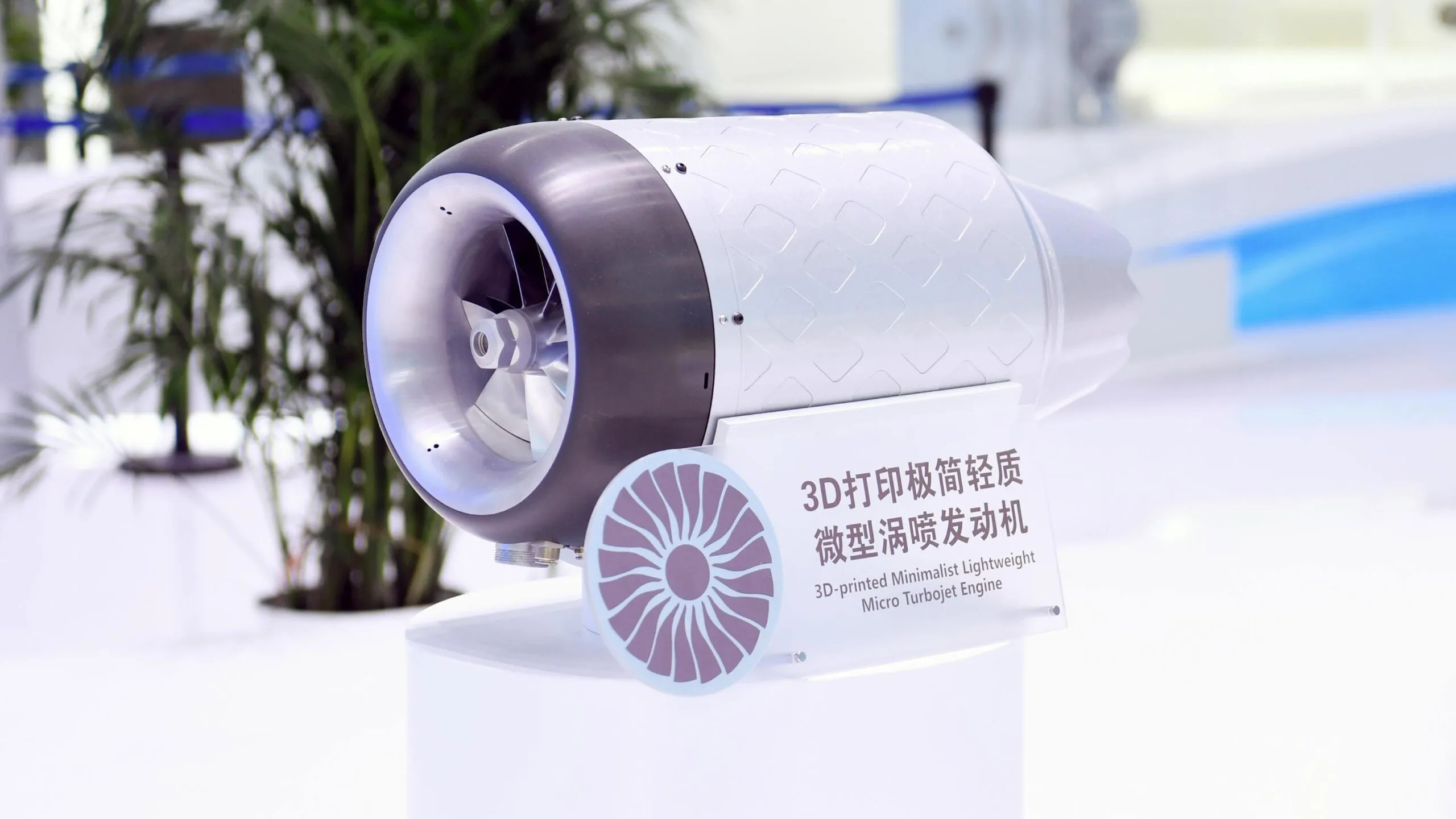
China has taken another significant leap forward in aviation technology with the successful maiden flight of a self developed mini turbojet engine that was manufactured almost entirely through 3D printing. The test took place in the vast open skies of Inner Mongolia, where engineers from the Aero Engine Corporation of China gathered to witness a moment that may change the future of lightweight aviation systems. The achievement reflects not only engineering skill but also China’s determination to push the boundaries of additive manufacturing and create high performance propulsion systems that are efficient, adaptable and capable of supporting future unmanned platforms.
A Smooth and Steady First Flight
According to the official report, the test flight lasted a full 30 minutes. The aircraft, powered by a single minimalist turbojet engine, climbed steadily to an altitude of six thousand meters. It also reached a top speed of approximately Mach zero point seven five, an impressive figure for an engine of this size and weight. Engineers noted that throughout the entire flight, the engine behaved exactly as expected. All key performance indicators remained stable and no irregularities were reported. From ignition to shutdown, the engine operated in a way that demonstrated both dependability and consistent output across different flight conditions.
Verified Performance at High Altitude
One of the most important aspects of this flight was the opportunity to verify whether a 3D printed propulsion system can maintain stability in higher and more complex flight environments. High altitude operations place greater stress on engines due to temperature changes, reduced air density and fluctuating pressure conditions. The test flight helped engineers confirm the engine’s resilience and adaptability. The successful performance proved that additively manufactured components can withstand real world atmospheric challenges, marking an important step toward future applications where reliability is essential.
Designed for UAVs and Next Generation Platforms
This new engine is not simply a technological showcase. It has been designed with practical applications in mind. The developer highlighted that the engine could become a reliable power source for a range of unmanned aircraft. These include loitering munitions, which require long endurance and stable thrust, unmanned aerial vehicles used for reconnaissance or surveillance and target drones used for military training. The compatibility demonstrated in the test flight shows that this engine can integrate smoothly with aircraft control systems. This level of flexibility is especially valuable for designers looking for lighter and more fuel efficient propulsion options.
A New Era in Additive Manufacturing
The success of the maiden flight also underscores the growing importance of 3D printing in China’s aerospace industry. Traditional engine manufacturing often requires thousands of individual components, each needing precise machining and assembly. In contrast, additive manufacturing allows engineers to produce complex structures as single integrated units. This reduces weight, minimizes assembly errors and improves aerodynamic efficiency. The use of 3D printing also speeds up development cycles, allowing teams to test new designs more quickly. For China, this test strengthens its position as a leader in advanced propulsion research and demonstrates how modern techniques can accelerate progress in aviation engineering.
A Step Toward Future Independent Capabilities
For the AECC, this achievement is about more than a single flight. It is a signal that China is building strong independent capabilities in the design, testing and production of advanced jet engines. For decades, propulsion technologies have been among the most challenging areas for aerospace industries worldwide. Achieving breakthroughs in this field requires enormous investment in materials, manufacturing and precision engineering. This successful flight shows that China’s investment is producing concrete results. The engine’s performance suggests the potential for a future family of lightweight, high efficiency engines that could support both civilian and military aircraft.
Implications for the Global Aviation Landscape
The global aviation industry is paying close attention to such developments. As demand for unmanned systems grows, countries are searching for propulsion solutions that are affordable, reliable and easy to adapt. China’s progress in 3D printed turbojet technology may influence the direction of future UAV design. Lighter engines mean longer endurance, higher altitude capability and more efficient mission planning. This breakthrough may encourage more research partnerships, competition and innovation in additive manufacturing worldwide.
Looking Ahead at What Comes Next
With the maiden flight completed, the next steps will involve extended testing, endurance trials and performance verification in different climates and mission profiles. Engineers will likely refine materials, airflow structures and thermal resistance. If these improvements progress smoothly, the engine may soon transition from experimental technology to a production ready power unit for a new generation of unmanned platforms. It is a moment that reflects the pace of China’s innovation and its expanding influence on future aviation technologies.

