
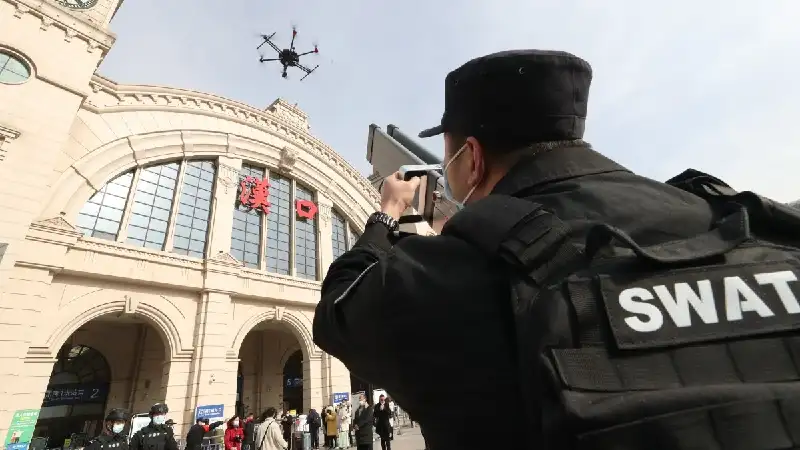
China has emerged as the global leader in anti drone technology patents, significantly outpacing other major economies as demand for counter drone systems accelerates worldwide. The rapid growth in patent filings reflects rising concerns over the use of drones in modern conflicts and security incidents. With geopolitical tensions increasing and drone capabilities becoming more advanced, countries are investing heavily in technologies designed to detect, disrupt, and neutralize unmanned aerial systems. China’s strong position in this field highlights its expanding influence in next generation defense and surveillance technologies.
Recent data shows that patent applications for anti drone systems increased by 27 percent over the past year, with China submitting a dominant share of filings. The United States followed with a considerably smaller number, while South Korea ranked third with only a handful of applications. This gap underscores China’s focus on research and development in emerging defense technologies. Analysts note that the country’s coordinated approach to innovation, combining state support with private sector involvement, has enabled rapid advancements in areas such as electronic warfare and advanced detection systems.
The growing emphasis on anti drone capabilities is closely linked to the evolving nature of modern warfare. Conflicts in regions such as Ukraine and the Middle East have demonstrated how drones can reshape battlefield dynamics by providing surveillance, precision targeting, and low cost attack options. At the same time, these developments have exposed the limitations of traditional defense systems, which are often expensive and not optimized to counter smaller, agile aerial threats. As a result, new technologies are being developed to address these gaps and improve defensive capabilities.
Among the most prominent solutions under development are laser based systems, microwave weapons, and electronic jamming technologies. These approaches aim to disable or redirect drones without relying on conventional missile based interception, which can be costly and less efficient against smaller targets. Researchers are also exploring integrated systems that combine detection, tracking, and neutralization capabilities into a single platform. Such innovations are expected to play a critical role in protecting critical infrastructure, military assets, and public spaces from potential drone related threats.
Industry experts suggest that the surge in patent activity reflects not only military demand but also growing concerns over civilian security. Incidents involving unauthorized drone activity near airports, public events, and sensitive facilities have highlighted the need for effective countermeasures. Governments and private organizations are increasingly looking for scalable solutions that can be deployed in both urban and remote environments. This has created a broader market for anti drone technologies, extending beyond defense applications into areas such as law enforcement and infrastructure protection.
China’s leadership in this sector is likely to influence the future direction of global security technologies, as countries seek to develop or acquire similar capabilities. The competition among major powers to advance counter drone systems is expected to intensify, particularly as drone usage continues to expand across both military and civilian domains. With ongoing research and rising investment, anti drone technology is set to become a key component of modern security strategies in an increasingly complex and technology driven global environment.

