
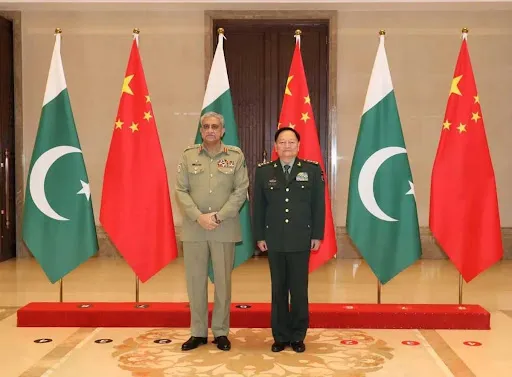
The defense partnership between China and Pakistan has entered a new phase, defined by technological collaboration, joint research, and next-generation weapons production. What began as traditional military assistance has evolved into an integrated framework of co-development and strategic innovation. According to Reuters and SCMP, the two nations are now expanding cooperation in fighter jets, missile systems, and unmanned aerial vehicles (UAVs), reflecting a shared goal of maintaining regional balance and self-reliant defense industries. This partnership has become a cornerstone of both countries’ security and strategic planning in South Asia.
Evolution of a Strategic Alliance
China and Pakistan’s defense ties date back to the 1960s, but the last decade has seen unprecedented technological depth. The co-production of the JF-17 Thunder fighter jet at the Pakistan Aeronautical Complex (PAC) marked a turning point, proving that Pakistan could assemble and maintain advanced platforms domestically. The project’s success laid the foundation for new ventures in drones, radar systems, and electronic warfare equipment. The Diplomat reports that both countries are now exploring 5th-generation fighter programs, integrating stealth design and AI-enabled avionics into future aircraft models.
Missile Systems and Air Defense Development
Collaboration in missile technology has been one of the most confidential yet transformative areas of the partnership. China’s expertise in short- and medium-range missile systems has helped Pakistan enhance its deterrence capabilities and precision-strike potential. Dawn notes that Chinese engineers assisted in the design and testing of the HQ-9/P long-range air defense system, now operational with Pakistan’s armed forces. This platform significantly strengthens Pakistan’s airspace protection, creating a deterrent against regional air threats. The development of guided missile systems using satellite-linked navigation demonstrates how technology transfer is reshaping Pakistan’s defense posture.
Drone Warfare and Unmanned Systems
Unmanned aerial vehicles have become a critical component of modern warfare, and China has positioned itself as Pakistan’s key partner in this domain. Joint projects between China’s AVIC group and Pakistan’s National Engineering and Scientific Commission have produced several UAV variants for reconnaissance and tactical operations. Reuters Defense reports that Pakistan is now locally assembling the Wing Loong II combat drone, equipped with precision-guided munitions. These drones enhance Pakistan’s surveillance and strike capabilities, particularly in border and counterterrorism operations. Their integration into the armed forces marks a leap forward in autonomous defense technology.
Naval Modernization and Maritime Security
At sea, the partnership has deepened through the acquisition and joint construction of advanced frigates and submarines. Pakistan’s Navy has received Type 054A/P frigates from China, featuring state-of-the-art radar, missile, and anti-submarine systems. Xinhua highlights that the latest frigate, PNS Tughril, has been equipped with integrated command and control systems enabling multi-role operations across the Arabian Sea. The Karachi Shipyard is now preparing for localized assembly of future vessels, signaling a long-term industrial partnership. These efforts enhance Pakistan’s maritime defense capability while strengthening regional security in the Indian Ocean corridor.
Cyber and Electronic Defense Cooperation
The digitalization of warfare has expanded the scope of defense collaboration to include cybersecurity and electronic intelligence. Joint research centers in Islamabad and Chengdu are developing software for signal interception, encrypted communication, and radar jamming. Nikkei Asia reports that the two countries are working on artificial intelligence frameworks for autonomous decision-making in electronic warfare systems. Such integration of cyber capabilities into defense platforms reflects the modernization of Pakistan’s military strategy and aligns with China’s vision of “intelligentized warfare.”
Training and Human Resource Development
Technological cooperation requires parallel investment in human capital. Thousands of Pakistani military engineers and officers have been trained at Chinese defense academies, gaining expertise in avionics, propulsion systems, and command technologies. CGTN notes that more than 300 Pakistani officers completed advanced courses in AI warfare and naval engineering between 2023 and 2024. These programs build self-reliance by ensuring that Pakistan’s defense modernization is not dependent solely on imports but is supported by skilled domestic personnel capable of sustaining innovation.
Strategic Implications for Regional Stability
The expanding defense partnership carries strategic implications for South Asia. Enhanced collaboration with China provides Pakistan with both deterrence and technological independence, countering traditional asymmetries in the region. Analysts at the Institute of Strategic Studies Islamabad argue that this partnership has created a new equilibrium in regional power dynamics by reducing Pakistan’s dependence on Western suppliers. Reuters reports that several joint military exercises are now conducted annually to ensure interoperability and readiness, reflecting the alliance’s operational maturity.
Challenges and Strategic Outlook
While progress is clear, challenges remain in balancing technological ambition with financial sustainability. High development costs, sanctions risks, and regional competition pose obstacles to long-term defense innovation. However, China’s flexible financing and shared R&D model have mitigated some of these pressures. Both countries are now working toward establishing permanent defense innovation centers to accelerate prototype testing and system integration.
Conclusion
China and Pakistan’s defense partnership is no longer confined to equipment transfer; it has evolved into a multidimensional alliance driven by co-development, training, and digital integration. The collaboration embodies a strategic convergence aimed at self-reliance, regional stability, and technological modernization. As new joint systems enter production and military training deepens, the partnership stands as one of the most enduring examples of South–South defense cooperation. It not only strengthens Pakistan’s defense capacity but also contributes to the broader architecture of security across the Indian Ocean and beyond.

