
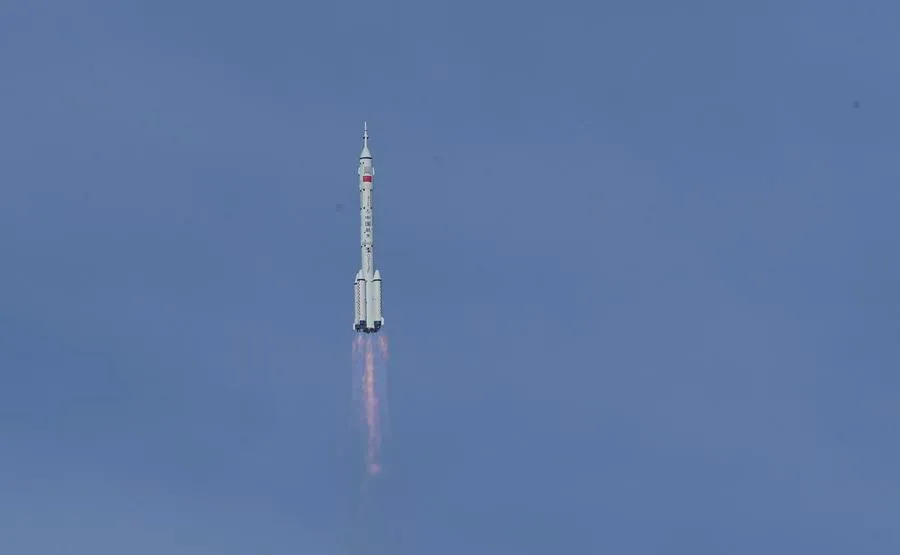
China has announced the successful launch of its Shenzhou 22 spacecraft, which lifted off at 12:11 p.m. Beijing time on Tuesday from the Jiuquan Satellite Launch Center in the country’s northwest. The China Manned Space Agency said the Long March 2F rocket placed the unmanned spacecraft into its planned orbit about ten minutes after takeoff.
Shenzhou 22 is carrying a range of essential supplies for the China Space Station, including space food, medical materials, fresh produce and spare components needed for ongoing maintenance. Among the cargo is specialised equipment designed to address the window crack discovered on the return capsule of the earlier Shenzhou 20 mission.
After entering orbit, the spacecraft will conduct a rapid automated rendezvous and docking with the China Space Station. The launch marks several milestones for China’s human space programme, including its thirty eighth crewed mission and the 610th flight of the Long March rocket family. It is also the first mission to test the programme’s emergency launch readiness.
The decision to launch Shenzhou 22 comes after safety concerns emerged during the Shenzhou 20 mission. Officials previously reported that the Shenzhou 20 return capsule may have been struck by tiny fragments of space debris. The spacecraft had been scheduled to return to Earth on November 5, but engineers postponed the landing after inspections raised concerns about the capsule’s condition.
Detailed photo analyses, simulations, structural reviews and wind tunnel tests later confirmed the presence of fine cracks in one of the capsule’s windows, likely caused by external debris impact. Although the damage did not threaten the crew while in orbit, it did not meet safety requirements for a crewed reentry. As a result, Shenzhou 20 will remain in orbit for further scientific work rather than attempting a return.
Meanwhile, the Shenzhou 21 return capsule landed successfully on November 14 at the Dongfeng landing site. Taikonauts Chen Dong, Chen Zhongrui and Wang Jie returned to Earth in good health following their mission. The Shenzhou 21 crew stationed aboard the space station continues its work and remains in stable condition.
China’s crewed space programme operates under a rolling “one launch, one backup” mechanism, ensuring a standby spacecraft and launch vehicle are always ready in case of emergencies. When Shenzhou 21 lifted off, Shenzhou 22 and its Long March 2F rocket had already been positioned at Jiuquan in emergency standby mode.
The successful launch of Shenzhou 22 highlights China’s continued expansion of its space station operations and its efforts to strengthen orbital safety as space debris becomes an increasingly significant challenge for global space missions.

