
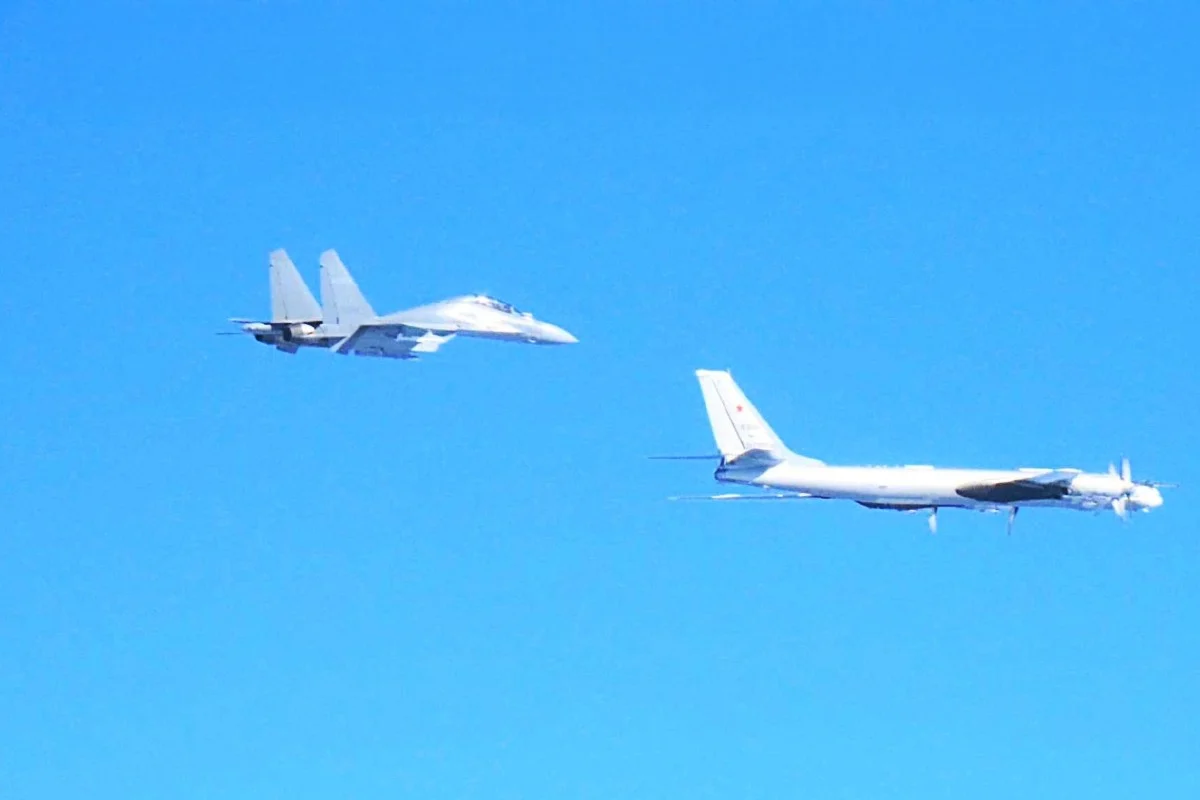
Japan’s Defence Minister Shinjiro Koizumi has voiced strong concerns after Chinese and Russian nuclear capable bombers carried out a coordinated patrol close to Japanese airspace. The incident, which unfolded over the East China Sea and continued around parts of Japan, has heightened anxieties in Tokyo about the growing frequency and scale of military cooperation between Beijing and Moscow. In a statement shared on social media, Koizumi described the operation as a serious national security concern and reaffirmed Japan’s commitment to closely monitor regional activity.
Details of the flight path and participating aircraft
According to Koizumi, the patrol began when two Russian Tu 95 bombers met with two Chinese H 6 bombers over the East China Sea. From there, the aircraft proceeded on a joint flight path that circled much of Japan’s outer airspace. The formation moved between Okinawa’s main island and Miyako Island, a sensitive zone that sits close to important Japanese and US military facilities. It then continued toward waters off Shikoku in the western Pacific, remaining in international airspace but traveling along routes that Japan carefully watches due to their strategic significance.
The bombers were accompanied by a substantial escort. Koizumi confirmed that eight Chinese J 16 fighter jets and a Russian A 50 airborne early warning and control aircraft supported the joint patrol. The presence of such a large and diverse fleet suggests a coordinated show of strength, underscoring the growing military alignment between China and Russia.
Japan’s response and growing security concerns
Japanese fighter jets were scrambled in response to the patrol, a routine measure when foreign military aircraft approach Japan’s air defense identification zone. While the bombers did not enter Japanese territorial airspace, their proximity and the scale of the operation prompted immediate concern. Koizumi emphasized that Japan views these joint flights as part of a pattern of increasingly assertive behavior in the region.
Japan has faced similar joint patrols in recent years, but the latest operation comes at a time of heightened geopolitical tension. Tokyo is deepening security cooperation with the United States, South Korea and other regional partners while also strengthening its own defense capabilities. The government sees the continued cooperation between China and Russia as a sign that Japan must remain vigilant and prepared.
Regional implications and shifting power dynamics
The patrol also has broader implications for the Indo Pacific region. China and Russia have expanded their joint military exercises, naval patrols and air operations in recent years, signaling a closer strategic partnership. Analysts note that such displays serve multiple purposes: demonstrating mutual support, testing regional defense responses and shaping perceptions of their combined military strength.
For Japan and its allies, the growing coordination raises questions about how the security landscape may evolve. As China increases its military presence around Taiwan and in the East China Sea, and as Russia maintains a confrontational posture toward Western nations, their joint actions are being watched with increasing concern. The latest patrol reinforces fears that the region may face more complex security challenges moving forward.
A call for vigilance and continued international cooperation
In his statement, Koizumi stressed that Japan will continue to respond calmly and firmly to protect its airspace and national security. The government is expected to raise the issue with partners and continue its policy of strengthening regional cooperation. Japan has also been investing heavily in new defense technologies and surveillance systems to ensure it can detect and deter potential threats.
The incident highlights how rapidly the security environment in East Asia is changing. As major powers deepen their military ties and conduct more frequent joint operations, Japan faces the ongoing task of balancing diplomacy, deterrence and readiness. For now, the patrol serves as a clear reminder of the strategic pressures shaping the region and the need for sustained attention to emerging risks.

