
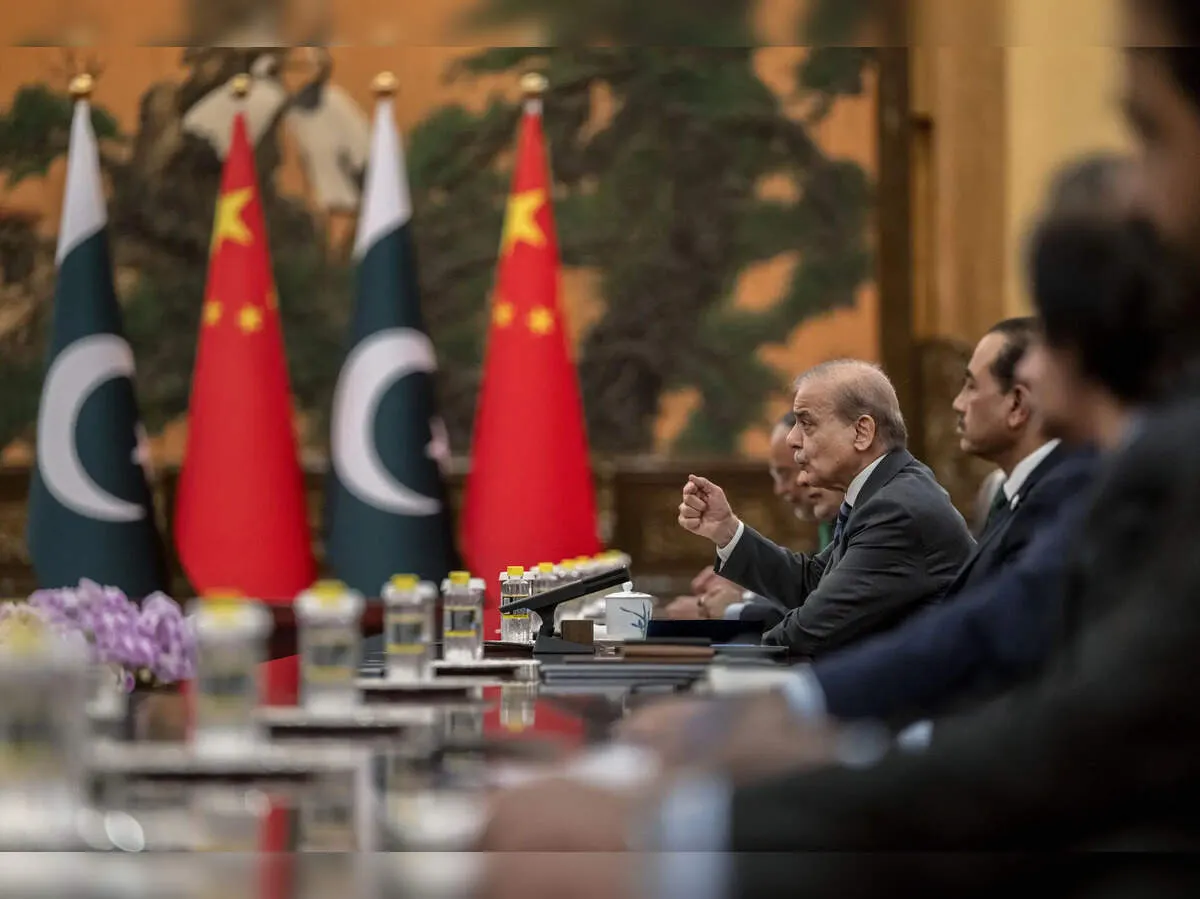
In a surprising yet calculated move, China has paused its participation in Pakistan’s $6.7 billion ML-1 (Main Line-1) railway modernization project, once hailed as the backbone of the China–Pakistan Economic Corridor (CPEC). The announcement, made quietly through diplomatic channels in September 2025, sent shockwaves through Islamabad’s economic and planning circles.
The ML-1 project was envisioned as Pakistan’s largest infrastructure initiative, designed to upgrade 1,872 kilometers of railway from Karachi to Peshawar. It was meant to transform Pakistan’s aging rail network, create thousands of jobs, and serve as a critical artery for regional trade under the Belt & Road framework. China’s withdrawal, even if temporary, raises serious questions about CPEC 2.0’s direction, financial priorities, and Pakistan’s ability to deliver on megaprojects amid a fragile economic recovery.
Why China Stepped Back
Beijing’s decision wasn’t abrupt. Chinese financial institutions, particularly the Export-Import Bank of China, had expressed concern for over a year about Pakistan’s rising debt risk and repayment capacity. Pakistan’s existing public debt crossed $132 billion in mid-2025, with nearly a quarter owed to Chinese lenders.
Additionally, a series of security incidents targeting Chinese engineers and contractors during 2024–2025 led to heightened scrutiny from Beijing. Insiders from China Railway Group Limited (CREC) told The Global Times that “project-level risk assessments no longer justify large-scale disbursements until comprehensive security mechanisms are ensured.”
Another factor is China’s global Belt & Road pivot. After facing setbacks in Africa and Southeast Asia, Beijing has recalibrated toward smaller, commercially viable projects emphasizing “quality over quantity.” ML-1, due to its immense cost, lengthy construction time, and reliance on government-backed financing, did not fit the new mold.
Pakistan’s Dilemma
For Islamabad, the withdrawal is both an economic and political blow. The ML-1 was expected to be a flagship of Pakistan’s infrastructure revival and a symbol of the enduring Pakistan–China partnership.
The government had hoped to start Phase 1 (Karachi, Hyderabad, Multan) by early 2026, with Chinese funding covering 85% of costs. Now, planners must rework financing through Public-Private Partnerships (PPPs), multilateral institutions, or sovereign sukuk bonds, all challenging options in a time of fiscal tightening.
Pakistan Railways officials estimate that delays could add $1.2 billion in cost escalations by 2027. More importantly, the project’s stall could ripple across supply chains, slowing down industrial output and cargo movement that underpins export competitiveness.
Economist Dr. Hafeez Pasha notes, “Pakistan’s logistics inefficiency already costs us 4–5% of GDP annually. The ML-1 was not a luxury; it was an economic necessity.”
CPEC’s Changing Structure
The ML-1 episode underscores a broader evolution in the CPEC framework. The first wave of projects (2015–2020) relied heavily on Chinese concessional loans and EPC contracts. The new phase, dubbed CPEC 2.0, is pivoting toward equity-based ventures and joint management rather than state-to-state loans.
China’s exit from ML-1, therefore, is not a retreat but a restructuring signal. Instead of mega infrastructure financed by government debt, Beijing prefers modular, revenue-generating projects such as renewable power plants, logistics parks, industrial estates, and digital corridors.
This aligns with China’s own domestic strategy of derisking its overseas exposure and encouraging private-sector-led Belt & Road engagement. In short, CPEC 2.0 aims for economic sustainability over political symbolism.
Domestic Political Fallout
The political opposition in Pakistan has wasted no time in turning the issue into a flashpoint. Critics of the government argue that poor project management, bureaucratic inertia, and security lapses have eroded Chinese confidence. Former Planning Minister Asad Umar claimed in a televised statement that “CPEC has lost its strategic rhythm because Islamabad has failed to implement institutional continuity.”
In contrast, government officials maintain that “China has not withdrawn permanently,” emphasizing that negotiations for a revised financing structure are ongoing. A joint task force is expected to submit recommendations on risk-sharing, insurance frameworks, and project downsizing by December 2025.
The Security Dimension
No discussion of CPEC is complete without addressing the security question. Since early 2024, at least seven incidents targeting Chinese nationals have been reported in Balochistan and Sindh. While the Pakistani government has increased patrols and intelligence coordination, concerns persist.
In response, Islamabad has proposed establishing a CPEC Security Authority, merging army, paramilitary, and police coordination under one unified command a move welcomed by Beijing but still awaiting parliamentary approval.
China’s caution over ML-1 is, therefore, as much about safety as solvency. Projects in energy and logistics remain vulnerable without robust on-ground protection.
Global Context: BRI Fatigue and Realignment
China’s Belt & Road Initiative (BRI) is undergoing its first major strategic contraction. After a decade of trillion-dollar commitments, Beijing is prioritizing digital connectivity, clean energy, and cross-border payment systems over heavy infrastructure. The world’s macroeconomic climate, characterized by high interest rates, sluggish trade, and political instability, has made megaprojects like ML-1 less attractive.
Moreover, the BRI’s geopolitical optics have shifted. In Washington and New Delhi, China’s large-scale lending is seen as “debt diplomacy.” Hence, Beijing is opting for lower-profile yet high-impact projects that sustain influence without inviting scrutiny. ML-1’s suspension aligns with this doctrine of “strategic restraint.”
Pakistan’s Next Steps
Facing China’s pause, Islamabad is exploring alternative options. Talks are underway with the Asian Infrastructure Investment Bank (AIIB) and Gulf sovereign funds for partial financing. Additionally, Pakistan has approached Turkish and South Korean rail consortiums for potential technology partnerships.
Experts believe that a hybrid financing model combining local equity, limited external debt, and phased construction might be the most feasible way forward. If executed properly, it could mark Pakistan’s first domestically anchored infrastructure mega-project in decades.
Lessons for CPEC 2.0
The ML-1 saga offers several lessons:
- Overreliance on foreign debt creates structural fragility.
- Security guarantees must evolve beyond temporary military deployments.
- Future CPEC projects should focus on self-sustaining economic clusters, not prestige-oriented construction.
- Pakistan must institutionalize transparency to attract diversified investors not just China.
In essence, the withdrawal could become a turning point rather than a setback, pushing Islamabad toward fiscal discipline, governance reform, and private sector inclusion.
Conclusion:
While the headlines paint China’s pullback as a crisis, a deeper reading suggests it’s an adjustment part of CPEC’s transition into a more strategic, commercially viable phase. The railway project may return in a smaller, smarter form, integrated with logistics, data, and renewable networks rather than standing as a monolithic venture.
CPEC 2.0, in its redefined scope, will depend less on political symbolism and more on pragmatic economics. If Pakistan adapts to this new reality, the ML-1 halt might one day be remembered as the moment CPEC learned to sustain itself.

