
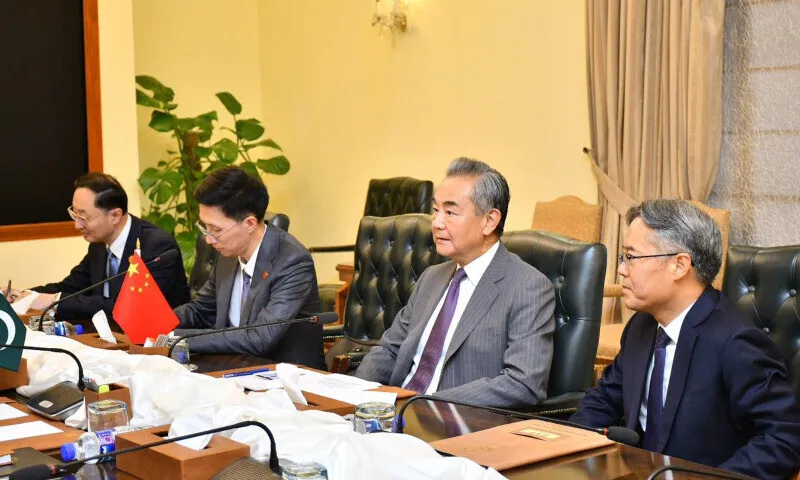
Over the past decade, China’s presence in South Asia has shifted from cautious diplomacy to an active regional strategy. Beijing’s engagement now spans infrastructure, energy, security, and digital connectivity. The China–Pakistan Economic Corridor (CPEC) remains its flagship, but new initiatives in Sri Lanka, Nepal, Bangladesh, and the Maldives show that China is broadening its footprint beyond a single corridor.
For Pakistan, this evolution carries both opportunities and risks. As China diversifies its partnerships, Islamabad must define its own role within a changing South Asian balance of power. The question is whether Pakistan will remain Beijing’s principal partner or one of many nodes in a larger regional web.
From Bilateralism to Regional Outreach
Historically, China’s South Asia policy centered almost exclusively on Pakistan. CPEC symbolized trust and mutual strategic depth. However, after 2020, China began expanding its presence to other regional capitals.
Beijing financed port developments in Sri Lanka’s Hambantota, rail projects in Nepal, digital infrastructure in Bangladesh, and renewable energy ventures in the Maldives. The message was clear: China seeks multidirectional access to the Indian Ocean and South Asian markets rather than relying solely on Pakistan.
This diversification also reflects practical lessons from CPEC’s early difficulties, including delays, security challenges, and governance issues. By spreading investment risk, China ensures that political instability in one partner does not jeopardize the entire regional strategy.
Pakistan’s Central Yet Challenged Position
Pakistan continues to occupy a central role because it connects western China to maritime routes. Gwadar Port remains critical for China’s energy security and access to the Middle East. Yet, China’s outreach elsewhere has subtly reduced Pakistan’s exclusivity.
For Islamabad, this means adapting from being the sole gateway to becoming a competitive partner. It must offer efficiency, transparency, and stability to maintain its strategic edge. Officials at Pakistan’s Planning Commission acknowledge that “China now measures value through performance, not rhetoric.”
Maintaining relevance requires Pakistan to accelerate CPEC Phase II, strengthen logistics integration, and ensure security for foreign personnel.
India Factor and Strategic Containment
No discussion of China’s South Asia policy can ignore India. Beijing’s expanding economic influence is often interpreted as an attempt to counterbalance New Delhi’s growing partnership with the United States and the Quadrilateral Security Dialogue (QUAD).
China’s projects in Nepal and Sri Lanka are particularly sensitive for India, which views them as encroaching on its strategic backyard. In this contest, Pakistan benefits indirectly. The deeper the rivalry between China and India, the greater Pakistan’s value as a strategic counterweight.
Yet overreliance on this triangular dynamic is risky. Pakistan must ensure that its partnership with China does not appear solely as an anti-India alignment but as a development-driven collaboration consistent with regional peace.
Economic Integration Beyond Borders
China’s new regional approach emphasizes connectivity over confrontation. Initiatives such as the China–Nepal Trans-Himalayan Railway, Bangladesh–China Economic Zone, and Digital Silk Road projects represent a softer strategy focused on trade facilitation and technology.
Pakistan can benefit by positioning itself as a hub linking these smaller projects to the western Belt and Road corridor. The CPEC Special Economic Zones, once fully operational, could export goods and services across South Asia, turning Pakistan into a supply-chain anchor.
Economists argue that if Pakistan adopts consistent tax and customs policies, its trade with South Asian neighbors could double within five years. Integration, not isolation, will define future relevance.
Security and Strategic Balancing
China’s military engagement in South Asia is increasing through defense sales, training, and maritime cooperation. Joint exercises with Sri Lanka and Bangladesh show a more visible security footprint. Pakistan, traditionally China’s main defense partner, now faces the challenge of sharing that space.
However, Islamabad still retains unique advantages. The Pakistan–China Joint Air Exercise Shaheen and collaboration on the JF-17 Thunder aircraft symbolize deep trust that others have not achieved. Pakistan’s geographic proximity to Xinjiang also makes it vital for counter-terrorism coordination and regional stability.
Beijing’s calculus is therefore two-tiered: diversify regionally while keeping Pakistan as the cornerstone of its strategic architecture.
Regional Connectivity and Economic Corridors
A key feature of China’s South Asia policy is corridor convergence. Planners in Beijing envision a network where CPEC connects westward to Central Asia and eastward through Nepal and Bangladesh to the Bay of Bengal. The idea is to integrate multiple routes into a pan-Asian logistics grid supporting the Belt and Road.
For Pakistan, this could unlock new transit revenues and strengthen its bargaining position. Linking Gwadar Port with Chittagong and Colombo through digital and maritime connectivity could generate economic synergies. However, achieving this vision demands infrastructure interoperability and consistent customs regimes across borders.
Diplomatic Realignment and Multilateral Engagement
China is also adapting diplomatically. It now participates actively in SAARC, SCO, and BRICS+ frameworks, using these platforms to shape norms on trade and technology. Pakistan, as a member of both SCO and the Belt and Road Initiative, has an opportunity to amplify its voice by aligning national policy with regional agendas.
Islamabad’s challenge lies in building bureaucratic coordination. Fragmented decision-making often slows implementation. To keep pace with China’s regional speed, Pakistan must streamline approvals and maintain continuity across governments.
Opportunities for Pakistan’s Foreign Policy
Beijing’s broader South Asia push can complement Pakistan’s own diversification goals. Engaging with China in joint projects in Sri Lanka, Nepal, or Bangladesh could elevate Islamabad from recipient to co-investor. Pakistani construction firms, already experienced with CPEC, could bid for regional contracts financed by Chinese banks.
This outward engagement would enhance Pakistan’s diplomatic visibility and reduce dependency on domestic CPEC phases. It could also foster South-South cooperation, positioning Pakistan as a proactive participant in regional growth.
Risks of Overextension and Perception Gaps
Greater Chinese activism in South Asia also generates new diplomatic sensitivities. Some Pakistani analysts fear that Beijing’s attention may dilute its focus on Pakistan. If other nations offer smoother regulatory environments or better credit ratings, they may attract projects that once would have gone to Islamabad.
Perceptions matter in diplomacy. Pakistan must demonstrate reliability through transparent governance, effective dispute resolution, and a welcoming investment climate. Only then will China continue to view it as the first-choice partner rather than one among many.
Conclusion:
China’s expanding South Asia policy represents both continuity and change. The underlying friendship with Pakistan remains strong, but Beijing’s vision has evolved toward a multi-partner regional ecosystem.
For Pakistan, the path forward lies in adaptation. Instead of relying solely on bilateral ties, Islamabad should integrate into China’s wider South Asian network through trade, technology, and collaborative diplomacy.
If managed wisely, this regionalization will not reduce Pakistan’s importance but redefine it from being the sole gateway to becoming the central link in a dynamic, interconnected South Asia.

