
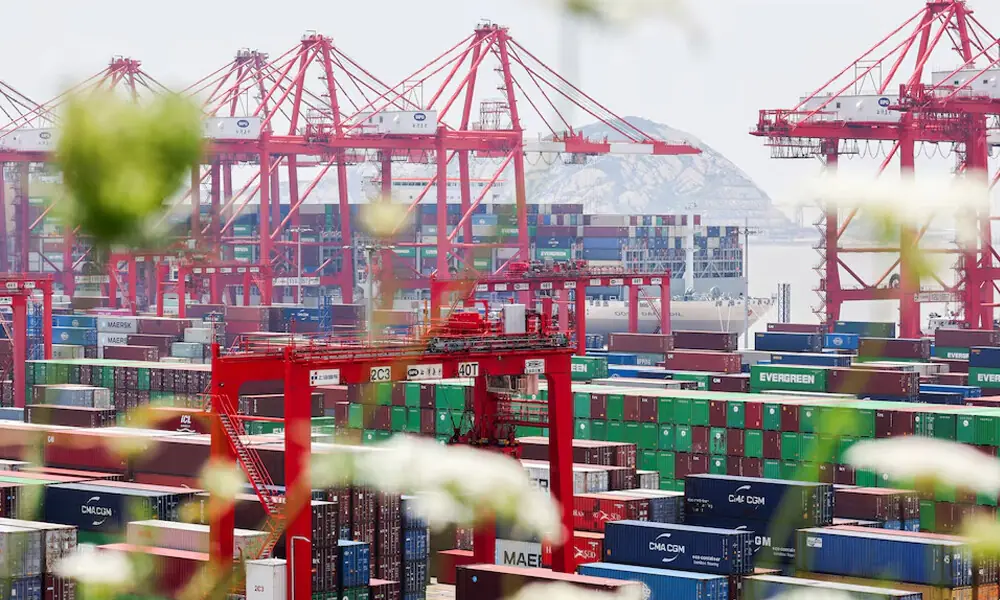
China’s export sector suffered a sharper-than-expected downturn in October, underscoring how renewed trade tensions with the United States are straining one of the country’s most critical economic engines. Official customs data released on Friday showed outbound shipments in U.S. dollar terms fell 1.1% from a year earlier, the first decline in eight months and the steepest drop since February. The reversal followed an 8.3% rise in September and missed market forecasts for a 3% increase.
Economists say the slump reflects the impact of new U.S. tariffs introduced earlier this year by President Donald Trump, which have disrupted trade flows and forced Chinese manufacturers to front-load exports in anticipation of higher duties. Many exporters rushed to ship goods in previous months to beat the tariff deadlines, leaving fewer orders for October.
China has worked to diversify its export markets since Trump’s return to office last November, strengthening ties with Southeast Asia and the European Union. However, analysts note that no region can yet match the scale of China’s U.S. trade, which accounts for more than $400 billion in annual exports. The loss in shipments to the U.S. alone is estimated to have shaved about 2 percentage points off China’s overall export growth, equivalent to roughly 0.3% of GDP.
Data showed exports to the U.S. tumbled 25.2% year-on-year in October, while shipments to the European Union grew only 0.9%. Exports to ASEAN economies rose 11%, but this was notably slower than in September, highlighting the challenges of offsetting weaker demand from Western markets. Economists said some Chinese producers appeared to be rerouting goods through countries like Vietnam to mitigate tariff exposure.
“The weakness in October was broad-based, affecting multiple non-U.S. markets,” said Zichun Huang, China economist at Capital Economics. “While some shipments to transit hubs like Vietnam increased, this likely reflects efforts by exporters to reposition inventory ahead of additional duties.”
Analysts added that last year’s strong base figures also amplified the drop. In October 2024, exports had surged to their fastest pace in over two years as manufacturers accelerated production ahead of expected U.S. policy changes. “Most factories have already front-loaded shipments,” said Alicia Garcia-Herrero, chief economist for Asia-Pacific at Natixis. “That means the fourth quarter will be tougher, and the first half of 2026 could remain under pressure.”
The latest manufacturing data supports that view. China’s official Purchasing Managers’ Index fell to a six-month low, with factories reporting a notable decline in new export orders. Economists at UOB Singapore said the trade truce agreed between Chinese President Xi Jinping and President Trump earlier this month could help stabilize sentiment in the short term. Still, they warned that both countries are likely to continue reducing their trade interdependence, with the U.S. share of China’s exports expected to shrink further.
Although tensions eased following the leaders’ meeting in South Korea, tariffs on Chinese goods bound for the U.S. still average around 45%, above the level many analysts believe erodes Chinese manufacturers’ profit margins. China’s trade surplus in October stood at $90.07 billion, slightly lower than September’s $90.45 billion and below expectations.
Weak domestic demand added to the pressures. Imports rose just 1% in October, the slowest pace in five months, compared with a 7.4% increase in September. Analysts said the figures highlight persistent weakness in consumer spending and the property sector.
Officials have pledged to raise household consumption as a share of GDP over the next five years, suggesting fiscal policy could become more expansionary early next year. Economists expect Beijing to rely more heavily on domestic demand and stimulus measures as external conditions remain uncertain.

