
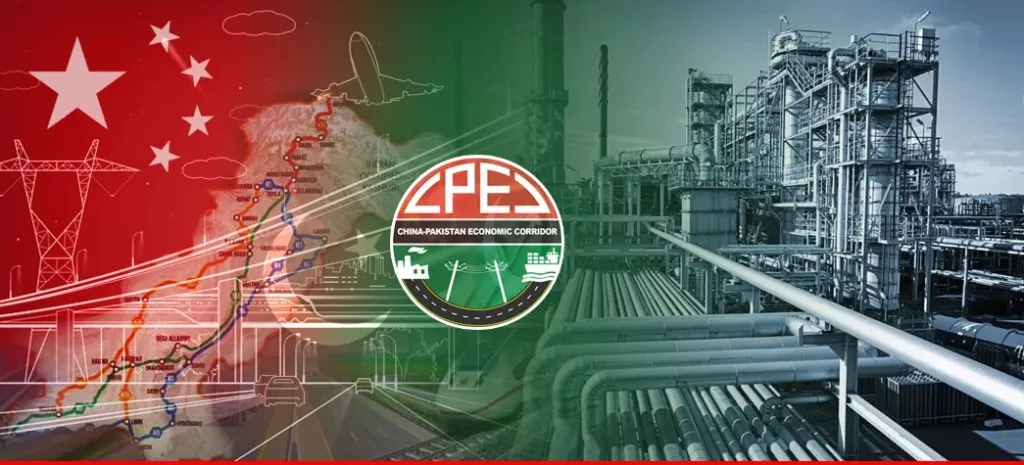
The China–Pakistan Economic Corridor (CPEC), once known primarily for large-scale infrastructure projects, is entering a new phase in 2025 one marked by diversification, industrial collaboration, and sustainability. Dubbed “CPEC 2.0,” this phase focuses on industrial zones, renewable energy, logistics digitization, and financial cooperation designed to make the initiative more balanced and locally integrated. Pakistan and China are recalibrating their partnership from construction-driven growth to investment-led industrial transformation, aligning with both Beijing’s Belt and Road recalibration and Islamabad’s urgent need for sustainable economic revival.
Recent high-level meetings between Chinese and Pakistani officials, including the Joint Cooperation Committee (JCC) held in Islamabad, have reinforced commitments to expand CPEC into new sectors. Reports from Reuters and Dawn suggest that this phase will emphasize regional trade connectivity, private-sector participation, and smart infrastructure, transforming CPEC from a series of standalone projects into a long-term economic ecosystem.
From Infrastructure to Industrial Integration
The first phase of CPEC, launched in 2015, was largely focused on transport and energy projects. Over US$25 billion in investments helped address Pakistan’s chronic power shortages and modernize road networks linking Gwadar to Kashgar. However, this top-down model faced criticism for limited local participation and rising debt concerns. CPEC 2.0 aims to correct these structural imbalances by strengthening Pakistan’s productive capacity through Special Economic Zones (SEZs) and technology-driven industries.
According to The Express Tribune, Pakistan’s Board of Investment (BoI) has fast-tracked the development of three major SEZs: Rashakai (Khyber Pakhtunkhwa), Dhabeji (Sindh), and Allama Iqbal Industrial City (Punjab). Chinese manufacturing firms are being encouraged to relocate labor-intensive industries such as textiles, automotive parts, and home appliances to these zones, where they can benefit from reduced costs and logistical proximity to export routes.
A report from China Daily highlights that more than 300 Chinese companies have registered interest in setting up operations within SEZs under public–private partnership models. This shift is expected to generate tens of thousands of jobs, boost Pakistan’s export base, and enhance bilateral industrial integration. By shifting focus from building roads to building factories, both nations aim to move from dependency to productivity.
Digital Connectivity and Green Investments
CPEC 2.0 also coincides with China’s broader Belt and Road transformation, which emphasizes digital connectivity and green development over purely physical infrastructure. As part of this strategy, new fiber-optic cables are being laid between Pakistan and China to strengthen data and communication networks critical for trade, e-governance, and security.
Digital logistics platforms are being introduced to streamline customs processes at key border points, including Khunjerab and Gwadar. The integration of blockchain and AI technologies in logistics monitoring is being tested to ensure transparency and efficiency in trade flows. A joint working group on the “Digital Corridor,” established in 2024, is exploring e-commerce, cloud infrastructure, and fintech cooperation to expand the corridor’s scope beyond traditional infrastructure.
In parallel, Beijing is redirecting investment toward renewable energy. Following global pressure to curb coal financing, China has committed to supporting solar, hydro, and wind energy projects under CPEC. According to Reuters, new agreements worth US$3 billion have been signed for renewable power generation, including the 1,000 MW solar project in Bahawalpur and the 720 MW Karot hydropower expansion. This transition aligns with China’s “Green Silk Road” policy and Pakistan’s national energy diversification goals.
Regional Integration and Policy Reforms
CPEC 2.0’s success depends not only on infrastructure but also on policy reforms that facilitate business and trade. Pakistan has simplified tax incentives for foreign investors and introduced a One-Window CPEC Facilitation Portal to streamline licensing, customs, and land acquisition processes. The Dawn reported that Pakistan’s new Industrial Policy 2025 focuses on export-led growth, encouraging domestic entrepreneurs to partner with Chinese firms in joint ventures.
Regional integration is another priority. Pakistan aims to position itself as a trade hub connecting Central Asia, the Middle East, and Western China. The extension of the Karakoram Highway, improved rail links to Afghanistan, and the operationalization of Gwadar Port enhance the corridor’s strategic potential. Economic planners envision Gwadar as the anchor of a new trade route facilitating cross-border commerce from Xinjiang to the Arabian Sea.
However, logistical efficiency alone will not guarantee CPEC’s sustainability. Economic analysts argue that governance, transparency, and security remain key determinants. Islamabad has pledged to strengthen project evaluation systems and ensure that future projects align with the national development agenda rather than political timelines.
Challenges and Future Outlook
While CPEC 2.0 presents significant opportunities, challenges persist. Financial constraints, slow implementation of SEZs, and rising political volatility continue to affect investor confidence. Moreover, Pakistan’s external debt situation complicates financing for new projects, despite Chinese assurances of long-term partnership.
A report by The Express Tribune notes that Beijing is now emphasizing a “risk-sharing” model, urging Pakistan to attract co-financing from multilateral institutions and private investors. This diversification of funding sources could help make the corridor more resilient to external shocks.
Security remains another crucial factor. Although attacks on CPEC projects have declined since 2023, ensuring the safety of Chinese personnel and Pakistani workers remains a top priority. New measures include enhanced coordination between Pakistan’s Special Security Division (SSD) and provincial law enforcement agencies.
Despite these hurdles, the overall trajectory of CPEC 2.0 remains optimistic. The shift from heavy infrastructure to high-value industrialization, combined with digital integration and renewable energy, aligns with both nations’ long-term goals. For Pakistan, CPEC 2.0 represents a chance to build a sustainable and diversified economic base; for China, it reinforces its strategic footprint in South Asia and the broader Belt and Road network.
Conclusion
CPEC 2.0 marks the evolution of a project that began as an infrastructure dream into a more complex, diversified, and sustainable economic partnership. The renewed focus on industrial zones, green energy, and digital cooperation reflects an understanding that infrastructure alone cannot guarantee long-term prosperity. What matters now is value creation through jobs, innovation, and connectivity.
As Pakistan and China enter this new phase of collaboration, CPEC’s future depends on how effectively both countries can balance economic ambition with pragmatic governance. The next decade will determine whether CPEC 2.0 can transform from a symbol of bilateral friendship into a global model of sustainable development and industrial cooperation.

