
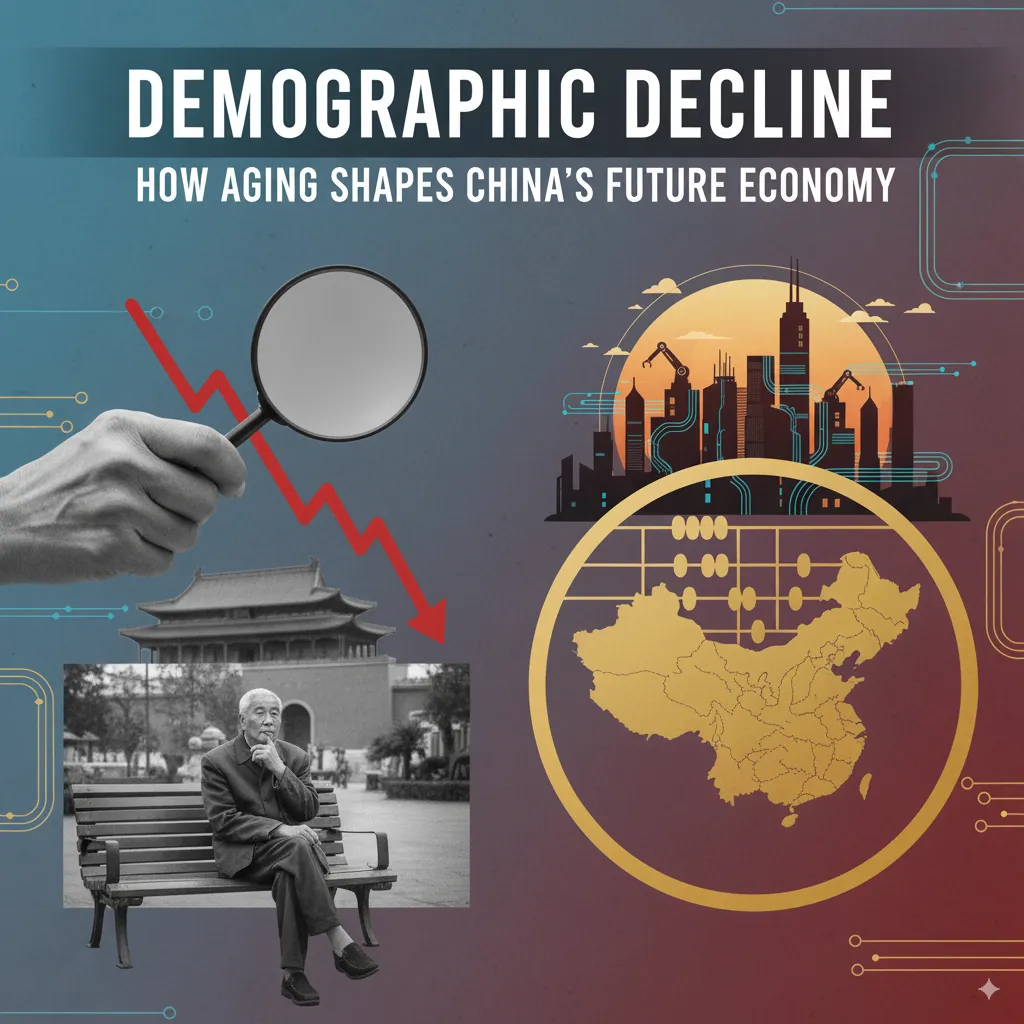
China’s shrinking workforce is testing growth models built on youth and expansion.
The Numbers Tell the Story
China’s 2023 census confirmed what demographers had long predicted: the world’s most populous nation has entered a period of decline. Birth rates are at historic lows, fertility incentives have failed to spark recovery, and the share of citizens over 60 is steadily rising. By 2035, one in three Chinese will be elderly.
This demographic shift marks a turning point. For decades, China’s economic miracle was powered by a vast, youthful workforce supplying cheap labor to factories and construction sites. Now, the same model is under pressure as the pool of working-age citizens contracts.
The Economic Strain
The demographic squeeze is already visible in several sectors:
- Labor Shortages: Manufacturing hubs in Guangdong and Zhejiang report rising difficulties in recruiting young workers. Factories increasingly turn to automation to compensate.
- Healthcare Costs: Hospitals and insurance systems face mounting pressure as chronic illnesses and eldercare needs expand.
- Pension Burdens: With fewer workers contributing and more retirees drawing benefits, local governments are grappling with fiscal shortfalls.
Economists warn that without reform, China could face the dreaded “middle-income trap”, growing old before it grows rich.
Policy Experiments and Limitations
Beijing has rolled out policies to counter demographic decline: ending the one-child policy in 2015, introducing a three-child policy in 2021, and offering tax breaks and childcare subsidies. Yet cultural and economic realities hinder success.
Rising living costs in cities, career pressures, and shifting social attitudes mean fewer young couples see large families as feasible. Surveys show many women are reluctant to have more children, citing concerns about gender inequality and work-life balance.
Immigration, another potential lever, remains politically sensitive in a country long focused on ethnic homogeneity.
Technology as a Stopgap
To offset workforce shortages, China is accelerating automation. Robotics, AI, and smart manufacturing are no longer optional but essential. Industrial zones highlight “lights-out factories” where machines operate with minimal human oversight.
Yet while technology may ease labor gaps, it does not address broader societal implications. An aging population means slower consumption growth, particularly in sectors like housing, which once drove much of China’s economy. Elderly households spend differently, prioritizing healthcare and savings over property or luxury goods.
The Global Dimension
China’s demographic decline reverberates beyond its borders. For exporters of commodities, slower construction growth means reduced demand for steel, copper, and cement. For global supply chains, rising Chinese wages push manufacturers to relocate production to Vietnam, India, and Mexico.
At the same time, multinational companies betting on China’s vast consumer market must recalibrate strategies. While opportunities in healthcare and elder services expand, other sectors face stagnation.
A New Growth Model?
Some analysts argue that demographic decline could force China to pivot toward higher-value growth. Instead of relying on low-cost labor, the country may double down on innovation, advanced manufacturing, and global finance. The government’s push for self-reliance in semiconductors, green energy, and biotechnology reflects this strategic shift.
But the transition will not be easy. Success depends on education reform, productivity gains, and institutional trust all while navigating the political imperative of stability.
Conclusion: Aging into Uncertainty
China’s demographic decline is not a sudden crisis but a slow-burning transformation. It reshapes labor markets, fiscal systems, and even cultural norms. The era of endless population dividends is over, replaced by the challenge of managing scarcity.
For policymakers in Beijing, the question is not how to reverse the trend that seems unlikely but how to adapt to it. The outcome will determine whether China can remain an engine of global growth or whether it faces a more modest, slower future shaped by the weight of age.

