
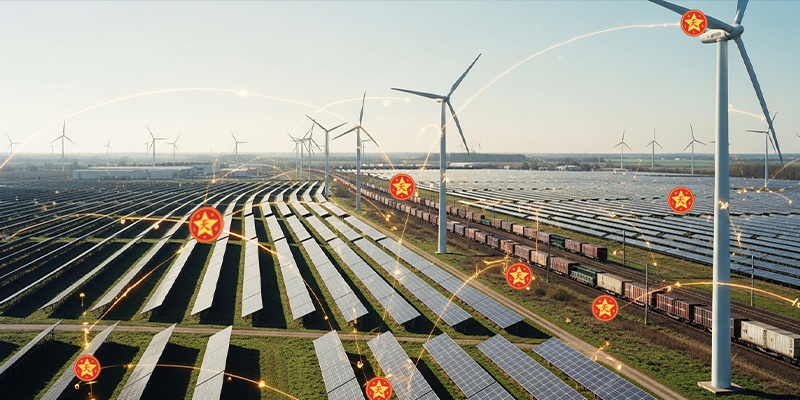
The Belt and Road Initiative (BRI) is entering a new era where sustainability and transparency define the next phase of infrastructure development.
With over 150 countries participating, the initiative is now focusing on reducing carbon intensity across energy, transport, and industrial projects.
To achieve this, participating nations are adopting digital finance systems that allow real-time tracking of emissions and investment flows.
These programmable platforms use blockchain-based tokenization to ensure that every stage of a project—from funding to carbon offset verification—is securely recorded and auditable.
The result is a more transparent financial ecosystem that links environmental accountability with economic growth.
Tokenization as a Tool for Climate Accountability
Tokenization has emerged as one of the most effective tools in green finance because it enables measurable and verifiable carbon tracking.
Each token represents a quantifiable asset, such as a carbon credit, renewable energy certificate, or verified offset unit.
When projects are financed under the BRI’s green investment program, these tokens act as digital certificates of environmental compliance.
Governments and investors can monitor progress through secure ledgers, reducing the risk of greenwashing and enhancing the credibility of sustainability claims.
This shift is transforming the way international stakeholders assess environmental impact, ensuring that capital flows align with verified ecological outcomes.
China’s Leadership in Carbon Finance Innovation
China’s policy direction has been pivotal in driving the digital transformation of green finance.
Through the Green Belt and Road Initiative, Beijing has prioritized investment transparency and sustainable project financing.
The Ministry of Ecology and Environment, in collaboration with the People’s Bank of China, has launched pilot programs linking environmental data with financial ledgers.
These initiatives aim to integrate emission monitoring directly into financing mechanisms, allowing automatic adjustment of funding based on performance metrics.
By embedding sustainability verification within the financial system itself, China is setting a global benchmark for accountable climate finance.
Building Trust Through Digital Verification
One of the persistent challenges in carbon finance is ensuring that reported emission reductions are accurate and independently verifiable.
Programmable blockchain frameworks address this issue by enabling multi-source data validation.
Sensors installed at renewable energy plants, transportation hubs, and construction sites automatically feed emission data into decentralized ledgers.
Once verified, this data triggers automated updates in tokenized financial contracts, linking real-world performance with funding schedules.
Such systems allow investors, auditors, and regulators to access consistent, real-time data, strengthening trust in environmental disclosures.
Financing Renewable Energy and Low-Carbon Infrastructure
The tokenization of green finance is supporting a broad range of renewable energy initiatives, including solar parks, hydroelectric systems, and smart grids.
By converting project performance data into digital assets, financial institutions can efficiently allocate capital to high-performing ventures.
Several BRI-linked energy projects in Central Asia and Africa are already using digital monitoring platforms to track emissions and verify the deployment of clean technologies.
This integration of data transparency and finance ensures that resources are directed toward genuinely sustainable infrastructure rather than carbon-intensive alternatives.
The approach aligns with the objectives of the Paris Agreement and the United Nations Sustainable Development Goals (SDGs).
Regional Cooperation and Standardization Efforts
As more countries adopt digital carbon finance models, regional organizations are working to standardize verification and reporting procedures.
The Asian Infrastructure Investment Bank (AIIB) and the UN Environment Programme (UNEP) are collaborating with Chinese institutions to create open frameworks for carbon data interoperability.
These standards enable cross-border recognition of green credits, making it easier for projects to attract international investors.
Experts at the China Council for International Cooperation on Environment and Development (CCICED) emphasize that unified digital standards are essential for scaling green finance.
Such cooperation ensures that tokenized carbon assets are credible, transferable, and compatible across markets.
Transparent Climate Finance
The integration of tokenization into the Green Belt and Road Initiative represents a fundamental shift in how environmental accountability is managed.
By merging climate data with programmable financial systems, countries can transition from voluntary disclosure to automated verification.
This evolution enhances not only transparency but also efficiency, reducing the administrative costs associated with traditional carbon accounting.
As digital verification systems mature, they are expected to expand beyond carbon tracking to include biodiversity, water use, and resource efficiency metrics.
For emerging economies along the Belt and Road, this convergence of finance and technology offers a pathway to sustainable development that is both inclusive and accountable.

